A grotesque symbol of starving Africa
Desperate women bind their stomachs to deaden hunger pains, eating next to nothing so children can be fed
Increasing numbers of children are dropping dead on the long trek to refugee camps. Those who do get there are more severely malnourished than ever before. And, says the UN, the number of people under threat has now reached 11 million – equivalent to every man, woman and child in Belgium facing starvation. Thus, the chronic food crisis of the Horn of Africa edges with every hungry day towards full-blown famine.
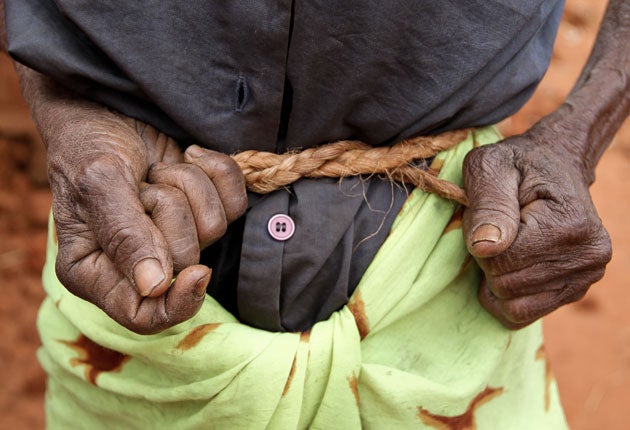
One image captures the degrading awfulness now facing millions. It is not that of a wide-eyed, swollen-bellied child crying for food – although there are countless numbers of them. It is the sight of mothers using rope to bind their stomachs so they will deaden the pangs of hunger as they give what little food they can get to their children – a grotesque parody of the gastric bands used for slimming in the West.
This potentially life-threatening practice has been highlighted by ActionAid. Zippora Mbungo, an 86-year-old grandmother from Makima, Kenya, told the agency's workers: "I tie this rope around my waist to hold my stomach in and avoid feeling hungry. Most of the time we have very little food, so I give it to my grandchildren first, leaving little or nothing for me. That is why I tie this rope around me. Only the rich people around here don't tie a rope in times like this." She added: "This is one of the worst droughts I have ever seen in my life." Philip Kilonzo, of ActionAid Kenya, said: "This practice shows just how desperately hungry women are. But it can be lethal – women have died after suddenly untying their stomachs once food is available."
The disaster, described by Unicef as "the worst humanitarian crisis in the world", is the result of one of the most terrible droughts in 60 years, which has led to repeated harvest failures and the death of large numbers of livestock. About 2.9 million people in Somalia – a third of the population – need humanitarian aid, while some 4.5 million, out of a population of 80 million, are affected in Ethiopia. In Kenya, the region's economic powerhouse, some 3.5 million are at risk of starvation, the UN says. Duncan Harvey, the acting country director for Save the Children in Ethiopia, said: "In terms of the sheer numbers of people affected, this is one of the worst droughts the world has seen in a long time."
Hunger and hopelessness in their own areas have driven hundreds of thousands to trek for days across arid lands to camps in Ethiopia and Kenya. Late last week, for instance, US officials spoke to a mother who had arrived at one camp with six children, including a seven-year-old suffering from polio, whom she had carried on her back.
The severity of this long-distance ordeal can be measured by those who do not make it. Outside the vast refugee complex of Dadaab in Kenya, young, lifeless bodies abandoned by their parents lie on the sandy path to the camp. No one knows how many have died before they reached even that point, and, in other cases, parents have perished on the journey, leaving children to trek through the wilderness alone. Andrew Wander, a spokesman for Save the Children, said his agency has provided care to more than 300 unaccompanied children found on roadsides after their parents died or abandoned them.
The UN's refugee agency says about 40 per cent of the Somali children arriving at Dadaab are malnourished. More children have died here in the first four months of the year than all of last year. Every day, more than 1,400 arrive at this sprawling complex filled with makeshift homes of sticks and tarpaulines, where more than 440,000 people are crammed into and around a camp built for 90,000. Alexandra Lopoukhine, of Care International, said: "This has led to the registration process taking much longer. As opposed to a few hours, or a day at most, it is now taking us three to four weeks at the least." She said the UN and the Kenyan government are currently holding meetings for permission to expand the camp.
Cases of rape and other violent attacks against women have doubled among refugees fleeing conflict and hunger in East Africa, according to member agencies of the Disasters Emergency Committee. Care International staff at two reception centres at the camp say reported cases have risen to 136 in the first six months of this year, compared with 66 in the same period in 2010. Ms Lopoukhine said: "The most dangerous period for refugees is when they are on the move. Women and girls are especially vulnerable to rape, abduction, illness and even being killed on the journey. Many women set out on the journey alone with their children, leaving husbands behind, and they may walk for weeks in search of food and safety."
In Ethiopia, Somalis fleeing drought and intensified fighting have been arriving at the rate of more than 1,700 a day. The overall mortality rate at the camps in Ethiopia is seven people out of 10,000 per day, when a normal crisis rate is two per day, a US government official said. The reason deaths are so high here and across the region is not just hunger but because disease is getting a formidable grip on people weakened by many months of malnourishment. The World Health Organisation (WHO) said that there is now a high risk of infectious diseases spreading, especially polio, cholera and measles.
Five million people are at risk of cholera in Ethiopia, where acute watery diarrhoea has broken out in crowded, unsanitary conditions, the WHO said on Friday. Cholera, an acute intestinal infection, causes watery diarrhoea that can quickly lead to severe dehydration and death if treatment is not given promptly. And, said the WHO, nearly nine million are at risk of malaria. There is also measles, with two million Ethiopian children at risk: the disease can be fatal for children. Ethiopian officials reported 17,584 measles cases and 114 deaths during the first half of the year. It has also broken out in the Kenyan camps, with 462 cases confirmed, including 11 deaths, the WHO said.
In response to the food and health crises, a massive aid operation is swiftly gathering force. Over eight days, the British public has given £18m to the Disasters Emergency Committee appeal (see panel). The British Government yesterday announced a further £52m in aid, which will, among other things, provide treatment for nearly 70,000 acutely malnourished children in Somalia, give healthcare and clean water to 130,000 in the Dadaab camps, similar assistance to 100,000 in Ethiopian camps, and provide extra aid to 300,000 Kenyans, including special rations for malnourished children.
Reuben E Brigety, a US State Department official responsible for assistance to refugees and conflict victims in Africa, said: "There are many seasoned relief professionals who would tell you we haven't seen a crisis this bad in a generation." He added: "It will get worse before it gets better."
What the aid agencies are doing
Some £18m has so far been raised by the Disasters Emergency Committee East Africa appeal. Here's what DEC agencies are doing:
ActionAid Food, water and income-generation for more than 220,000 in Kenya and Somaliland.
AgeUK Together with Cafod, cash grants to older people for food, job creation, plus animal feed and care.
Red Cross Food aid, safe water, community health. Somali Red Crescent has 44 mobile and static clinics.
Care International Food, water and primary education in Dadaab, plus help going to Ethiopia and Somalia.
Christian Aid Water supplies for 77,400 people in Kenya, plus 25,210 in Ethiopia. Animal feed provided.
Concern Worldwide Cash transfers and food vouchers,in Somalia. 400,000 beneficiaries across region.
Islamic Relief Food aid, nutrition, water and sanitation across region.
Merlin Food, plus 15 new clinics, health facilities and feeding centres in Kenya. Plus programmes in Somalia.
Plan UK Food, water, shelter, medical assistance, child protection, education, health and food in Ethiopia.
Save the Children Cash transfers for acutely malnourished families in Somalia. Treatment of malnourished children in Kenya being scaled up.
Tearfund Cash for work programmes in Ethiopia, and, in Kenya, water trucking.
To make a donation to the DEC East Africa Crisis Appeal visit www.dec.org.uk
Join our commenting forum
Join thought-provoking conversations, follow other Independent readers and see their replies
Comments