Guantanamo traumas give Obama a dose of political reality
President's new policy disappoints the left – but signals determination to win again

The latest headlines from our reporters across the US sent straight to your inbox each weekday
Your briefing on the latest headlines from across the US
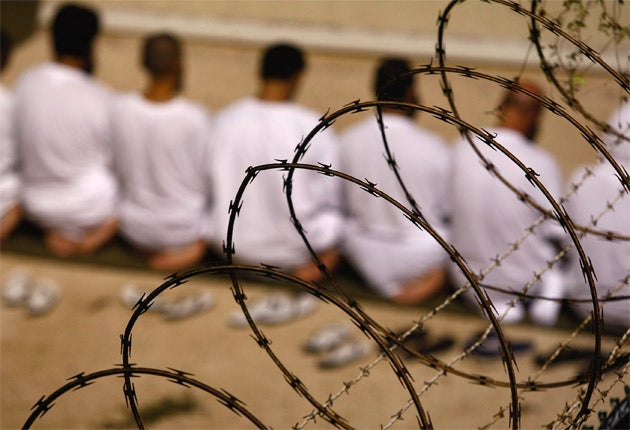
Barack Obama's decision to restart military tribunals for terrorist suspects, and institutionalise a system of indefinite detention at Guantanamo Bay, may be a humbling policy reversal for a president who on his second day in office suspended such courts and vowed to shut the prison for good within a year.
But from a leader who is nothing if not pragmatic, it is an acknowledgement of simple political reality. And the signs yesterday were that whatever the anger of many liberals who flocked to him in 2008, the decision is unlikely to do much lasting political damage. And as the campaign for re-election begins to loom, it may be an indication of the President's determination to tack to the US political centre.
In 2008, candidate Obama spoke of Guantanamo in almost apocalyptic terms, savaging his predecessor George W Bush for "running prisons which lock people away without telling them why they're there or what they're charged with". The extra-territorial facility, on what is technically Cuban soil, made a mockery of the US constitution, he declared.
Now, however, President Obama has discovered what Mr Bush found out when he tried to close the prison during his second term, having finally realised the damage Guantanamo was doing to America's global reputation – that some things are easier said than done. The announcement on Monday tacitly acknowledged that Guantanamo will be part of how Washington deals with terrorist suspects for the foreseeable future, barring an astonishing reversal by Congress and public opinion.
Since January 2009, Mr Obama has done his utmost to keep his promise, and bring the prison's inmates within the civilian judicial system – proposing to transfer most remaining Guantanamo inmates to a prison in Illinois, and to put five 9/11 plotters, including the attacks' alleged organiser Khalid Sheikh Mohammed, on trial in federal civilian court in Manhattan.
Both ideas however were disliked by the public, and both ran into implacable opposition on Capitol Hill, even though Mr Obama's Democrats at the time held large majorities. What was impossible then is even more so now, after the Democratic rout at last November's midterms.
In reality, Mr Obama is behaving much as he has done throughout his presidency, and especially since Republicans regained control of the House of Representatives, by discarding policies that could not become law, however desirable they might be.
He did so on his signature issue healthcare reform, dropping a public option and leaving coverage in the hands of private for-profit insurance companies. He did so in December 2010 when he went along with an extension of the Bush era tax cuts for the rich. Now he is doing much the same on Guantanamo Bay, and trying to make the best of a bad job.
While Monday's executive order has upset liberals and human rights activists, the anger is perhaps less than might have been imagined. Human Rights Watch, for instance, reiterated that federal courts offered the only "legitimate and viable means" of trying terrorists, and that indefinite detention without trial violated international law.
But it did welcome the modest improvement in due process for detainees, including a new review board that that will consider each case. Essentially though, lawyers say, the changes are mere refinements of provisions put in place by the Bush administration.
Human Rights Watch also expressed relief that the Obama changes applied only to the 172 prisoners now being held at Guantanamo (down from a peak of over 700), of whom 49 have been slated for detention without trial indefinitely. "By excluding future terrorism suspects, the administration is indicating a reluctance to expand indefinite detention beyond the cases it inherited from the Bush administration," the group said.
This concession may not satisfy Mr Obama's left-wing base – but that is unlikely to hurt him in 2012. With no recent attacks, the broader issue of terrorism, of which Guantanamo is a part, has slipped far down the public's list of worries, behind the domestic concerns of jobs, the economy, healthcare and education. In the meantime, the President faces no primary challenger to give voice to liberal complaints nor is there sign of one emerging.
That of course has not stopped the right from crowing that the Obama turnabout has proved that Mr Bush was right all along. "This affirms the Bush policy that the government has the right to detain dangerous terrorists until the end of hostilities," said Peter King, the Republican Congressman from New York. For its part, the conservative Wall Street Journal noted drily that "the responsibilities of power and the realities of a dangerous world tend to be educational".
Subscribe to Independent Premium to bookmark this article
Want to bookmark your favourite articles and stories to read or reference later? Start your Independent Premium subscription today.
Join our commenting forum
Join thought-provoking conversations, follow other Independent readers and see their replies