Huge cut in warheads banishes legacy of the Cold War
First Obama secured his historic healthcare reforms. Then he laid down the law to Israel. Now – a landmark nuclear disarmament deal
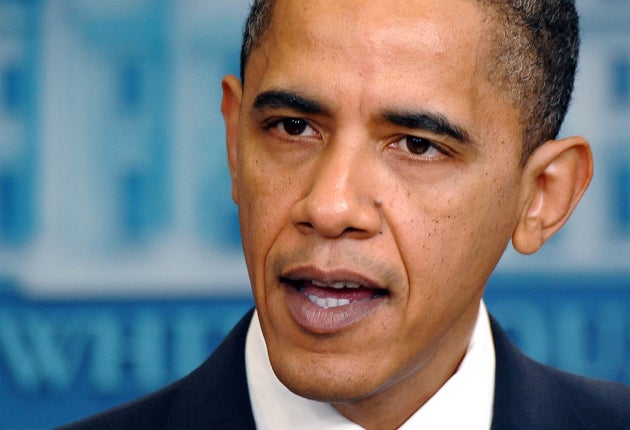
Russia and the US will sign their most comprehensive nuclear arms control agreement of the post-Cold War era in Prague next month, slashing their strategic warheads by a third, and making substantial cuts in missiles and other long-range delivery systems.
The deal announced yesterday by Barack Obama and Dmitry Medvedev breaks years of deadlock but it is at least as important in diplomatic and political terms as in its purely military aspects. For Mr Obama, the new treaty is a foreign policy achievement to match his huge domestic victory this week in pushing through historic healthcare legislation – and one that goes a long way to fulfil his administration's pledge to "re-set" relations with its former superpower rival.
The timing of the arms control breakthrough – the first comprehensive deal limiting nuclear weapons since 1991 – moreover is perfect, amounting to a down payment by the US ahead of the nuclear security summit Mr Obama is hosting in Washington next month, and the nuclear non-proliferation review conference at the United Nations in May.
One of Mr Obama's first acts after his election was to set out, in a landmark speech in Prague, his ambition of a world without nuclear weapons. But in the first 12 months he has held office, despite being awarded the Nobel Peace Prize, he has struggled to deliver any foreign policy successes or to shake off perceptions of weakness.
But this week's victory in the domestic power struggle over health has indirectly given a huge boost to Mr Obama's international stature with implications for some of the most intractable international problems. The Israeli-Palestinian conflict remains at an impasse but on Tuesday the President demonstrated a new uncompromising approach with Benjamin Netanyahu using the Israeli leader's visit to Washington to turn up the pressure over Jewish settlements in occupied territory.
Yesterday's nuclear agreement meanwhile is calculated to send a message to Iran and North Korea, both embroiled in disputes over their nuclear weapons programmes, that the West, with Mr Obama flanked by Russia, is determined to prevent nuclear proliferation. The improved climate between Washington and Moscow also raises hopes among the Western powers that Mr Obama may be able to rally Russia around to supporting harsher UN sanctions on the regime in Tehran.
Yesterday's sinking of a South Korean military vessel raised fears that Pyongyang may be dangerously sabre-rattling to avoid being frog-marched back to the negotiating table on nuclear proliferation. But the deal with Russia allowed Mr Obama to declare that the two largest nuclear powers in the world, the US and Russia, were sending "a clear signal that we intend to lead".
The announced pact breaks a long deadlock between Moscow and Washington on a deal that will replace the previous Start treaty that expired in 2009, and run for the next decade. Each side must now reduce its arsenal of deployed warheads to 1,550 from the 2,200 currently permitted.
"I'm pleased to announce that after a year of intense negotiations, the United States and Russia have agreed to the most comprehensive arms control agreement in nearly two decades," Mr Obama said in a personal appearance in the White House press room. In Moscow, Mr Medvedev praised the new pact as reflecting "the balance of interests of both countries".
The agreement contains strict verification procedures and, US officials insist, does not involve any commitment for the US to roll back its missile defence programmes. Any such undertaking might have made ratification impossible in the Senate, where a two-thirds majority is required for approval of the treaty. It will be signed by the two leaders at a ceremony in the Czech capital on 8 April.
The ceremony in Prague will take place almost a year to the day after Mr Obama's speech in that city laying out his vision of a world one day rid of nuclear weapons – a cause that has been gathering increasing support both here and in Russia from former diplomats and statesmen, among them Mikhail Gorbachev and Henry Kissinger.
Currently the US is estimated to have about 2,100 warheads deployed, compared to Russia's 2,600. Even after the reductions, however, Washington would retain "the flexibility we need to protect and advance our national security, and to guarantee our unwavering commitment to the security of our allies," the US President said.
With Russia's nuclear arsenal set to shrink drastically in the coming years due to aging; it was always in Russia's interests to persuade the Americans to reduce their own arsenal. Nonetheless, the view in Moscow is that the agreement is above all a political trade-off; Mr Medvedev has helped give Mr Obama a diplomatic coup. In return, the Russian President gains political weight both at home and in the US.
But his mentor, the Prime Minister Vladimir Putin, is widely credited as being the real force behind the deal, and he seems to have won some negotiating concessions. Ever sceptical of American motives, Mr Putin had demanded information about US interceptor missiles in exchange for intelligence about Russia's offensive arsenal. He may not have got that, but according to the Kremlin's statement, the treaty terms will recognise "a legally binding position on the relationship of strategic offensive and strategic defensive weapons."
The biggest obstacle to the treaty taking effect may now lie not in Moscow, but on Capitol Hill. The required majority of two-thirds, or 67 votes, in the Senate implies the support of at least eight Republicans, by no means a certainty given the bitterly partisan mood of Congress.
But Hillary Clinton, the US Secretary of State and herself a former Senator, struck an optimistic note. "National security has always produced large bipartisan majorities," she told reporters. "I see no reason why this should be any different. I believe that a vast majority of the Senate, at the end of the day, will see that this is in America's interest. And it goes way beyond politics."
The Foreign Secretary David Miliband signalled British willingness to follow the US and Russia with nuclear arms limits. "As soon as it becomes useful to do so, the UK stands ready to include our nuclear arsenal in a future multilateral disarmament process," he said. His German counterpart Guido Westerwelle said the deal was "a milestone that will promote overall nuclear disarmament".
Additional reporting by Roland Oliphant in Moscow
Join our commenting forum
Join thought-provoking conversations, follow other Independent readers and see their replies
Comments