Pentagon hits bullseye on spy satellite
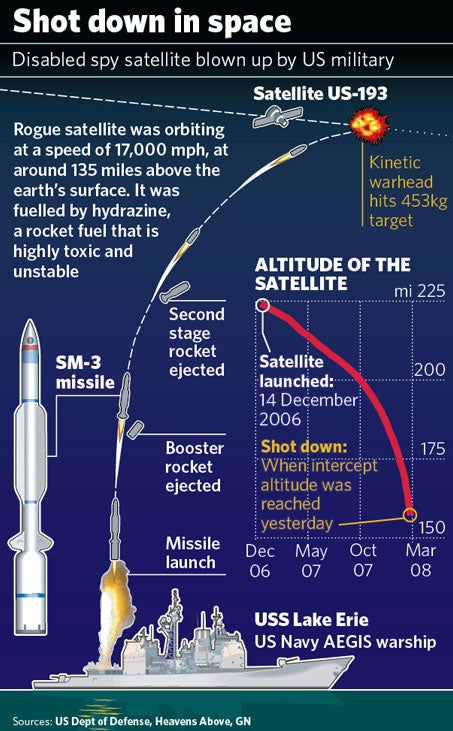
The Pentagon has claimed a bullseye hit on an out-of-control US spy satellite over the Pacific Ocean – a mission officially aimed at preventing the satellite's dangerous fuel falling on a populous area but which critics say was a deliberate test of the US missile defence system that would only accelerate an arms race in space.
The spectacular collision took place early yesterday, London time, 153 miles above the Earth's surface, between the rogue satellite orbiting at 17,000mph and an SM-3 missile travelling at 5,000mph, just three minutes after the latter's launch from a US Navy cruiser.
A Pentagon spokesman insisted the missile had achieved a "pretty solid" hit. But despite video seeming to show a fire ball and vapour cloud, further investigation will be needed to make sure that the satellite's fuel tank, containing deadly hydrazine, had been fully destroyed. Debris falling over the Atlantic and Pacific would be monitored over the next two days, he added, "but thus far we've seen nothing larger than a football."
But few – and least of all China and Russia – take at face value the explanation that the satellite was brought down simply because it was a health hazard. As far as Moscow and Beijing are concerned, the real purpose was to test a key component of the Bush administration's missile defence system, bitterly contested by Russia – and whose implementation, China and several other countries have warned, would increase the risk of an arms race in space.
For US officials however, such concerns are vastly overblown. Having shot down a satellite for the first time in 1985, the Pentagon has had the ability to do it for more than two decades, they note. In January last year, China successfully destroyed a weather satellite at a reported altitude of 600 miles, four times farther from Earth than the space craft just brought down.
A separate theory is that the satellite, known asUS-193 and costing hundreds of millions of dollars, was blown up because it carried super-advanced US military technology. According to reports, it had been commissioned by the ultra-secret National Reconnaissance and carried the most modern radar imaging systems, that might have fallen into hostile hands.
Whatever the truth, the episode is bound to heighten fears that an arms race in space, targeting the communications and spy satellites now so vital for military operations, is unofficially under way.
Last year, Washington strongly objected to the Chinese satellite shoot down, and some speculate that this US operation was intended to send a message to Beijing and Moscow.
Both have submitted a draft treaty at the United Nations aimed at banning the deployment of weapons in space and the use or threat of force against satellites or other craft. But the US has rejected any such agreement, having stated in 2006 that it would "oppose the development of new legal regimes or other restrictions" that sought to prohibit or limit US access to, or use of, space.
The destruction of the spy satellite may well heighten that dispute. "The potential political cost of this shooting down is high," said Laura Grego, an astrophysicist with the Union of Concerned Scientists. Whatever the motivation, she argued, "demonstrating an anti-satellite weapon is counter-productive to US long-term interests, given that the US has the most to gain from an international space weapons ban."
It would now be very difficult to convince other countries not to develop a similar capability, she said.
Join our commenting forum
Join thought-provoking conversations, follow other Independent readers and see their replies
Comments