Rupert Cornwell: Mass invasion of the alien swamp monsters
Out of America: The US loves movies about bizarre creatures wreaking havoc. Now it's got them for real

The latest headlines from our reporters across the US sent straight to your inbox each weekday
Your briefing on the latest headlines from across the US
America has a huge immigration problem. I don't mean the human one from south of the Rio Grande that so exercises the Republican party this election season. I'm talking about immigrants with scales, fins, feathers, flowers and leaves – invasive animal and plant species from the four corners of the globe that by various means, accidental and deliberate, have found their way into the country. Today, they're everywhere.
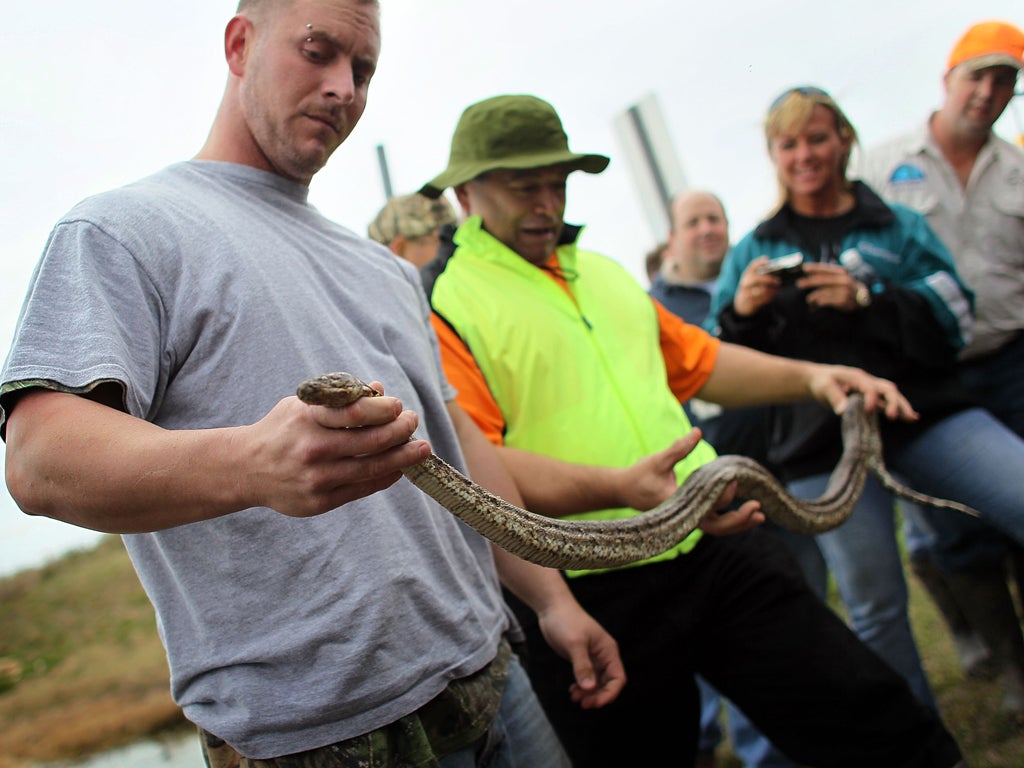
The big news last week on the invasive species front was the plague of Burmese pythons in southern Florida. The problem isn't new; the snakes, up to 15ft long, have been occasionally popping up in back-garden swimming pools almost ever since the first ones were released into the wild years ago by bored owners. Americans, it would appear, have a thing about exotic snakes. An estimated 11 million are kept as pets, part of a business worth some $2bn annually. Inevitably, some have tired of them and just let them go. It seemed a harmless and humane way of disposing of an unwanted pet. After all, snakes can look after themselves, can't they?
Indeed they can. The pythons have not only thrived, they are slaughtering the wildlife of the Everglades, the vast area of subtropical wetlands west and south-west of Miami which is one of the most remarkable ecosystems in the country. But for how much longer? The alien snakes have formed a solid breeding population, and are eating virtually everything that moves – even attacking the odd alligator.
According to a new study by the US National Academy of Sciences, in less than a decade, sightings of raccoons, opossums, bobcats and whitetailed deer have dropped by 90 per cent or more in the Everglades. Sightings are not hard proof, but they do give a pretty good indication of fluctuations in a population. The python population, by contrast, has probably soared into the thousands, or tens of thousands. The lead author of the study, the herpetologist Michael Dorcas, says he saw more pythons than the indigenous Everglades rat snake.
The day after the study came out, the US government ordered a halt to the import and interstate trade of some, but not all, python and anaconda species. But the ban is probably too late to make much difference to the Everglades. The real question is how far the rogue pythons will spread across the southern US. There is already evidence they can cope with salt water, removing one barrier to their advance.
From snakes to fish. A decade ago, there was a brief scare here when specimens of the northern snakehead, native to China and the Korean peninsula, were found in a pond behind the post office in the small Maryland town of Crofton, about 20 miles from Washington – released there by a man who had bought them in New York.
The northern snakehead is no ordinary fish. For one thing, it's a voracious predator. Second, it has the ability to travel small distances out of the water, a skill that, for those of a febrile imagination, conjured up a vision of armies of snakeheads marching across dry land, devouring anything in their path. Someone even made a film about them, called Frankenfish.
Since that first appearance in Crofton in 2002, snakeheads have been sighted in Florida and elsewhere. But as a piscine threat, they pale beside the Asian carp. The fish is native to China, but in the 1970s some escaped from hatcheries in the southern US where they were being cultivated as a means of algae control. They've now spread up the Mississippi and its tributaries as far as Minnesota, and the upper Midwest is close to panic.
The Asian carp is tasty, but trouble. An adult can be 4ft in length and weigh 100lb. It's a ravenous eater, and grows so fast that it's soon too big for the usual aquatic predators. The fish also has a disconcerting habit, when startled by a boat, of jumping out of the water and hitting people. Now the carp is at the gates of Chicago, threatening to enter Lake Michigan and wreak havoc on the $7bn-a-year Great Lakes fishing industry.
"Stop the Asian carp," was the headline on Friday's lead editorial in The Buffalo News, implying that Lake Erie, at whose eastern tip stands Buffalo, would be next in line after Lake Michigan. To this end, the paper advocated nothing less than the re-reversal of the Chicago river. In 1900, engineers reconfigured the city's waterways, so that the river flowed out of Lake Michigan, linking the Mississippi basin with the Great Lakes to aid shipping. Now many experts want to restore the river's original flow, and sever the link with the Mississippi.
Burmese pythons and Chinese carp are but two invasive species. There are also alien bugs that damage trees and crops, not to mention Russian zebra mussels that damage harbours, ships and power plants at a cost of $1.5bn a year. If we are in a new era of mass extinctions, as many scientists warn, invasive species are an important reason why.
Scores if not hundreds of invasive plant species thrive here also. Take the Japanese kudzu vine, once encouraged as a means of stopping soil erosion. Now it can blanket whole thickets, denying trees the light they need to live. Even my own modest garden in Washington is victim to Asiatic tearthumb, known as the "mile-a-minute weed", which can overwhelm shrubs while your back is turned. But at least there are no Asiatic pythons here, menacing the cat. At least, not yet.
Subscribe to Independent Premium to bookmark this article
Want to bookmark your favourite articles and stories to read or reference later? Start your Independent Premium subscription today.
Join our commenting forum
Join thought-provoking conversations, follow other Independent readers and see their replies