Torture: Obama's painful legacy from the Bush years
Obama's 100 days: The President is battling the fallout from his predecessor's treatment of terror suspects
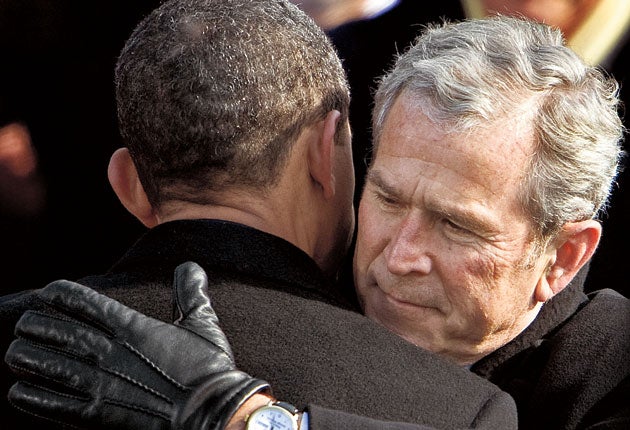
A new president's first months should be a showcase for his own policies. But as Barack Obama nears completion next week of his first 100 days in office, the headlines are dominated by a controversy entirely of his predecessor's making: the Bush administration's use of what the rest of the Western world regards as torture against detainees in the "war on terror".
The argument came to the boil last week as Mr Obama ordered the release of secret Justice Department memos setting out the methods used against al-Qa'ida suspects in the minutest detail.
This week new developments raised the temperature further. It now emerges that waterboarding, the technique almost universally deemed to be torture, far from being employed extremely rarely, had in fact been applied no less than 266 times to two leading al-Qa'ida detainees.
Meanwhile, the Senate Armed Services Committee released a report indicating that the previous administration explicitly approved the harsh tactics used by military interrogators at Abu Ghraib prison and Guantanamo Bay, as well as those employed by the CIA at its "ghost camps" and elsewhere.
The report also suggests that the Pentagon and the CIA were readying these new "torture" techniques months before the memos that gave them their blessing.
Now Mr Obama himself is at the centre of the crossfire. Liberals, human rights groups, not to mention the overwhelming majority of Democrats in Congress demand a full reckoning. But the right accuses him of indulging what the Wall Street Journal's editorial pages – that daily bible of conservatives – call "the liberal mob" bent on score settling, and refusing to recognise how harsh interrogation had kept the country safe since 9/11.
Only last weekend Rahm Emanuel, the White House chief of staff, was re-iterating what his boss was saying even before he was inaugurated. A new administration meant a new beginning. It was time to "move on" and, Mr Emanuel indicated, the former White House and Justice Department officials who formulated the policy, as well as the CIA operatives who had carried them out, should not be prosecuted.
But on Tuesday Mr Obama seemed to shift his position. After a meeting in the Oval Office, he confirmed that agency staff who had conducted the "enhanced interrogation" sessions should not face charges. But he left open the possibility that the lawyers who drew up the justificatory memos might be punished. The final word, he indicated, would rest with Eric Holder, the Attorney-General. If so, that would not be good news for Steven Bradbury, John Yoo, and Jay Bybee, the three senior former Justice Department officials who were prime architects of the so-called legal "new paradigm" allowing techniques akin to torture, and whose signatures appear on the memos. Mr Holder has been uncompromising in the belief that those responsible for torture be brought to account.
But their criminal prosecution would create a new thicket of legal issues. Evidence has emerged that some of the memos were written after the tough new methods had started to be used – in other words raising the question of whether the lawyers were trying to justify practices that they knew were illegal.
In which case, human rights advocates ask, why should not the topmost figures in that administration – ex-vice president Dick Cheney, Donald Rumsfeld, defence secretary until 2006, and the former CIA chief George Tenet for instance – face criminal action as well?
This would meet one of the main criticisms of the Bush response to Abu Ghraib – how a few small fry had been punished while those in high places, who had given the green light to the brutal treatment of inmates, had escaped scot-free.
At the very least, exhaustive further investigation of the torture issue is inevitable. One possibility is a bipartisan commission, modelled on the 9/11 Commission which delivered a comprehensive report on the September 2001 terrorist attacks. Another is a US equivalent of South Africa's post-apartheid Truth and Reconciliation Commission, to which victims would testify, as well as those responsible for the alleged torture, under promise of immunity from prosecution.
Whatever happens, the controversy will not quickly fade. Mr Obama himself once opposed a formal inquiry on the grounds it would generate more heat than light. Now, however, he supports one. At the same time, Dianne Feinstein, Democratic head of the Senate Intelligence Committee, is planning a lengthy and "unvarnished" closed-door inquiry that may take six months or more.
And more revelations are almost certain, perhaps throwing light on the great unanswered question: do such "enhanced interrogation" techniques actually work? Dennis Blair, Mr Obama's new intelligence chief, said in a statement released on Tuesday that "in some instances" they had generated "valuable" leads.
But, he added, it was impossible to know whether the information might have been produced by more standard methods. Beyond doubt, moreover, any benefits had been outweighed by the damage to the country's international image, he said.
Now none other than Mr Cheney, dark eminence of the Bush administration and its most strenuous advocate of secrecy, is urging the publication of intelligence gleaned. "There are reports showing specifically what we gained as a result of these activities," he told the conservative-leaning Fox News. They had not been declassified but now they should be, he said, to set the record straight.
Pressed on Mr Cheney's remarks at a hearing on Capitol Hill yesterday, Hillary Clinton, the Secretary of State, described Mr Cheney as "not a particularly reliable source of information". But "we ought to get to the bottom of this matter," she said, without committing herself to publishing the documents, as suggested by the former vice-president.
Under interrogation: Obama's sticky wicket
April 08 Asked about an inquiry into Bush officials who may have approved torture, candidate Obama says he would ask his new Attorney General to "immediately review the information that's already there".
August 08 "If crimes have been committed, they should be investigated," Obama says, adding: "I would not want my first term consumed by what was perceived on the part of the Republicans as a partisan witch hunt, because I think we've got too many problems to solve."
January 09 After one day in office, President Obama bans "enhanced" interrogation techniques, but talks about the "need to look forward as opposed to looking backwards".
16 April 09 Obama announces release of memos but says "those who carried out their duties relying in good faith upon legal advice... will not be subject to prosecution".
21 April 09 Door opens to prosecution of Bush officials. "I would say that that is going to be more of a decision for the Attorney General... and I don't want to prejudge that."
Join our commenting forum
Join thought-provoking conversations, follow other Independent readers and see their replies
Comments