Karzai was 'diagnosed with manic depression', new book on war claims
President Obama's distrust for Afghan President and his agonising search for a way out are revealed by Bob Woodward
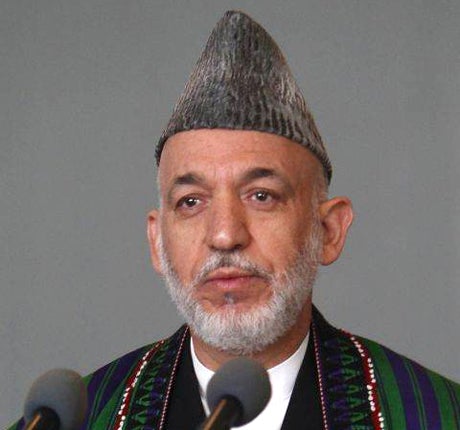
President Obama fought hard but in vain to force the Pentagon to come up with an exit strategy for the deepening war in Afghanistan – his difficulties compounded by fierce disputes within his national security team and the need to deal with an Afghan leader they trusted little and who, according to US intelligence, was a manic depressive.
These are the most striking disclosures of Obama's Wars, by the former Watergate reporter Bob Woodward, the prime focus of which is on the agonising and protracted policy review that led to the President's December 2009 announcement of a 30,000 troop surge in Afghanistan.
The book is the 16th by Mr Woodward, who has become the de facto court historian of every presidency since Ronald Reagan. It gives a blow-by-blow, memo-by-memo account of the deliberations, based on copious interviews with virtually every protagonist in the drama, including Mr Obama himself.
What emerges is a President desperate not to be trapped in a war without end – a cool, rational and analytical man faced with a choice between bad options. "I'm not doing 10 years; I'm not doing nation building; I'm not spending a trillion dollars," Mr Obama is quoted as saying to Robert Gates, the Defence Secretary, and the Secretary of State Hillary Clinton, during one key meeting in October 2009.
In itself, the book breaks little major new ground. The argument between the Pentagon, spearheaded by its former Afghan commander General Stanley McChrystal, who wanted a 40,000-plus surge, and the Vice-President Joe Biden, who led sceptics in arguing for a smaller force and a more restricted counter-terrorism strategy, is well known. Allegations have also circulated before about the mental state of Hamid Karzai, the Afghan President.
Nonetheless, the appearance now of Obama's Wars, and its detailing of bitter arguments at the summit of US government, will not do Mr Obama and his Democratic Party any good less than six weeks before the midterm elections.
If anything, it can only further weaken public support for an unpopular and ever deadlier war – and for a strategy that, according to the Woodward account, even close advisers like Richard Holbrooke, the President's special envoy for Afghanistan and Pakistan, and Lt- Gen Douglas E Lute, the President's Afghanistan adviser, doubt will work.
As US troop levels have risen, to around 100,000 today, so have casualties. This year is already the bloodiest year yet for Nato forces, with 529 servicemen killed.
Meanwhile, confusion reigns over Mr Obama's plan for a start in the drawdown of US troops by July 2011. Some officials have publicly stated the date is a mere target and any force reduction will be purely symbolic, but the President himself is quoted as insisting on a firm timetable, because "I can't lose the whole Democratic Party".
Yesterday, the White House was playing down the book's impact, after the first excerpts emerged in The Washington Post, and The New York Times, ahead of publication next week. The depiction of Mr Obama as "an analytical, strategic and decisive" leader was accurate, an administration official told the Associated Press. Nor was it a surprise that there had been "vigorous debate" on the future of the war.
Indeed, the plural "wars" of the title refers not to Iraq (barely mentioned by Mr Woodward except as a model for a strategy in Afghanistan) but to a combination of the Afghanistan conflict, and the intense policy and personal wars among his top advisers.
Mr Biden, rarely one to mince words, described the hard-charging Mr Holbrooke as "the most egotistical bastard I've ever met", while several administration officials expressed scorn for General James Jones, the national security adviser – who reputedly referred in turn to some of Mr Obama's political aides as "the water bugs" or "the Politburo".
Among other revelations in the book, the CIA has set up a 3,000-strong paramilitary force of local Afghans – called Counterterrorism Pursuit Teams – that also make raids into Pakistan, while Mr Obama has retained or expanded 14 presidential orders issued by George W Bush that form the legal basis for the CIA's global covert operations in the "war on terror".
But most poignant is Mr Obama's quest for a way out of what has become one of America's longest wars. "I want an exit strategy," he is said to have implored at one meeting. But the Pentagon never produced one. Fearful of continuing attempts by the military to expand the mission, Mr Obama eventually personally dictated a six-page "terms sheet" setting out precisely what the military could and could not do. A copy of the document is printed in the book.
The author: Reporter the politicians want to impress
When Bob Woodward was half of the team that broke the Watergate story, it might have been beginner's luck; but since then he has carved out a career that proves it was anything but.
A reporter for the Washington Post, he is also the unofficial historian of the White House, writing books on the presidency relying on his impeccable sources ever since the Nixon era.
As one White House official put it to Politico: "Instead of thinking, 'I'm talking to Bob Woodward; I'd better be careful,' sources tend to think, 'I'm talking to Bob Woodward; I'd better tell him something good.'"
Join our commenting forum
Join thought-provoking conversations, follow other Independent readers and see their replies
Comments