Medvedev steps out from Putin's shadow as Russia goes to polls
With the election result not in doubt, former president has already been usurped by his anointed successor

For free real time breaking news alerts sent straight to your inbox sign up to our breaking news emails
Sign up to our free breaking news emails
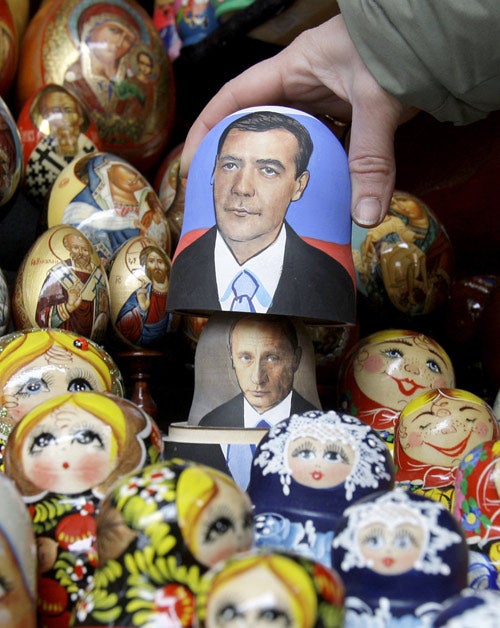
There's a new doll on the block. The familiar frowning face of Vladimir Putin is no longer the "outside" shell of the matryoshka sets on St Petersburg's souvenir stalls. His usurper is a dark-haired, less well-defined character named Dmitry Medvedev.
The likeness is not perfect – the painters have not yet got the measure of the country's next president. But as Russians go to the polls today, Mr Putin's relegation to second doll is a sign that power is in transition. By this evening, election results will confirm what the painters already know: Mr Medvedev, only 42, a native son of St Petersburg and previously one of two first deputy prime ministers, will be Mr Putin's successor.
Mr Medvedev is officially the nominee of United Russia, otherwise known as Mr Putin's party. His election has been a foregone conclusion ever since the outgoing President gave him his support.
Expected to take between 65 and 70 per cent of the vote – more than 70 per cent is unlikely as that would make him look more popular than Mr Putin – Mr Medvedev takes over in early May.
A lawyer by training, Mr Medvedev is not quite standing unopposed. There is Andrei Bogdanov, head of the Democratic Party, seen as a token candidate put up by the Kremlin to expand the range of choices. The last pre-election polls gave him 1 per cent.
The real opposition, such as it is, is supplied by two old warhorses from left and right. Gennadi Zyuganov, 63, is the Russian Communist Party leader who threatened to topple Boris Yeltsin from the presidency in 1996. He is still in fighting form.
So, too, is the fourth candidate, Vladimir Zhirinovsky, 61, the right-wing populist demonised by the Kremlin through the 1990s.
These experienced operators are tolerated by the Kremlin as safety valves for those at either end of the post-Soviet political spectrum. Estimated to get between 10 and 15 per cent apiece, they present no danger to Mr Medvedev.
But this does not mean they have not scored some points in the past month of campaigning. Confident of defeat, they have put up a spirited fight at what will probably be their last stand in national elections. Mr Zyuganov campaigned on rising prices (inflation is running at 12 per cent), housing and the glaring gap between rich and poor.
Mr Zhirinovsky's campaign was given new impetus by Kosovo's declaration of independence last month. US plans to station anti-missile installations in central Europe, and talk of Ukraine being fast-tracked into Nato, added fuel to his contention that Mr Putin has presided over eight years of Russian humiliation.
The pair reserved their fiercest salvos for the final, live televised "debate" on Thursday night, when they attacked Mr Medvedev's refusal to take part, what they saw as his lack of a common touch, and the way they claimed voters were being pressured into backing Mr Putin's candidate.
When similar accusations are voiced by international human rights organisations, Russians become defensive. And the fact that such claims were made on national television marks a new stage in the long civics lesson to which post-Soviet Russian voters are being exposed.
It is unlikely that in eight years' time, when Dmitry Medvedev reaches his two-term limit, either Mr Zyuganov or Mr Zhirinovsky will be around. That neither party has been able to renew its leadership in almost 20 years, however, and that no other politician has been able to found a durable new party with a mass following reflects poorly on the development of Russian democracy.
Subscribe to Independent Premium to bookmark this article
Want to bookmark your favourite articles and stories to read or reference later? Start your Independent Premium subscription today.
Join our commenting forum
Join thought-provoking conversations, follow other Independent readers and see their replies