Merkel tips Brown's grand plan into crisis
Germany's Chancellor receives French backing as she uses a London meeting to warn against proposals to pump billions more into the global economy
GETTY IMAGES
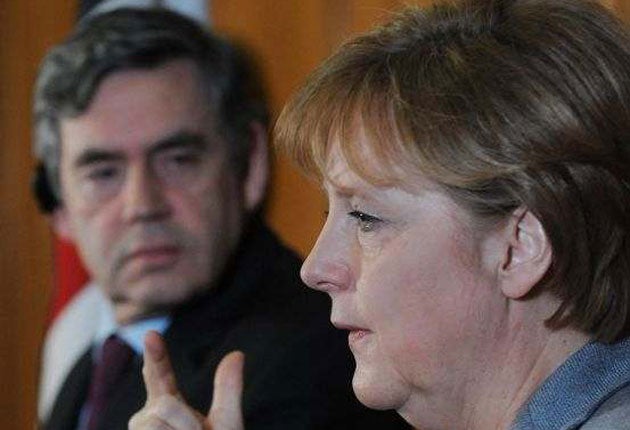
Warning words: Angela Merkel cautions Gordon Brown at their Downing Street press conference yesterday
Gordon Brown's grand plan to save the global economy was in crisis last night when the German Chancellor, Angela Merkel, refused to commit to a new global fiscal stimulus package to steer the world out of recession.
In a pointed warning to the Prime Minister, the German leader said it was too early to measure the effects of the first multibillion-dollar stimulus to give the go-ahead for any more state aid.
Mrs Merkel was backed up by Christine Lagarde, the French Finance Minister, who said nations needed to assess the impact of earlier measures before making any further tax and spend decisions
Mrs Merkel's remarks, made in a press conference alongside Mr Brown after talks in Downing Street, cast a shadow over yesterday's G20 meeting of finance ministers in Horsham, West Sussex, and Britain's attempts to secure a lasting rescue plan in the wake of the world's worst economic crisis since the 1930s.
France and Germany, two of Europe's largest economies, are reluctant to back the moves, instead calling for tougher financial regulation.
Finance ministers and central bank governors from the G20 group of rich and emerging nations, hosted by the Chancellor, Alistair Darling, tried to steer clear of the rift by agreeing a package of measures, including pumping more cash into the International Monetary Fund to rescue struggling countries. They also pledged to boost bank lending and to support developing nations. But there was no agreement on who would provide the money to the IMF.
In a blueprint for a meeting of G20 leaders, which is due to take place in London on 2 April, the finance ministers vowed to make a "sustained effort" to revive the global economy.
At the Downing Street press conference, Mrs Merkel said that Germany had already committed 4.2 per cent of GDP to a fiscal stimulus, putting her country at the "vanguard" of the global rescue effort.
Asked whether additional money was necessary, she said: "Nothing has actually taken effect on the ground yet. If we want to make real impact you really must implement the package first before you talk about the next step."
The German Chancellor said it was for individual countries to decide on further tax and spend decisions, adding: "We will talk to our parliamentarians about that."
Germans did not suffer the same problems with home loan and credit card debt that Americans had, she said, adding: "We must return to a solid, sustainable fiscal policy after the crisis. So we have got to signal to markets that on the one hand we are
tackling the crisis decisively and that, on the other, we will permanently avoid excessive global imbalances."
Speaking in Horsham, Mr Lagarde said that nations needed "to evaluate the remedies already put in place".
The tensions undermined Mr Brown's attempts to present a united front with Germany ahead of the London summit. The Prime Minister said: "I think you will find that countries will be agreeing together about what we are going to do in future, both in fiscal and monetary policy and in the regulatory system. I believe that we are setting a path with the G20 where, one by one, we are reaching agreement on the big issues for the future."
Mr Brown and Mrs Merkel agreed on the need for tougher regulation of hedge funds, and were confident they would secure American backing. But the rift was seized on by the Conservatives, who are seeking to make political capital out of David Cameron's apology on Friday for not anticipating the recession.
The Shadow Chancellor, George Osborne, said: "Hopefully this weekend Gordon Brown has learnt his lesson that he should stop trying to use the international stage to fight his domestic political battles, and instead focus on getting international agreement on banking reform and trade that really would have a stimulating effect."
The US Treasury Secretary, Timothy Geithner, praised the "broad-based consensus globally on the need to act aggressively to restore growth".
View all comments that have been posted about this article.
Offensive or abusive comments will be removed and your IP logged and may be used to prevent further submission. In submitting a comment to the site, you agree to be bound by the Independent Minds Terms of Service.
- Print Article
- Email Article
-
Click here for copyright permissions
Copyright 2009 Independent News and Media Limited


Comments
What the present situation is really down to is that this world has limited resources. We all need to get used to a lower standard of living. Growth cannot carry on forever. The sooner we all realise this the better. Chucking billions at the economy will do next to nothing. We will get progressively worse recessions after small recovery periods.
The bottom line is that we humans are inundating our host and killing it. We need to reduce population rather than incentivise its growth.
I looks as if someone is up to Gordy's skullduggery and knows he speaks with a forked tongue!
Good on ya ma'am!!!!
The Germans have a far more basic approach to money having learned the hard way.
They konw you do not get out of debt by even more debt for your children and grand children.
This is the Brown way that was the cause in the first place.
Maybe one bright day we will all be aware of who controls the strings of the puppet politicians, and why
Blair was received into the arms of J.P. Morgan, who no doubt will be arranging a well padded
mahogany seat on the board of one of it's scores of subsiduary business's for G Brown.
Meanwhile this is as good a guide to the fraud perpetrated by the Federal Reserve and Central banks as any
http://www.themoneymasters.com/faqs.h
http://en.wikipedia.org/wiki/Carlyle_Gr
'Ere! I used to mention thirties of trillions worth of N. Sea assets as a blockbuster fact that quelled opposition argument, but just realised it's no longer so effective 'cause of the hundreds of trillions recently socialised by stooges of organised economic crime as "toxic assets". Shucks
If the newspapers are to be believed it was not even his plan - it was developed at Standard Chartered - and in any case it failed to deliver what Brown promised. How often have we seen that?
Everyone knows that Brown is trying to buy his job at whatever cost in some vain hope that he can be seen as a great leader etc, sadly he could not live long enough for that too happen, and it never would. Brown is a nerdy academic who would never be good enough for this job, and the only surprises in the last few months is how quick he took to the international stage to show the world how bad he was.
It takes some believing when the french can look down their noses at you and be right as well.
I can only hope that this circus turns into an acute personal embarassment for Brown and that it will be very public.
Mandy put out some rubbish that Brown was seen as a sort of moses figure by the world, surely more like the captain of the titantic with an old queen as first steward welcoming all on board, taking their money and sinking their dreams.
Why isn't the boy Cameron shouting this from the rooftops every hour of the day?
I can't give an opinion on quantitive easin, but I know a man from a woman ( 9 out of 10 anyway !)
The plan is simplicity itself.
1/ From the 90s, banks built up assets on their balance sheets from lending to governments, corporates and us. The risks of default became increasingly clear. Dotcom and sub-prime being big triggers.
2/ So the plan is for governments to buy the assets - toxic and all - first by borrowing and new low interest rates, then by printing money, as necessary. 3/ Governments reduce and pay off the debt using a) our money of course, but b) they also have the hope that the assets will reflate in value once the economy takes off again so privatising them back them will raise cash.
3/ Why will the economy reflate? Banks will start lending because what else can they do with the liquidity flooding the economy from the government buying (nationalising) their assets.
4/ Side effects are, unfortunately, inflation greater than interest rates and currency devaluation. Currency devaluation is inflationary, but means the giovernment can pay off old debt in new devalued currency.
5/ After the depression, we will awake to find we have swapped positions with the Chinese - we will be at the back of the global supply chain (we have given them our knowledge, our jobs and our capital), working for 16 hours a day (to pay off the debt via greatly increased taxes) and living in countries without infrastructures anymore (too expen to maintain).
The plan is simplicity itself.
1/ PRIVATE SECTOR DEBY BUILDS UP. From the 90s, banks built up assets on their balance sheets from lending to governments, corporates and us. The risks of default became increasingly clear. Dotcom and sub-prime being big triggers. BAnks have to find a way to reduce that risk....
2/ TRANSFER DEBT TO PUBLIC SECTOR. So the plan is for governments to buy the assets - toxic and all - first by borrowing and new low interest rates, then by printing money, as necessary.
3/ GOVT TO REDUCE & PAY OFF DEBT. Governments reduce and pay off the debt using a) our money of course, but b) they also have the hope that the assets will reflate in value once the economy takes off again so privatising them back them will raise cash. Devaluation helps ... see below.
4/ REFLATE ECONOMY. Why will the economy reflate? Banks will start lending because what else can they do with the liquidity flooding the economy from the government buying (nationalising) their assets.
5/ ALAS...Side effects are, unfortunately, inflation greater than interest rates and currency devaluation. Currency devaluation is inflationary, but means the giovernment can pay off old debt in new devalued currency.
6/ POST DEPRESSION. After the depression, we will awake to find a) we have swapped positions with the Chinese - we will be at the back of the global supply chain (we have given them our knowledge, our jobs and our capital), working for 16 hours a day (to pay off the debt via greatly increased taxes) and living in countries without infrastructures anymore (too expen to maintain). And b) a new centre of world power will have emerged - maybe Iran/Pakistan/Russia. Unless c) The much bigger threat is that the planet and other life forms survive, but we alas do not as planetary warming etc is a much bigger threat and we have up to 4 years to catch that humpty dumpty.
Aside : homage to Mohnhaupt. I hope you are well and recovering from you long ordeal
Bush, Blair, Obama, Putin, Merkel, Sarkozy, Harper, Howard, Rudd and most other leaders are (covert) Jews.
See for yourself (PHOTOS):
http://linux.50webs.org/jews/JewLeaders.h
And while you are looking,... try this 2.2 MB mega-photo of Rabbis and politicians:
http://linux.50webs.org/jews/images/smal
Although not included in the photos,... Obama is also a Jew.
Here is a picture of Obama's Jew Momma:
http://cleveland.indymedia.org/uploads/2
Here is a picture of Obama's wife's (first) cousin. The rabbi Capers C. Funnye:
http://cleveland.indymedia.org/uploads/2
And here is a photo of Obama himself wearing a skullcap.
http://cleveland.indymedia.org/uploads/2
Even Germany and Austria have Jew presidents/Prime Ministers:
It is hardly necessary to hide away ones Jew roots at all.
For example, the Austrian President didn't even bother to change his Jewish name, Heinz-Fischer:
http://cleveland.indymedia.org/uploads/2
At least the German Prime Minister changed her Jewish name, Angela Kasner, to Angela Merkel (via a short marriage).
Kasner, Kastner, Kasztner, Kostiner, Costner, are well-known Jew names.
It is usual for Jews to own every horse in the electoral race, i.e., every candidate is a (covert) Jew.
Examples, are the 2000, 2004, 2008 American elections.