Russia's post-Putin era kicks off with demonstrations and a police crackdown

For free real time breaking news alerts sent straight to your inbox sign up to our breaking news emails
Sign up to our free breaking news emails
Dmitry Medvedev spent yesterday savouring his overwhelming victory in Russia's presidential election, and fielding congratulations – of varying degrees of warmth – from foreign leaders. What should have been a joyous day for Mr Medvedev and his patron, President Putin, however, was soured by allegations of manipulation and vote-rigging. International parliamentary observers also failed to give the election a clean bill of health.
The first complaints came from the Communists – a party not without experience in vote-rigging in its time. The party leader, Gennady Zyuganov, threatened to sue over alleged violations of the electoral rules. "We have evidence of falsification of the elections and we will go to court," he said.
Vladimir Churov, the head of Russia's Central Electoral Commission, said that all complaints would be investigated. In fact, Mr Zyuganov – with almost 18 per cent – won a larger share of the vote than advance polls had suggested, performing especially well in the central industrial region of the country.
He did not give precise details of his allegations, but there were persistent reports from different parts of the country of staff coming under pressure from employers to vote for the United Russia candidate – that is, for Mr Medvedev. In some places, activists were said to have been buying votes of, for instance, poor pensioners, for as little as 300 roubles (£7). There were also fears that the count in some places had been compromised, with figures being changed to meet centrally imposed targets – both for Mr Medvedev and for turnout.
The conduct of the election was also criticised by the head of the only Western observer mission in Russia, representing the Parliamentary Assembly of the Council of Europe. Andreas Gross said that Russia's "democratic potential was unfortunately not tapped", largely because Mr Medvedev had preferential access to the media and registration procedures had made it difficult for independent candidates to stand. He acknowledged, however, that Mr Medvedev had a "solid mandate" from an election that was more in the nature of a referendum on the eight years of Mr Putin's presidency. The Organisation for Security and Co-operation in Europe did not send observers because of what it regarded as unacceptable restrictions imposed by Moscow.
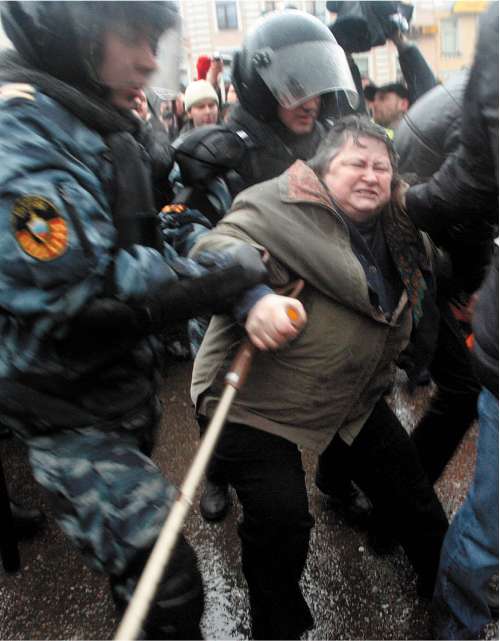
Yesterday evening members of democratic reform groups, under the umbrella of the Dissenters movement, held protest marches in Moscow and St Petersburg, to complain about the lack of choice in Sunday's election. In Moscow, where the march went ahead without official permission, about 200 people were dispersed by police.
In St Petersburg, hundreds of police were mobilised for a march which was given authorisation after the organisers agreed to change the route. A couple of thousand protesters carried banners representing a range of civic organisations, including the reformist Yabloko party, which had not nominated a candidate for the election.
Home-made placards said "No to Medvedev" and the marchers, mostly young and middle-aged, chanted "Russia will be free". Closed phalanxes of police walked in front and behind the column, hemming them in, and riot police "heavies", with helmets and shields, sat in vans along the route.
Through the day, Russian television played and replayed clips of Mr Medvedev and Mr Putin walking through the snow to address the crowd at a victory rock concert the previous evening. It also showed Mr Medvedev addressing a press conference – held at 1am, when the bulk of results were in. The two answers they singled out were one where he admitted to feeling nervous about the result – but "not enough to lose sleep over" – and a second, asked by the BBC, about the division of responsibilities with Mr Putin, who is set to be named prime minister in Mr Medvedev's first government.
The presidency and the government, Mr Medvedev said very deliberately, are distinct arms of the administration. The President works out of the Kremlin and the Prime Minister works at the White House. "That will continue." The Russian White House is the Soviet-era parliament building which now accommodates government ministers and departments.
Among the congratulatory messages received by Mr Medvedev was one from Gordon Brown, expressing hopes of improved relations after the Litvinenko affair and the stand-off over the British Council offices in Russia. But the Foreign Secretary, David Miliband, stressed that Britain would not renounce its demand for the extradition of Andrei Lugovoi, who is wanted for Litvinenko's murder.
Congratulations from the German Chancellor, Angela Merkel, voiced regret about apparent irregularities, while the French Foreign Minister, Bernard Kouchner, called for a new EU-Russia dialogue.
Russian media coverage was predictable positive, with only Novaya Gazeta – the independent paper where the murdered campaigning journalist Anna Politkovskaya worked – deploring what it called an "unimaginative campaign".
Subscribe to Independent Premium to bookmark this article
Want to bookmark your favourite articles and stories to read or reference later? Start your Independent Premium subscription today.
Join our commenting forum
Join thought-provoking conversations, follow other Independent readers and see their replies