The ship twists and turns – and so does the captain and his story
Satellite information has shed further light on the last moves of the Costa Concordia but, as David Randall sifts through the evidence, he finds that the picture of what happened aboard the cruise ship on Friday the 13th is far from complete
New navigation satellite data has revealed the Costa Concordia's extraordinary manoeuvres before the capsizing of the cruise ship, which has so far claimed 12 lives. A further 20 people are still missing, presumed dead.
Click here to launch the graphic mapping the ship's final movements
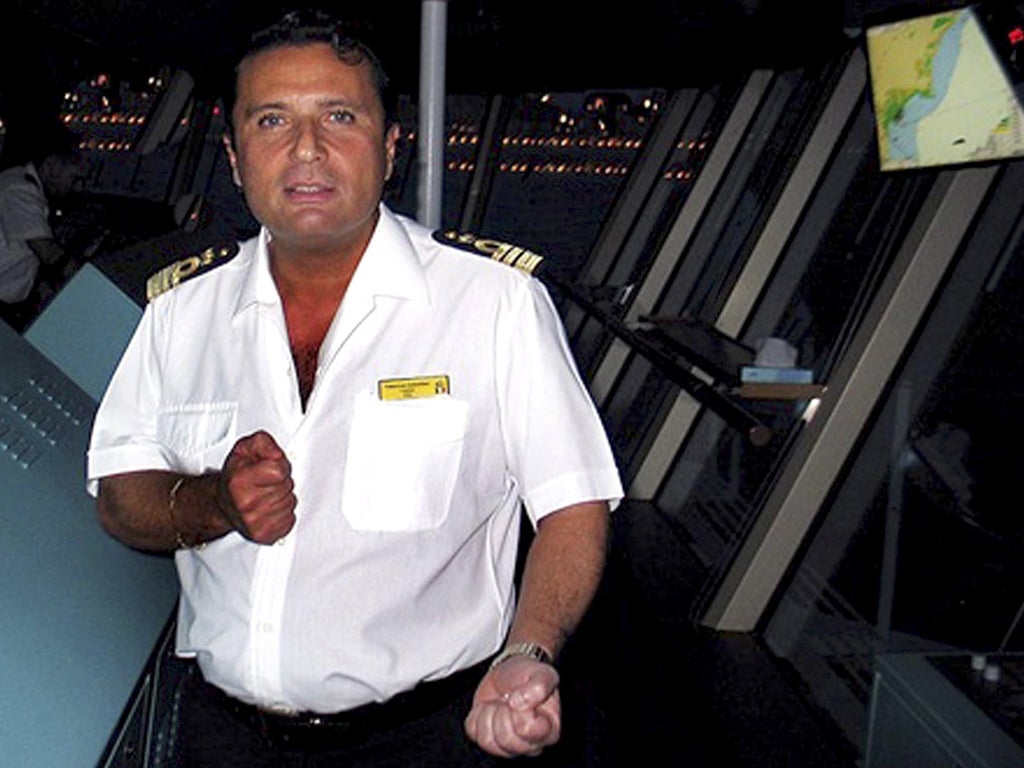
The new information shows that the ship performed a sort of nautical hand-brake turn to get close to the island of Giglio and make evacuation easier. Depending on the interpretation put on this move by any inquiry, it may back up the contention of Captain Francesco Schettino and his supporters that, having made the initial error which crunched the ship into submerged rocks, his subsequent actions saved lives.
The new data, however, does little to shed light on his departure from the ship – whether intentional or not – before the evacuation was complete. And a study of available evidence a week after the accident still leaves large gaps in his claim that he was co-ordinating the rescue operation from a lifeboat. The ship's owners have now heaped further problems on his head by saying that Captain Schettino did not relay correct information either to the company or crew after the ship hit rocks. He insists he did.
A survey of all the week's sourced information does enable a preliminary account of the events of that night – Friday the 13th – to be assembled. It is, as major maritime accidents go, a very odd one, on a par with that of the Titanic, whose centenary is but a few weeks away. Both calamities were in calm seas, but this raised even bigger questions about the navigation, and how little on-board technology seemed to help. The behaviour of the White Star liner's senior officers holds up well by comparison.
The initial impact with underwater rocks was due to the captain deciding to deviate from the prescribed route – an error he has admitted. He has not spoken of why he did this, but the desire to sail close to Giglio in a salute to the crew's existing and former members seems well established. A Facebook posting by an islander saying it was about to happen confirms this. Such a sail-by was not unprecedented, the ship having done a similar sail-by last August, for which it had authorisation from its owners. Last Friday it did not. It is hard to disagree with the investigating judge that the manoeuvre was "highly imprudent", to say the least.
Satellite images show the initial collision was very near a rocky outcrop above water. They also show that the ship, travelling at an estimated 15 knots, hit them side-on, and appeared to be in the act of turning when it did so. This was at 9.42pm, as passengers were served dinner, and the severe jolt caused lights to go out and much that was not fixed to be thrown around. The ship would have been under manual control, and it is not clear if Captain Schettino was on the bridge at the time. He has maintained that the submerged rocks were not shown on charts. There is also the possibility that the Concordia's sonar failed to pick them up, either due to a malfunction or perhaps because of the angle at which it was approaching them.
Having been holed, the ship then headed away from Giglio towards the mainland, and passengers were told that there was an electrical fault which engineers were trying to fix. Some have accused the captain of misleading them, but, with 4,200 people on board, not panicking them until the extent of the damage was known seems understandable.
What is not understandable is the apparent failure to notify port or coastguard authorities of what had occurred. Allegedly they were told merely of a "blackout" on board. It was passengers' mobile phone calls to land that first alerted emergency services to the seriousness of the situation. The judge's view is that: "The captain, due to incompetence and negligence, underestimated the extent of the damage and failed to notify the coastal authorities of the accident in timely fashion ... The captain could not help being aware immediately of the seriousness of the damage produced both due to the ever increasingly evident tilt of the ship and because he was advised by the crew of the huge amount of water shipped."
According to transcripts published by Italian media of his questioning by prosecutors, Mr Schettino said that immediately after hitting the rock he sent two of his officers to the engine room to check on the state of the vessel. As soon as he realised the damage caused to the ship, he called the director of operations for Costa Cruises, Roberto Ferrarini.
"I told him: I've got myself into a mess, there was a contact with the seabed. I am telling you the truth, we passed under Giglio and there was an impact," Mr Schettino said. "I can't remember how many times I called him in the following hour and 15 minutes. In any case, I am certain that I informed Ferrarini about everything in real time," he said.
However, Costa's chief executive, Pierluigi Foschi, has told Italian state television that the company spoke to the captain at 10.05pm, some 20 minutes after the ship ran aground, but could not offer proper assistance because the captain's description "did not correspond to the truth".
What emerges from the satellite "best guess" tracking of the ship's course is that 11 minutes after impact, at 9.53pm, the ship had slowed to about three knots. A few minutes later, around 10pm, it was decided to go sharply to port to get closer to Giglio. The captain has reportedly said that he used the anchors to help to perform this sharp turn. During this, according to the tracking, the ship listed by as much as 20 degrees to starboard, the opposite side to where the 150ft gash had been opened up. Shortly afterwards, at 10.10pm the Concordia came to rest 50 metres from shore, listing badly, and the evacuation order was given.
This has been described as chaotic by many passengers. But it is hard to believe that any evacuation of several thousand people in the dark could be anything else. The company says the comparatively small loss of life is a tribute to those crew who assisted passengers. Understandably, a worldwide review of safety and evacuation on such megaships is now under way. Reassuring the industry's mainly over-50s market will depend on it.
Mr Schettino's role for the next few hours is perplexing. He says he helped passengers into lifeboats, gave one his own life jacket and, at some point, tripped and fell into a lifeboat. The time he left the ship, intentionally or otherwise, is not confirmed, but initial reports said it was around 11.30pm, with others claiming that he was then in a boat or on the island's rocks, implying it was even earlier. The latest information suggests it was later than that, and the Moldovan dancer Domnica Cemortan, a passenger on the ship, says he was still on board at 11.50pm. The judge, in her statement, says he "abandoned about 300 persons, unable to fend for themselves ... who he was supposed to take care of". A transcript of communication between him and the Livorno harbour master indicates he was still on board when all but 300 had been evacuated.
Once Mr Schettino was off the ship, he had the now notorious conversation with Captain Gregorio de Falco, the senior coastguard officer, in which Mr Schettino was ordered to go back on board. He didn't. The transcript includes the following exchanges:
De Falco: "What are you doing, commander?"
Schettino [in a boat]: "I am here to co-ordinate the rescue ..."
De Falco: "What are you co-ordinating there? Go on board! Co-ordinate the rescue from aboard the ship ... Go. There are already bodies, Schettino."
Schettino: "How many bodies are there?"
De Falco: "I don't know ... You are the one who has to tell me how many there are. Christ!"
Schettino: "But you do realise it is dark and here we can't see anything."
Thus he made clear that it would have been very difficult for him to co-ordinate anything. The judge said: "The fact that other members of the crew and officers still aboard ... were doing everything they could to make possible the disembarkation of the passengers objectively gainsays what the captain declared about the objective impossibility of directing and managing the emergency and rescue procedures."
Mr Schettino is now under house arrest near Naples. The ship's owners have suspended him, announced it is no longer paying his legal fees, and signed on as a civil party in the prosecution.
Additional reporting by Katie Upton
The search continues: Light oil spills into sea as death toll reaches 12
The body of a woman wearing a life jacket was recovered by Italian coastguard divers from a narrow corridor of the capsized Costa Concordia yesterday, raising the death toll to 12 in the week-old accident that has sent some light fuel spilling into the sea off Tuscany.
Search and rescue efforts for survivors and bodies have delayed the operation to remove heavy fuel in the Concordia's tanks, although specialised equipment has been standing by for days. On Saturday, light fuel, apparently from machinery aboard the capsized vessel, was detected near the ship. However, Coastguard Commander Cosimo Nicastro said there was no indication that any of the nearly 500,000 gallons (2,200 metric tons) of heavy fuel oil has leaked from the ship's tanks. He said the leaked substance appears to be diesel, which is used to fuel rescue boats and dinghies and as a lubricant for ship machinery.
There are 185 tons of diesel and lubricants on board the crippled vessel. Earlier yesterday, crews removed oil-absorbing booms used to prevent environmental damage in case of a leak. The ship still rests on a rocky ledge of sea bed.
Join our commenting forum
Join thought-provoking conversations, follow other Independent readers and see their replies
Comments