Obama calls for peace talks but reaffirms US support for Israel
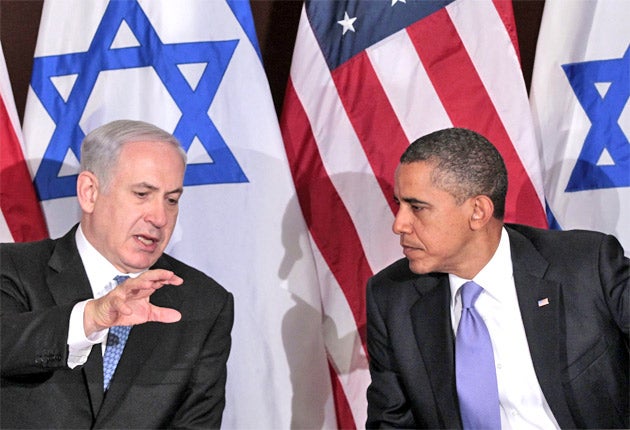
Warning that there was "no shortcut" to a Middle East peace settlement, President Barack Obama sought yesterday to persuade Israeli and Palestinian leaders to re-start direct negotiations – and thus blunt the Palestinian bid for full United Nations membership that Washington has vowed to veto.
But as Mr Obama held separate talks with Benjamin Netanyahu, and the Palestinian President, Mahmoud Abbas, on the sidelines of the UN General Assembly, prospects of a early breakthrough seemed remote. With the US President sitting beside him, the Israeli Prime Minister flatly declared that any attempt to secure statehood via the UN would not succeed. "The Palestinians want statehood but aren't prepared to offer peace to Israel in return," Mr Netanyahu said.
Barring an astonishing last-minute reversal, Mr Abbas will make the application official when he addresses the General Assembly tomorrow. It is certain of broad but mainly symbolic approval by the assembly. But the critical arena is the 15-member Security Council, where the US would wield its veto, if a statehood resolution won the required majority of nine votes.
Mr Obama's overriding goal, however, is to prevent matters reaching that point, which would be a lose-lose situation for the US. A veto would shatter what remains of Washington's credibility in the region, after his embrace of the democracy movements of the "Arab Spring".
But to refrain from a veto would play into the hands of his Republican opponents at home, who accuse him of abandoning the Jewish state – in the words of Mitt Romney, a leading contender for the 2012 nomination, of "throwing Israel under a bus".
In his address to the General Assembly, Mr Obama sought to walk that tightrope, re-affirming America's support for a Palestinian state, but stressing that a settlement could only be reached by negotiation and compromise, "not by statements and resolutions at the UN". Peace, he warned, "is hard work".
Addressing a domestic political audience as least as much as the world leaders listening in the chamber, Mr Obama pledged unwavering US backing for Israel. He spoke explicitly of the hostility to it across the region, of Iran's threats to "wipe Israel off the map", and the historical persecution of Jews that culminated in the Holocaust. "Friends of the Palestinians do them no service by ignoring these truths," he added.
But those words cut little ice with Mr Abbas and his delegation, frustrated by decades of failure to secure peace. There was a gap, complained Yasser Abed Rabbo, the secretary-general of the Palestinian Liberation Organisation, "between praising the struggle of Arab peoples for the sake of freedom and between an abstract call for negotiations between us and the Israelis".
Yesterday, Mr Netanyahu again called on the Palestinians to return to the bargaining table, but gave no public sign of any concession on settlements or anything else. Nor did Mr Obama go into specific issues in his speech.
The one hope is that procedural requirements mean any vote in the Security Council is probably some weeks off, offering a window in which a formula could be found for a restart of talks. And as Mr Obama spoke, frantic efforts were taking place to avert such a diplomatic disaster.
Nicolas Sarkozy, the French President, called on the UN to grant the Palestinians the status of observer state, like the Vatican, while outlining a one-year road-map to peace. A US veto in the Security Council, he warned, could plunge the Middle East into new violence. But the stakes are highest of all for Mr Obama as he tries to right his struggling presidency and preserve Washington's influence in the Middle East.
The options: Full vs partial membership
What would full membership mean?
The Palestinians believe that full UN membership would level the playing field when it comes to negotiations with Israel, enhancing their ability to extract concessions. Instead of an occupying state negotiating with an occupied territory, the relationship would shift to that of state versus a state. But, in taking the full membership route, the Palestinians would not only defer a vote by months as various subcommittees review the application: they also invite almost certain failure, because the US will use its veto against a bid for statehood.
What would partial membership mean?
Palestinians could pursue the so-called "Vatican option" – an upgrade of their status from a non-member entity to that of a non-member state. The resolution would probably pass with little difficulty, given that it would only require a majority in the General Assembly, where the Palestinians have a strong base of support. Some Palestinian leaders see this as the best route to full membership, giving them in the meantime access to various international bodies, including, it is thought, the International Criminal Court. The latter is a deeply worrying prospect for Israel, which could be exposed to legal challenges over its policies in the Occupied Territories.
Catrina Stewart
Join our commenting forum
Join thought-provoking conversations, follow other Independent readers and see their replies
Comments