End of the Afghan war is in sight. Now the political fighting begins
France and Germany follow US in calling troops home but Obama is hit by barrage of criticism from top military chief and Republicans

For free real time breaking news alerts sent straight to your inbox sign up to our breaking news emails
Sign up to our free breaking news emails
President Obama's decision to pull more than 30,000 US troops out of Afghanistan before the 2012 presidential election ran into criticism from all sides yesterday: from fellow Democrats who said it was too slow, some Republicans who accused him of acting overhastily, and a thinly veiled warning from the Pentagon that it could endanger the hard-won gains of nearly 10 years of war.
Testifying to a Congressional committee, Admiral Mike Mullen, chairman of the Joint Chiefs of Staff, took care not to challenge his commander-in-chief directly. But, he declared, the decision was "more aggressive" and incurred "more risk than I was originally prepared to accept".
A larger force, for a longer period was undoubtedly the safer course, he said, to ensure military success. "But that does not necessarily make it the best course", and ultimately it was the President who had to determine the acceptable level of risk.
With those last words, Admiral Mullen was acknowledging the political realities: that Mr Obama simply could not be seen to be doing nothing to wind down a long and unpopular war as he embarked on a tough re-election campaign, set to be dominated by the economy.
Mr Obama's announcement triggered statements from Nato allies about their own intentions to pull out, with French President Nicolas Sarkozy saying that the French will also reduce its military presence from September.
The announcement could pave the way for a speedier withdrawal of British forces from Afghanistan. The Government yesterday spelt out its determination to pull out all combat troops by the end of 2014 and insisted that deadline was set in stone. It denies accusations that the timing has been fixed to coincide with the general election due in May 2015, insisting that Afghan forces will be ready to take over responsibility for the nation's security by then.
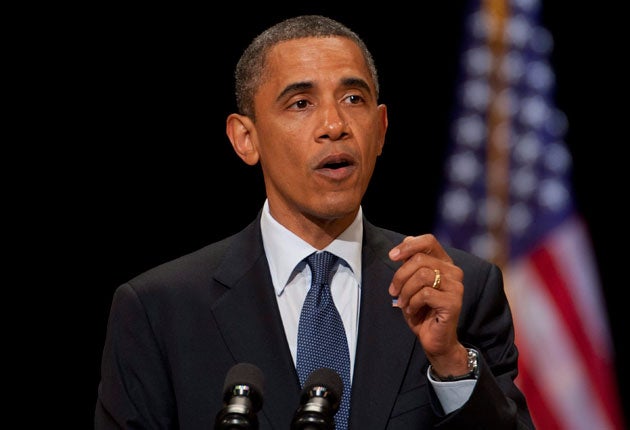
The plan set out by the US President in a 13-minute prime-time TV address on Wednesday basically calls for all the extra forces sent in his December 2009 surge to be recalled by next summer, leaving some 70,000 US troops in situ.
The goal is a complete handover to the Afghans by 2014 by which time, the administration hopes, President Hamid Karzai's government will have struck a deal with the Taliban. Many experts say that target is unrealistically ambitious, but Admiral Mullen insisted yesterday that Afghan security forces were making big progress. In Kabul, President Karzai, welcomed the plan for a gradual pullout and said Afghans increasingly trusted their security forces.
The initial withdrawal of 10,000 US troops is expected in two phases, with 5,000 troops coming home over the summer and 5,000 more by the end of the year. More than 20,000 more are to follow by September 2012, the month when the general election campaign moves into top gear.
But Democrats were complaining that the pullout should be faster, given the killing last month of Osama bin Laden, the top target when the US first attacked then Taliban-run Afghanistan a month after the 9/11 attacks on New York and Washington.
Nancy Pelosi, the House minority leader and former Speaker, said Americans had been hoping for a faster drawdown, "and we will continue to press for a better outcome". Ms Pelosi's criticism was politely framed, but it reflects the views of many liberal activists that Mr Obama can ill afford to alienate.
Not a few Republicans agree, including presidential candidate Jon Huntsman, who called for a much smaller US force in Afghanistan, focused on anti-terrorism, the approach long advocated by Vice-President Joe Biden and other top Democrats. Some of Mr Huntsman's rivals echoed Admiral Mullen.
But few Republicans were as critical as John McCain, the party's 2008 nominee and a strong supporter of both the Afghan and Libyan wars, who said Mr Obama was acting much too rashly. "This is not the 'modest' withdrawal that I had advocated," the Arizona Republican said. The Taliban also added to criticism, saying that a US troops reduction would be a step towards ending "this pointless bloodshed" but called for the full withdrawal of all foreign troops immediately. "Until this... happens, our armed struggle will increase from day to day," said Taliban spokesman Zabihullah Mujahid in a rare statement in English.
The 4,000 French troops will be reduced on roughly the same timetable as the US troops, and under much the same domestic, political pressures. President Sarkozy is expected to stand for re-election in April and the French presence in Afghanistan has always been unpopular with both right- and left-wing voters. The German Foreign Minister Guido Westerwelle also announced that Berlin would reduce its 4,900 strong force in northern Afghanistan from the end of the year.
William Hague, the Foreign Secretary, said on a visit to Kabul that there were "no ifs and buts" over the withdrawal date for British forces. The British force of 9,500 in Helmand is expected to fall to just over 9,000 later in the summer and to between 8,500 and 8,800 by the end of 2012.
Situation on the ground
Security More Afghans are being killed in the conflict each year, with a record 2,777 civilian casualties last year. Nato officials argue that as more troops are pumped into volatile areas, higher casualties are to be expected. But what will happen when foreign troops leave? Security improved in the southern Taliban heartland after more troops were deployed as part of Obama's surge, but attacks have increased in areas where troop numbers remained stable. The Taliban now operates elaborate shadow administrations in all provinces, ready to step into any vacuum. It will be up to the Afghan police and army to stop them, but their training and recruitment has been patchy, and plagued with mismanagement and corruption.
Government President Hamid Karzai has won two elections since the ouster of the Taliban, but fewer than 40 per cent of registered Afghans voted in the 2009 poll, cowed by Taliban attacks and disillusioned at the political process. EU monitors said about a quarter of all votes cast could be fraudulent. To hold together a nation fiercely divided along tribal lines, Karzai has had to make deals with a number of unsavoury warlords. Without the backing of Western powers, he may struggle to retain their loyalty.
Rights When the US led the charge into Afghanistan nearly 10 years ago, the Taliban's human rights abuses were among the justifications for the war. Nearly 10 years on, there is a national human rights commission and many local watchdogs monitoring abuses. But atrocities continue. In the remote districts where the Taliban hold sway, justice is still rough. A video emerged last year of a women being stoned by a crowd for adultery, before being shot dead as she tried to crawl from her grave.
Subscribe to Independent Premium to bookmark this article
Want to bookmark your favourite articles and stories to read or reference later? Start your Independent Premium subscription today.
Join our commenting forum
Join thought-provoking conversations, follow other Independent readers and see their replies