Good news! The nations where women are on the march
To mark International Women's Day, an <i>IoS</i> survey shows progress is being made
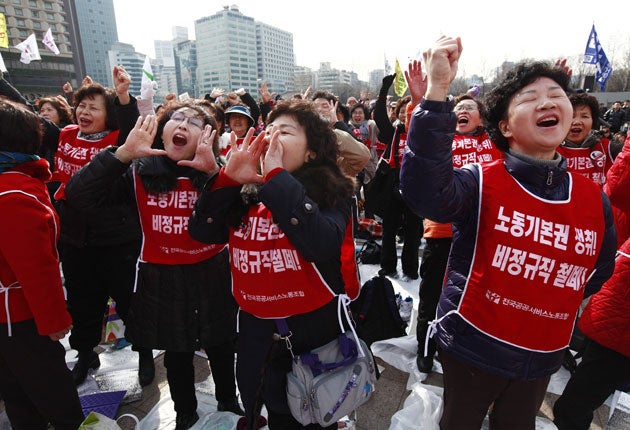
Women are capturing an increasing number of seats in parliaments around the world, an Independent on Sunday survey to mark International Women's Day has found. In places such as South Africa and Iceland, they are approaching parity with men, and in one country, Rwanda, they are actually in the majority.
While much remains to be done, not least in the UK where barely one in four MPs are women, governance experts this weekend hailed the advances that many countries have made, including some of the world's least developed nations. Not that progress has been easy: even in the Nordic countries, where female representation in politics is at least twice as high as elsewhere, victory has been a long time coming. Nan Sloane, director of the Centre for Women and Democracy (CFWD), said yesterday: "The Scandinavian countries have been working at it for decades. They decided a long time ago that this was important, and then dealt with it."
Sweden, Finland, Norway and Iceland all rank in the top 10, with Denmark just outside it. Other notable examples include Cuba, Belgium, Mozambique and Angola. By way of contrast, the UK comes in at a lowly 53rd place, tied with Uzbekistan, Eritrea and the Czech Republic, according to the Inter-Parliamentary Union, which represents parliaments around the world.
And there the UK will stay, experts warned, unless it adopts some of the radical legislative measures that have helped women to smash the crucial 30 per cent barrier that gives them critical mass. In all but four of the 25 countries where 30 per cent or more of their parliamentarians are female, it has taken quotas to break the centuries-long male stranglehold.
Anne-Marie Goetz, a leading governance specialist at UN Women, said: "In most countries there has been stubborn resistance to fair competition by women for prominent positions in public decision-making. The only known means to overcome that has been the use of quotas."
Yvonne Galligan, director of the centre for the advancement of women in politics at Queen's University Belfast, said it took "something strong" like quotas "to break the political culture and political behaviour that excluded women from politics and from public office". Before the African National Congress introduced a 30 per cent quota for female candidates, South Africa trailed at 141st according to the percentage of legislative seats held by women: today it is in third place. The same rule applies in Argentina, where women hold 39 per cent of seats in the lower house, and the President, Cristina Fernandez de Kirchner, is female.
Yet quotas are controversial. Professor Galligan said positive measures ultimately "become self-sustaining", helping to make changes mainstream. Hence Denmark abolished quotas in the mid-1990s and today women still control nearly 40 per cent of the country's legislative. Others warn that quotas stop countries from developing a political culture that integrates women into the political system. Ms Sloane warned that it doesn't necessarily follow that having more women in the legislature gives them a better chance of snapping up key cabinet posts, calling the correlation between the two "limited", while the link between women in parliament and women as heads of state was "very limited".
Ireland remains an extreme example: it has had two female presidents yet struggles to get women elected to its parliament. Even last month's overwhelming re-election of Joan Burton, the Labour Party's deputy leader, couldn't make up for the fact that just one extra woman joined her peers in parliament.
Despite women's elevated political status in Mozambique, the country is notably absent from the CFWD's list of the top 26 countries ranked by the number of female cabinet ministers, barely giving women a say at the executive level. As for what it takes to force change, this paper's analysis of countries where women prosper politically suggests that, to paraphrase Edwin Starr's 1969 hit "War", conflicts can actually be good for something: political change.
"It doesn't require massive social disruption, but it's striking that countries that have been through very serious transition have often been most open to a dramatic change in women's leadership roles," Ms Goetz said. "This is partly because in a lot of political conflicts, women are often at the frontline of freedom struggles. Plus often, especially after violent conflicts, women have taken responsibility in their households, leaving them eager to step into leadership roles to prevent conflicts re-occurring."
Dorcas Erskine, head of public affairs at ActionAid, said conflicts give "societies a chance to restructure and reform and make big differences". She said: "It can give women an opportunity if they are brave enough to take it."
Rwanda is the most striking example. Desperate for an alternative to Hutu rule that plunged the country into civil war in 1994, the new government instead favoured gender equality and decentralisation. "Plus women played such a central role in peace building that it became obvious they couldn't be excluded from political life," Professor Galligan added.
The result? Women hold more than 56 per cent of seats in Rwanda's lower house, 35 per cent in its upper house, and six of its 23 cabinet ministers are female. Although critics argue that the Rwandan parliament is far from a shining democratic beacon, the mere presence of women has helped the country to pass some "extremely difficult" laws, according to Ms Goetz. These include laws that enable women to own land for the first time.
Yifat Susskind, executive director of the human rights group Madre, said female parliamentarians expand the range of issues up for debate. "This isn't biological predeterminism, but reflects the fact that women's lives around the world still differ significantly from their male counterparts'. In places that have experienced armed conflict, where rape is often used to terrorise, women leaders are more likely to understand the violent threats that women face. In matters of labour and economic policy, women are better positioned to understand the value of unpaid care work."
In Afghanistan, women MPs have turned the closure of women's shelters into an international issue. Shinkai Karokhail, who was elected to the Afghan parliament in 2006, fought against attempts by some of the country's Shia male MPs to limit women's rights. She told this paper that "the presence of women and the support of some men who believe in equality" had been crucial to her success. Habiba Sarabi, the only female governor in Afghanistan, said it was easier for women's voices to be heard in her region, Bamiyan, than elsewhere. "There are more opportunities and more respect for women there," she said.
Ms Goetz said that women's influence was most needed in peace talks. "Women's presence is not just self-serving but contributes to the sustainability of the peace. For example, if ceasefires don't prohibit the use of sexual violence, then guns can fall silent but rapes can continue." Yet a recent study of 585 peace accords from the past 20 years, by the University of Ulster's Christine Bell, showed that only 16 per cent even mentioned women and gender at all.
Ultimately, however, without the sort of cultural change that convinces the general public that gender equality is in everyone's interests, female parliamentarians will remain symbolic at best and tokenistic at worst. "Getting women there is just half the journey," Ms Goetz said.
Join our commenting forum
Join thought-provoking conversations, follow other Independent readers and see their replies
Comments