Netanyahu warns 'odious regime' is greatest threat to humanity
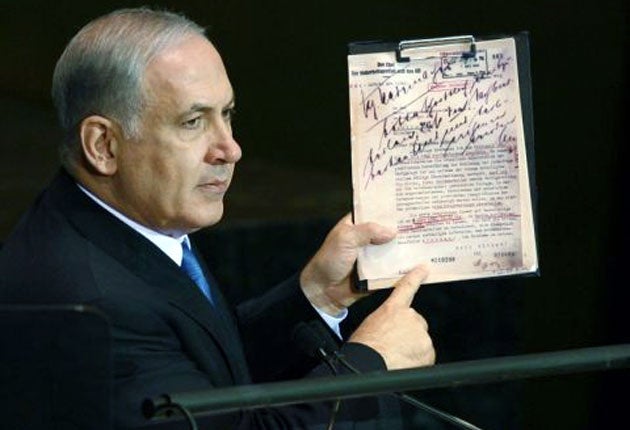
A week before crucial nuclear talks with Iran, Israel's Prime Minister Benjamin Netanyahu yesterday delivered a blistering tirade against the country, hinting anew that if negotiations failed to halt the regime's suspected weapons programme, Israel might take matters into its own hands.
In his speech to the UN General Assembly, the Israeli leader used the claim by Iranian President Mahmoud Ahmadinejad that the Holocaust never happened to argue that Iran was the incarnation of the greatest threat facing humanity, representing the "marriage of Islamic fanaticism and weapons of mass destruction". As he opened his address, Mr Netanyahu brandished the protocol of the 1942 Wannsee conference in Berlin at which the Nazis finalised their plans to exterminate European Jewry, as well as a copy of the original plan for the Auschwitz/Birkenau death camp.
"Are these documents lies?" he asked. "Perhaps you think this man's odious regime threatens only the Jews, but how wrong that would be. History shows that what starts as an attack on the Jews ends up by engulfing many others."
The Iranian delegation was conspicuously absent when Mr Netanyahu spoke, just as Israel's had been for Mr Ahmadinejad's address. He castigated those who had stayed to listen. "What a disgrace, what a mockery of the charter of the UN," Mr Netanyahu said of those who had listened to a man who had said the Holocaust was a lie.
In policy terms, Mr Netanyahu broke little ground on Iran or on the deadlocked peace talks with the Palestinians. In an address intended as much for domestic consumption as for the General Assembly, he did not mention the vexed settlements issue.
But his uncompromising language about the threat posed by Iran underlines the importance of the 1 October talks between a senior Iranian negotiator and representatives of the US, China, Russia and the EU trio of France, Britain and Germany.
This week, Hillary Clinton, the US Secretary of State, as well as David Miliband, the Foreign Secretary, have warned Iran that these discussions will present it with a choice: serious moves to halt its uranium enrichment programme, or the prospect of much tougher sanctions from the UN.
Both sides are dug into their positions but some potentially new elements emerged this week. Russia, a Security Council member, has indicated it is ready to countenance stronger sanctions against Tehran but China still seems unenthused by the idea.
Mr Ahmadinejad, in an interview with The Washington Post, suggested that Iran may allow its nuclear experts to be questioned by Western scientists – an offer that if taken up might allay suspicions about the nature of its nuclear programme. Tehran also wants to buy enriched uranium from the US for what the Iranian President insists are medical purposes.
This uranium would fuel a reactor supplied to Iran by Washington during the Shah's regime. The request could put the US on the spot. If the administration refuses, the Iranians would insist that they have no choice but to enrich their own uranium, ostensibly for humanitarian purposes.
In his speech to the assembly, Mr Ahmadinejad was as uncompromising as Mr Netanyahu. He dismissed suggestions that he had stolen the country's election earlier this year – the ballot, he said, had been "glorious and fully democratic". He also delivered an oblique tirade against the Jews, condemning the "private networks" that he said largely ran the world.
Join our commenting forum
Join thought-provoking conversations, follow other Independent readers and see their replies
Comments