Worried Washington is being forced back into arms of unreliable Musharraf

For free real time breaking news alerts sent straight to your inbox sign up to our breaking news emails
Sign up to our free breaking news emails
It was, by any standards, a political assassination waiting to happen. But that does not numb the world's shock at the violent death yesterday of Benazir Bhutto, nor lessen fears for the repercussions on Pakistan, on America's "war on terror" and on the stability of the south-west Asian region.
Nowhere will the shock or anxiety be more acute than in Washington. President Pervez Musharraf may arguably be the most vital US ally in its struggle with Islamic extremism, flattered by fuzzy photo-ops with President George Bush at the White House and Camp David, but he has been an increasingly unreliable one.
As his own domestic position has weakened, he has proved both unwilling and unable to move decisively against the Taliban and al-Qa'ida leadership hiding in Pakistan's remote, tribally run frontier regions, and has repeatedly postponed promises to return the country to civilian rule.
As a result, a resurgent Taliban is more threatening in neighbouring Afghan-istan than at any time since it was driven from power in November 2001. Only this week, The New York Times reported in damning detail how billions of dollars of US aid, intended to beef up the Pakistani armed forces in its battle with radical Islam, has been diverted to weapons to counter India, or siphoned off in corruption.
Rapprochement between the now-retired general and Ms Bhutto, the most charismatic opposition leader, has been the centrepiece of US-led efforts to rebuild a popularbased democracy in Pakistan after more than eight years of military rule. That strategy is in mortal peril.
The US and thus Britain and the other Western powers are left with no good options. With no obvious civilian political alternative to Ms Bhutto, and no other military leader offering any stronger prospect of a return to democracy, Washington is even more closely locked into its uneasy embrace of Mr Musharraf, in whom it has invested so much, but feels short-changed.
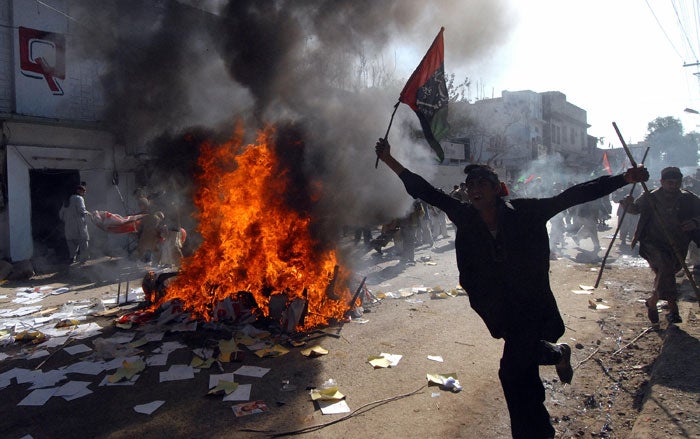
That harsh truth was discernable on Mr Bush's face, tense and drawn as he interrupted his Christmas break at his Texas ranch to condemn "this cowardly act by murderous extremists". He urged the Pakistani people "to honour Benazir Bhutto's memory by continuing with the democratic process for which she so bravely gave her life". But as panic, chaos and violence swept Pakistan's major cities after the assassination, the elections scheduled for 8 January that were key to that process may well have to be put back again.
And US officials are grappling with the troubling questions left by the assassination, not least the security breach that allowed a fanatical killer so close to Ms Bhutto, barely two months after she narrowly escaped death at a rally immediately after returning to her country.
The assumption is that Islamic extremists were responsible for the death of an unabashedly secular politician. But because it happened in Rawalpindi, headquarters of Pakistan's dominant military, that will raise anew the spectre of infiltration of the army and the powerful intelligence service. If the 18 October assassination attempt, in which 130 died, was ever seriously investigated, no one has been held responsible.
Beyond that, looms a still more worrying issue: the apparently growing influence of religious extremists in the one Islamic country with nuclear weapons. In fact, US officials say they are confident that the nuclear arsenal is secure, and only a small minority of Pakistanis support radical Islam.
But Ms Bhutto's death is proof of the limits of America's ability to shape events in the region. Assuming he now stays in power perhaps buttressed by a new state of emergency Mr Musharraf may be less inclined to deliver the promised help to track down and bring to justice Osama bin Laden and other al-Qa'ida leaders.
The former prime minister had many imperfections nepotism, an enduring taint of corruption, and a domineering style that alienated many during her two stints as prime minister. But Ms Bhutto was seen by Washington and its allies as offering the best hope of the Pakistan they want: secular, democratic and pro-Western, committed to the fight against the Islamic extremism she so often condemned, and on easier terms with India, Pakistan's regional arch rival. That prospect has receded, if not vanished.
Instead they must deal with an even more discredited Mr Musharraf. The exasperation here was underlined last week by new Congressional curbs on US assistance to Pakistan, including tying $50m (25m) in military aid to guarantees that Pakistan is making "concerted efforts" to prevent terrorists operating inside its borders.
Under the law, which provides a total $300m of aid and which Mr Bush signed, the State Department must also certify Pakistan is implementing democratic reforms. Yesterday's assassination may lead to even tougher conditions.
It may also have an impact on US domestic politics. With the recent improvement in security in Iraq, and the diminishing likelihood of a US military attack on Iran, the "arc of instability" stretching from the Maghreb, through the Middle East to south-west Asia, had been looking marginally less unstable.
Ms Bhutto's death has banished any such complacency. It is a fresh reminder that Pakistan may be the most dangerous country on earth. Thus 2008 presidential candidates such as the former New York mayor Rudolph Giuliani and Senator John McCain, who tout their national security credentials, could gain a boost.
But, in the end, the West can do little more than watch. "Pakistan has experienced many other crises, and will come through this one," Mahmud Ali Durrani, Pakistan's ambassador to the US said yesterday. We can only hope he is right.
Subscribe to Independent Premium to bookmark this article
Want to bookmark your favourite articles and stories to read or reference later? Start your Independent Premium subscription today.
Join our commenting forum
Join thought-provoking conversations, follow other Independent readers and see their replies