The first living things: how chemicals began to replicate into microscopic forms of life
What is life?
The magic of a living cell is that it can reproduce. It can have buds, offspring, make replicas of itself. Usually single cells made exact copies of themselves – as viruses and bacteria do today, although sometimes a copying error creeps into the system to form a mutant cell. The ability to multiply is what makes life so completely different from anything else in the known universe. Nothing dead can do it.
Some experts believe the magical leap from life-giving amino acids to single-celled living organisms may have taken place deep down in the early oceans. Methanogens – one of two basic types of single-celled bacteria – evolved deep within the oceans so they could hide away from the lethal effect of the sun's solar wind. They thrived next to volcanic vents called "black smokers" that belched out thick, black fumes from the ocean floor, providing chemicals for food and warmth.
The other type of single-celled life-form probably evolved from a copying error when food was scarce. It adapted to live off a completely new energy source – sunlight – which it used to split carbon dioxide (CO2) and water into food. This simple but ingenious feeding process is what we now call photosynthesis.
Unlike the methanogens, these cyanobacteria needed to live close enough to the surface of the seas to feed off the light of the sun shining through the water. Their photosynthesis transformed the planet's atmosphere, because its waste product is oxygen. Over billions of years cyanobacteria caused surplus supplies of oxygen to build up in the air.
How oxygen changed life on earth
To begin with, the oxygen bonded with iron on the sea floor left over from the giant impact with Theia. The iron became iron oxide, a rusty red mineral ore. When all the available substances that oxygen could bond with ran out, it was simply left to hang around in the air – which is where it has remained ever since. Oxygen now accounts for about 21 per cent of all the air we breathe. The rest consists mostly of nitrogen (71 per cent), with a little water vapour and a number of other trace gases in small measures under 1 per cent, including carbon dioxide.
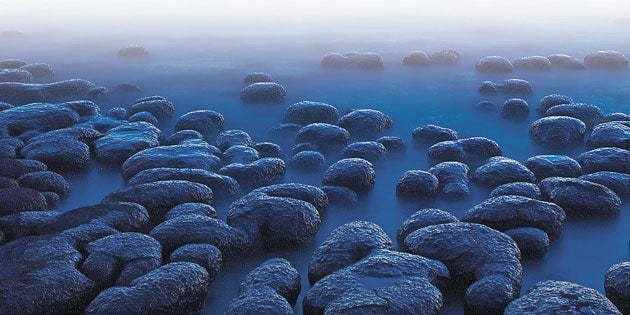
Without oxygen, life on Earth would have carried on, but it might never have developed beyond columns of sticky, microscopic bacteria called stromatolites. Humans could never have evolved, because oxygen is an energy-rich gas that sustains all forms of advanced animal life. Also, high up in the atmosphere, oxygen provides an essential protective blanket in the form of the ozone layer that protects land life from the sun's powerful ultraviolet rays.
About 2 billion years ago, thanks to another mutation, a single-celled bacterium began to feed off the oxygen-rich atmosphere. Oxygen's enormous energy-giving properties meant that this process – called respiration – could produce up to 10 times more energy than other processes. Soon the oceans were filled with highly energetic microscopic cells that fed off oxygen that was dissolved in the oceans.
So energetic were these microscopic cells that some found they could drill their way inside other larger cells and strike up a mutually beneficial bargain. While the smaller cells fed off the larger cells' waste products, the larger cells used up surplus energy created by the smaller cells' respiration. Through such a collaboration, called endosymbiosis, these new combined cells were now better equipped for survival in the increasingly oxygenated world.
By working together, these more complex cells ( eukaryotes) developed a range of special skills. Some parts, called mitochondria, turned food into energy. Others, called chloroplasts, became experts at getting rid of the cell's poisonous waste products. Still others turned into something like librarians. Their job was to store all the necessary information about how to construct an identical cell from scratch.
We call these librarians genes: the word comes from the Greek genos, meaning birth. They live in a part of the cell called its nucleus and they are made from a compound called deoxyribonucleic acid, or DNA. What looks like altruistic teamwork now fell victim to a far more gruesome approach to life. Some of these highly energetic and complex cells found that by engulfing another living bacteria whole, they could gain access to a new, more abundant source of food. The world's first mouth was nothing more than a toothless, microscopic hole, yet it triggered a powerful predator/prey relationship among living things. Creatures now evolved rapidly in an arms race to protect themselves from being eaten or to equip themselves better for attack.
Some found that the best survival strategy was to link up into teams. Gangs of cells joined together to form the world's first multi-cellular creatures. Some of them became the forefathers of all animal life while others turned into the ancestors of today's plants and trees.
Already we have travelled more than 3 billion years since the Earth was first formed. If we think of the Earth's history in terms of a 24-hour clock, the first signs of life emerged at about 05:19, and the stage we have now reached has taken us to about 16:00, leaving just eight hours to go for all the rest of life to evolve. Although miraculous signs of life have already appeared in the form of complex microscopic bacteria, hundreds of millions of years have yet to pass before fish, animals, plants and trees make their first appearance.
They only ever made it thanks to another piece of extraordinary teamwork – one that prepared the planet for yet more dramatic changes to life on Earth.
The enigma of life: the view from the laboratory
One hot sunny afternoon in the autumn of 1951, Professor Harold Urey strolled into the lecture hall at the University of Chicago. The room was filled with students eager to hear this great scientist talk about his pet subject: the theory of the origins of life on earth.
For more than 150 years scientists had been struggling to come up with credible theories of how life began. The problem, as Urey knew, was that so far it had proved impossible to actually demonstrate how life could have started from a ragbag of primitive or "primeval" substances such as those found on the early, hostile Earth. As a result, no one could agree on the origins of life.
Urey dreamed of concocting a laboratory experiment that would simulate conditions on early Earth, and show how life was created out of a lifeless jumble of nothing. One of the students in the audience that day was utterly gripped by what Urey was saying. Stanley Miller had stopped off in Chicago on his way across the US. He was in the process of trying to decide on a research project that would complete his training as a scientist.
The more Urey spoke, the more excited the 21-year-old Miller became. At the end of the lecture he went up to the professor and – after a great deal of talking – persuaded Urey to work with him on a project to try to create life in a laboratory out of nothing more than a cocktail of chemical junk.
The two men set to work by designing an elaborate glass apparatus, in the middle of which was a large jar that would contain all the substances which they believed existed at the time of the early Earth – such as hydrogen, methane and ammonia. Steam was fed into the glass jar through a tube connected to a flask of boiling water. Inside the jar were two metal rods, or electrodes. A powerful electric current would surge through these to make sparks – re-creating smaller versions of the violent lightning strikes that were common on early Earth. The whole apparatus was designed to reproduce the Earth's early atmosphere, complete with thunder and lightning.
Miller started off the experiment by boiling the water in the flask. Steam climbed up through a tube connected to the large glass chamber where it mixed with the primeval gases. Next, he flicked the electric switch. Some 60,000 volts of electric current surged into the electrodes, beginning a constant stream of mini lightning strikes.
To his bitter disappointment nothing happened. A despondent Miller left the lab that night with nothing to show for his efforts.
But when Miller arrived the next morning he found that the water in the flask had turned pink, indicating that some kind of chemical reaction must have taken place. After running the experiment for a week the results he had hoped for were unmistakable: the clear water had turned a definite shade of red. The water now contained amino acids – the vital ingredients for life, used by all plants and animals (including you and me) to construct their living cells. Surely this was the demonstrable proof that Urey had so strongly believed in. Life, Urey and Miller concluded, began by chance on the hell that was the Earth some 3.7 billion years ago because the Goldilocks-like conditions for it to do so happened to be just right.
Yet for all the science and technology, and the brilliant academic minds that have tried to come up with an explanation, no one has actually solved the riddle of how those chemical building blocks re-created in the laboratory by Miller and Urey turned into living cells, the stuff of you and me.
Join our commenting forum
Join thought-provoking conversations, follow other Independent readers and see their replies
Comments