Brian Viner: The name game: from Gerulaitis to Bilyaletdinov via Goolagong
The Last Word
Sign up for the View from Westminster email for expert analysis straight to your inbox
Get our free View from Westminster email
Britain's Davis Cup team play this weekend at the Vitas Gerulaitis Memorial Tennis Centre in the Lithuanian capital of Vilnius, hence my colleague Paul Newman's fascinating feature in these pages earlier this week, about the short life and fast times of the late Vitas Gerulaitis.
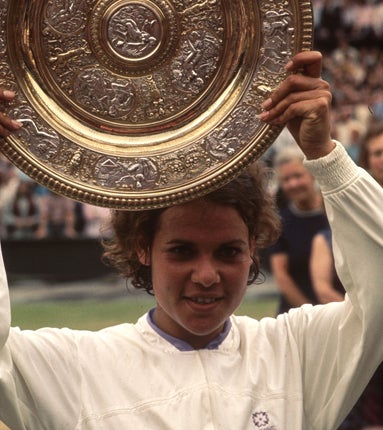
But Paul's piece also got me thinking about sporting names. I was 12 years old when I first heard of Gerulaitis, and it was about the strangest name I'd ever come across, although Evonne Goolagong ran it close. I can remember grown-ups saying that Vitas Gerulaitis sounded like a disease, and then roaring with laughter. I can also recall my disappointment when exotic Miss Goolagong became prosaic Mrs Cawley, partly because it reduced the admittedly slim chance that she might one day marry me, but mostly because I mourned the loss of her glorious name.
As they say, the past is a foreign country. Thirty years ago, hardly a Wimbledon fortnight went by without one umpire or another grappling with the name Navratilova almost as though it were that Welsh railway station which starts Llanfairpwll and ends gogogoch. It seems ridiculous now that anyone could repeatedly struggle to articulate "Navratilova", yet they did, while around the same time, the name Severiano Ballesteros used to throw commentators into paroxysms of what Ronnie Barker, also about the same time, called pispronunciation. That too seems bizarre, now that Ballesteros, like Navratilova, is a household name in Bagshot no less than Barcelona or Baltimore. That we are no longer either taxed or tickled by foreign names represents, I suppose, a great leap forward. Evidence of the global village and all that. After all, football supporters don't need to follow the top clubs to see men with complicated names in their favourite colours; Latvians and Lithuanians play in the lower divisions too, along with Nigerians, Liberians, Peruvians and Bolivians. True, there's still the odd tongue-twister. Diniyar Bilyaletdinov of Everton is a tricky one, just as for some folk it's as hard to say Muttiah Muralitharan as it is for some batsmen to read his doosra, and we all fall gratefully on the shortened Murali.
But on the whole the rules of the name game have changed in Britain.
To an extent, this is because ours has become a much more multi- ethnic society over the last 30 years: Anne Keothavong's parents might come from war-torn Laos, but she comes from Hackney, while Ugo Monye, the son of Nigerian parents, grew up in neighbouring Islington. Also, greatly increased media coverage of sport has made foreign stars with exotic names, the likes of Svetlana Kuznetsova and Makhaya Ntini, about as familiar to us as plain Alastair Cook and Joe Cole. Moreover, we know now what we didn't know when we were sniggering at Vitas Gerulaitis for sounding like a disease, that it is inappropriate for anyone in a civilised world to laugh at a name simply because, as the Countdown contestant Clarke Carlisle might say, it contains a curious configuration of vowels and consonants.
In this day and age, there is only one group of people whose names we can justifiably still laugh at, and that is American golfers. Long live Duffy Waldorf, Fred Funk and Howard Twitty.
Kinnock puts his foot in it over Plymouth
Lord Kinnock popped up on Radio 4 on Wednesday to make an eloquently moving tribute to Michael Foot. He pointed out that the great man had been a passionate supporter of "Plymouth Argyle and other lost causes" and it occurred to me that, however affectionately he meant it, Kinnock probably would have thought better of such a jibe had he still been in the House of Commons. After all, there's a general election fast approaching, and the constituency of Plymouth Sutton, currently held by Labour with a 4,109 majority, but won in the past by Conservative luminaries such as Nancy Astor and Alan Clark, could swing either way. Nobody who needed their votes would tell the good constituents of Plymouth Sutton, even in jest, that Argyle are a lost cause.
Turf's peculiar breed still truly a race apart
On Thursday afternoon, under a virtually cloudless blue sky, I spent a couple of hours at Ludlow races, reflecting – even after my fancy in the 4.30 showed that he was a 20-1 shot for good reason – that there was hardly anywhere else on earth I would rather be. I spent my childhood being taken to race meetings by my dad, sometime bookie and inveterate gambler, and although I rarely go racing any more, that mingled scent of hot dogs and horse flesh does for me what the madeleines did for Proust.
Another reliable source of delight on these infrequent visits is the racecourse look, one that you simply never see anywhere else. Those men in their late fifties with the profusion of nostril hair, the broken veins in their cheeks, the battered trilbies, the well-worn brogues... where on earth do they go between race meetings? I never see them on trains or planes, in shops or parks, at football matches or even rugby internationals. My guess is that they rise from the ground, like the skeleton warriors in the 1963 version of Jason and the Argonauts, then sink back down again as soon as the last shredded betting slip hits the turf.
Join our commenting forum
Join thought-provoking conversations, follow other Independent readers and see their replies