John Rentoul: Cameron wrongfoots his head boy
Another year of politics ends and the PM takes the side-stepping and bullishness prizes, while Nick Clegg smarts

Nothing much happened this year in politics, except at the end. The graph of opinion-poll standings was flat for the whole year, with Labour usually three to five points ahead, until eight days ago, when the Conservatives drew level. That is not a blip, but nor is it yet one of those big moments when public opinion shifts from one alignment to another.
We had a referendum – the symbolic object of desire for many members of the largest party in Parliament – but it was on a subject in which hardly anyone is interested, the Alternative Vote. If you asked people, even political activists, what happened this year, most would fail to mention it. I am one of the very few who enthusiastically prefer allowing voters to number their ballot papers in order of preference to either the existing system or to any proportional system, and I had forgotten it.
The other thing that didn't happen this year was the economic recovery. That felt like something that ought to make a big difference to politics. In the eight months between the Budget in March and the Autumn Statement in November, the failure of the economy to grow cost George Osborne £100bn of public money in the plans for the next five years. That makes the 1970 election, which Harold Wilson thought he lost because an order for two jumbo jets distorted the trade figures, look like a Toytown contest. Osborne has just mislaid 439 jumbo jets and the Tory poll rating did not flicker.
The Ed Balls argument that trying to balance the books has choked off the recovery has failed to convince. Even if it may be partly true, the voters do not accept the idea that more borrowing in the short term means more growth and therefore less borrowing in the long run. That view is not affected by numbers, not even numbers as large as 439 jumbo jets.
What has happened this year is, on the surface then, very little. Underneath, some big changes are taking place. The least important is that the Labour Party is entering, rather early on, another period of introspection and plotting about its leader. If the opinion polls get worse for Labour, a change of leader seems likely. Against the background of a long cycle of change in the political economy associated with the European crisis, the political cycle seems to be speeding up. Tony Blair's rise was once regarded as indecently fast, and he was an MP for 11 years before becoming leader, and 14 before becoming Prime Minister. David Cameron became leader in less than five years and Prime Minister in nine. Nick Clegg became leader in less than three years and Deputy Prime Minister in five. In the case of both, and of Barack Obama, who had been a US Senator for barely two years when he declared for the presidency, people said it was "too early".
I had thought that Labour might go for Yvette Cooper as leader before 2015. But she has been an MP for 14 years already; if recent leaders are a guide, she has missed her moment. Although little seems to be happening in the Labour Party, the lesson of recent history is that leaders can emerge as if from nowhere, and as soon as someone says it is "too early" for one of the 2010 intake to be leader, we will find that they already are.
The one big political event of the year, however, was Cameron's veto of the euro fiscal compact on 9 December. It may have only a small effect on the opinion polls – certainly Labour won last week's Feltham and Heston by-election well, even if a nine-point swing was not the sort of mid-term result that suggests a government in serious trouble.
But the veto has done two things. It has made Cameron look strong and it has insulated him politically – if not economically – from the long implosion of the euro. Yes, I know that it was not a "veto" in the sense that it did not stop the others going ahead. I know that isolation in Europe has its costs and that winding up Anglo-French hostility is not sensible. But if the single currency is never going to work, which I think is the most important conclusion to draw from the past year, then out is a better position than half in.
Whatever the whingeing from pro-European diplomats about alliances that could have been worked on before the summit, a fudge would have been a fudge. If the fiscal compact is ever sealed, our exclusion from it, probably with Sweden, Denmark, the Czech Republic and Hungary, merely follows the logic of our decision not to adopt the single currency when it started.
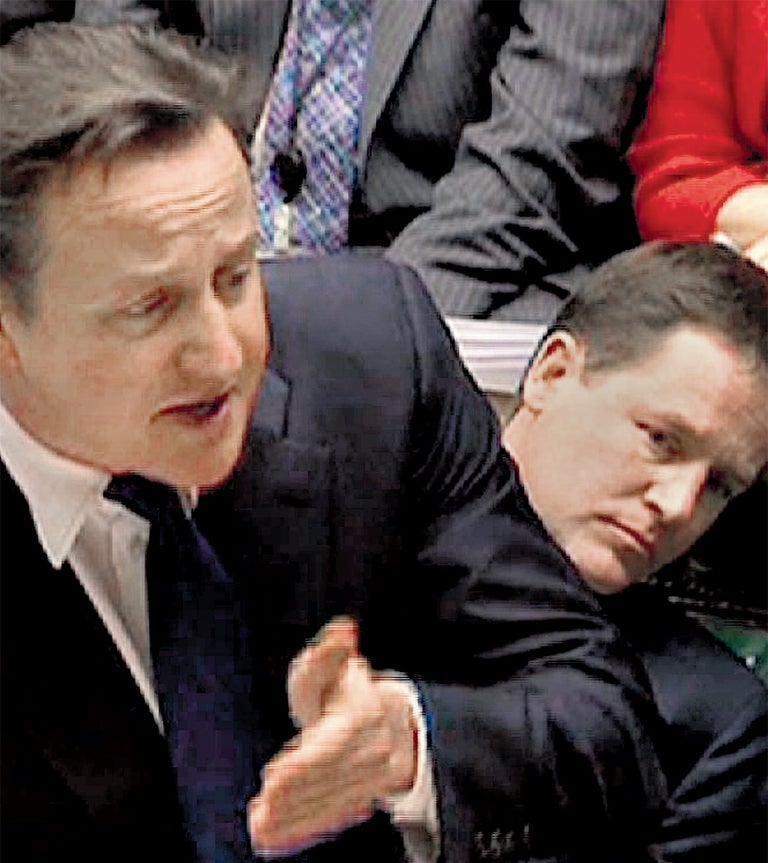
Finally, the veto was another disaster for the Liberal Democrats. Nick Clegg has now led his party into the destruction of its core beliefs on tuition fees, electoral reform and Europe. When the Government is also shooting badgers, is there anything left of which its activists can be proud? Jeremy Browne, the Liberal Democrat Foreign Office minister and MP for a south-western and therefore Eurosceptical seat, observed with blistering understatement last week: "It would be a mistake for the Lib Dems to come to be known in the public minds as the party that in 2011 was the party that was in favour of AV and EU." A bit late now.
The other conclusion to draw from this year is that the voters remain deeply alienated from politics. The 29 per cent turnout in Feltham and Heston confirmed that. On issues such as Europe and immigration, most voters think that politicians fail to understand their concerns, with Labour if anything more out of touch than the Tories.
Cameron failed to overcome that hostile apathy in the election last year, but his No to Europe is a simple enough message to cut through. The voters think the EU is a distant conspiracy by the elite against them, and Cameron's veto, while it may have little practical effect, puts the Prime Minister on the right side of that perceived divide.
That is a big challenge for the Opposition. Is there anyone in the Labour Party who can rise to it?
Join our commenting forum
Join thought-provoking conversations, follow other Independent readers and see their replies
Comments