London greets 5,000 athletes with one ambition: to win gold
The Paralympics are coming home to the country where they were conceived after the war – and Tom Peck can’t wait
There is no Acropolis on the B4443 just south of Aylesbury. None of the fire-extracting High Priestesses in white linen garb who graced our screens as the Olympic flame began its journey, what feels like a lifetime ago, to the London Games. Yet it was there, in wartime Stoke Mandeville, that the first creaking wheel turned on a juggernaut that will on Wednesday come rolling into London. Greece might be the birthplace of the Olympics but with these British Games the Paralympics, emphatically, are coming home.
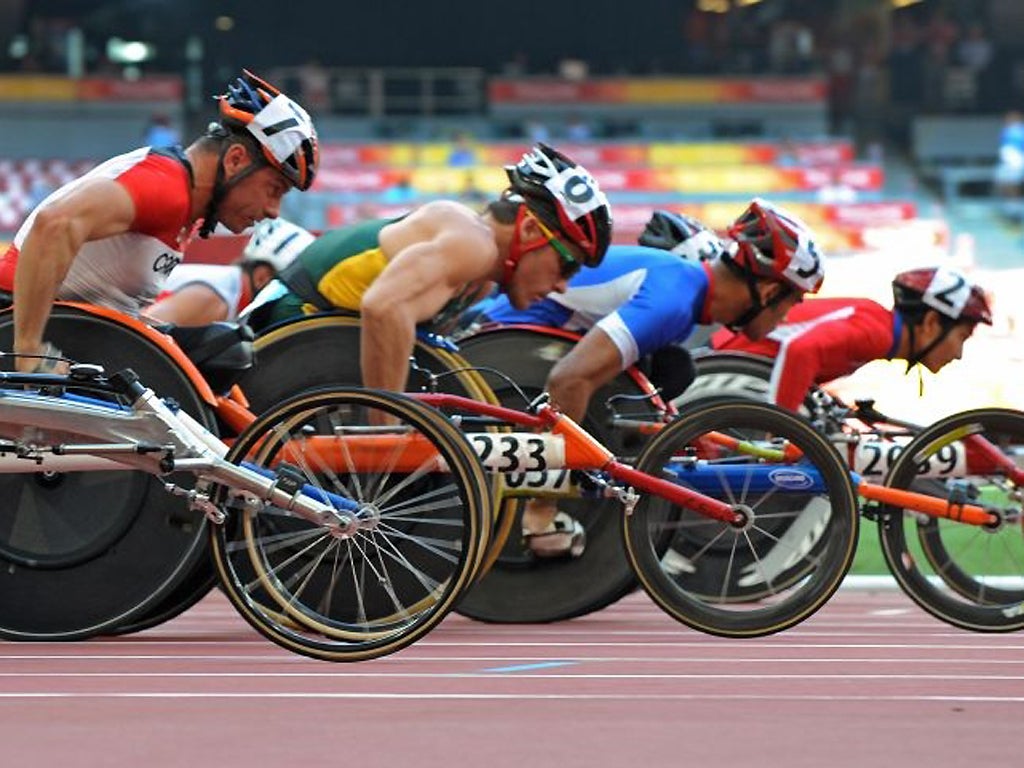
All week athletes have been arriving in the East End, nearly 5,000 of them from 165 different countries. Four feet tall, seven feet tall, on wheels, on crutches, on one leg, two legs, six legs even, if you count the guide dog too. With so many extraordinary stories, it is a bewildering task to even begin telling them. A South African swimmer whose right foot was bitten off by a shark he had deliberately taunted to get it away from his little brother. A Rwandan volleyball team whose players lost their limbs fighting on opposite sides of the civil war.
The suffering could seem almost endless, if you were minded to look at it that way. But London’s Paralympians are not here to worry about adversity, only about triumph, in an utterly compelling spectacle of sport.
Great Britain’s Jonnie Peacock and the USA’s Jerome Singleton both ran the 100 metres in under 11 seconds earlier this year, each on one functioning leg and one carbon fibre blade. There will be only one gold medal to give out, amidst that deafening roar in the Olympic Stadium, and whoever doesn’t get it will be heartbroken.
In the basketball arena, the wheelchair rugby players will jink and weave around each other with the dexterity of a scrum-half breaking down the blind side, and then crash into one another with the fury of an NFL linebacker, sending each other flying from their chairs and slumped onto the floor.
Welders are positioned next to the pitch, to deal with structural damage to the chairs. In the words of Team GB player Ross Morrison: “I train six times a week. I’m not here for a pat on the back.”
He is one of hundreds of British medal hopefuls who are full-time elite athletes, with meticulous diets, gruelling schedules and lottery funding. There is camaraderie, but there is the most intense rivalry too. Britain’s most famous paralympian, Dame Tanni-Grey Thompson, has often admitted she would refuse to talk to the other athletes at competition time. “I’m there to win races, not to be friends with people.”
She also chose her honeymoon location in Switzerland because it was close to a good training camp. She carried on training almost throughout her pregnancy, as she was so fascinated by new medical research that suggests the hormones released in pregnancy can boost athletic performance. “The biggest problem is not getting too warm because it kind of boils the baby,” she said at the time.
The Games have travelled a long way from their beginnings at Stoke Mandeville Hospital’s spinal injuries unit, but entirely in the direction their founder, Dr Ludwig Guttman, would have wanted. When the German Jewish neurologist arrived at the Buckinghamshire hospital in 1944, he found an 80 per cent mortality rate and a two year life expectancy.
The doctor, a stubborn man who had fled from the Nazis years earlier, was determined the wounded patients didn’t need sedating and comforting, and weren’t beyond happiness or usefulness, as was the conventional wisdom at the time. Instead they played wheelchair hockey and basketball, archery and javelin, rediscovering the use of their bodies and their self esteem.
When the London Olympics began, on 28 July 1948, so did the Stoke Mandeville Games, in parallel, in the gardens of his hospital.
Today’s Paralympians on not short on self esteem. Their event is likely to sell out all of its 2.5 million tickets, across 21 different sports. They will compete using wheelchairs and prosthetic limbs that cost tens of thousands of pounds, and benefit from the most advanced engineering on the planet. But the role of the Games in transforming attitudes to disability remains fundamental.
South Africa’s Oscar Pistorius, who made history earlier this summer by running on his carbon fibre blades against able bodied athletes at the Olympics, admits there is more to it than sport.
“I believe I’ve got a responsibility to educate people about disabilities,” he said earlier this year. “We’ve got more amputees than ever before in the world. I happen to be able to run really quickly, and if I can use that as a platform to promote Paralympic sport and those living with disabilities, then that’s something that’s worth doing.”
London’s Paralympic organisers have also long hoped the Games will transform attitudes towards disability among the general public, who might not always be dealing with disability in their day to day lives. The Olympics proved beyond doubt that we love almost nothing more than winning at sport and, barring a disaster, there is a veritable truckload of gold to come.
Great Britain won 42 gold medals in Beijing, in eleven different sports. We finished second in the medal table, far above the USA, Russia and Australia. Only the Chinese were ahead.
Anything less than that this time will be something of a disaster. At its upper limit, the medal target is more than 150.
Not all of those who win them will become household names, but some are already on that road. Ellie Simmonds, Jonnie Peacock and Jon-Allan Butterworth are people you’ll be reading more about in the days to come. And just as Simmonds came out of nowhere to win two golds in the Beijing pool as a prodigiously talented 13-year-old, there will soon be new names, faces we don’t yet recognise, on the front as well as back pages of our newspapers.
Not long to wait now. Brand new big screens are about to be switched on in Trafalgar Square. Hundreds of thousands more people will get their first look inside the Olympic Park, many for as little as £5. All too soon we will be watching a second closing ceremony, two weeks tomorrow, which will mark the end of this much-hyped summer like no other. But before that, we have medals, anthems, tears and cheers to look forward to. Let the Games begin again.
Join our commenting forum
Join thought-provoking conversations, follow other Independent readers and see their replies
Comments