Raise your game by going to the Continent
Why don’t more cash-strapped graduates choose to study in Europe?
Studying abroad is a popular choice for undergraduates who, through international exchanges, are experiencing the benefits of living in another country in increasing numbers. Yet the number of British students choosing postgraduate study abroad remains relatively small. According to the Higher Education Careers Service Unit, only 4 to 5 per cent of UK graduates who go on to do further study choose do to so abroad.
The launch of the European Higher Education Area (EHEA) in March may go some way towards changing this. The creation of the EHEA was the overarching aim of the Bologna process, a Council of Europe initiative to increase the mobility of students, graduates and staff within its 47 member countries. It is hoped the introduction of a standardised three-part degree structure (Bachelor, Masters and Doctorate) across the Continent will make movement across borders easier. With tuition fees in mainland Europe a fraction of those in the UK, it could become an increasingly attractive option for cash-strapped graduates.
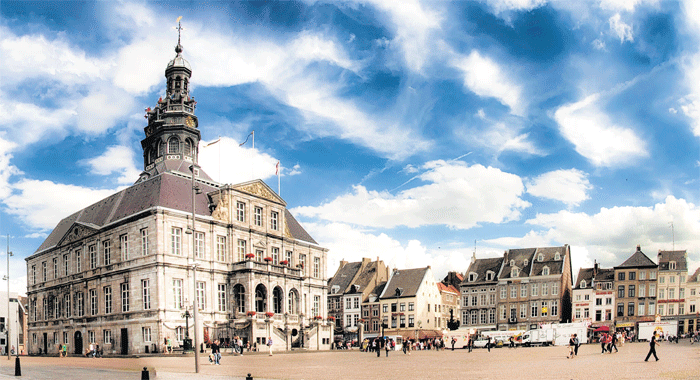
Simon Burns, 21, is a British student who has already made the leap across the Channel. After studying politics at Liverpool, he decided to take a Masters in EU politics and administration at Maastricht University in the Netherlands, which he started last September.
“Studying here is not that different from studying in England,” he says. “In the first few months, when everything was new and a bit difficult, being in class was a safe haven because it was a familiar environment. But the teaching style here is a little different, because it relies more on problem-based learning, which encourages independent study.”
The course, like most Masters degrees aimed at international students on the Continent, is taught in English. “It’s really international,” says Burns. “I can’t think of a European nationality that isn’t represented on my course. But the common language is English, so I don’t have any problems with communication.”
In common with many students who choose to study abroad, the idea of learning a language was a motivating factor. However, Burns has found the widespread knowledge of English in Maastricht, within the university and outside it, has hindered his attempt to learn Dutch. “I intended to learn some Dutch, but it didn’t really work out,” he admits. “The Dutch are so proud of speaking really good English that I’ve given up.”
The potential difficulty in learning a new language when the default language is English should be taken into account when weighing up the pros and cons of studying abroad. Saiyada Smith, a careers adviser at the University of London, says: “You need to ask yourself: ‘What do you think you will get out of studying in Europe that you won’t get studying in the UK?’
“We have had mixed feedback from students. Some have come back feeling very positive, and have enjoyed the challenge of living in another country. But it can be hard to adapt to new surroundings, and, although mainland Europe is only a few hours away, there can be big differences in culture.”
Smith notes that postgraduates who return to the UK after studying abroad can face additional problems. “Some return and experience reverse culture shock – they find their friends and family support network has changed while they’ve been away,” she says. “And some have struggled to find jobs when they return to the UK, as they feel out of step with the UK job market. So if you do decide to go away, it’s important to look at ways of maintaining your contacts.”
But for students intending to pursue international careers, or careers within a firm or institution with international ties, having done a postgraduate degree abroad can be an advantage.
“The feedback we get from employers is positive if the skills you have gained are relevant,” says Smith. “If an employer needs people who understand a particular culture or language, having studied abroad can really be seen as a bonus, a way of selling yourself.
“You should selectively target employers, and ensure that your cover letter and CV show the skills you’ve gained from the experience.”
Burns believes the experience of living and studying in an international environment will help his future career prospects. “At the end of the course, pretty much everyone migrates to Brussels,” he says. “I’m hoping to get an internship there when my course finishes this summer, and I think this will have been good training for it. Studying abroad, away from your family and friends, takes away your mental safety net. It forces you to become more independent.”
Having added up the possible advantages and disadvantages, what do you do if you decide a postgraduate degree in mainland Europe is a good idea? Research, says Smith. The Times’ Higher Education World University Rankings is a useful comparison tool, as the standard of European institutions varies widely.
Several resources provide country-specific information, with details of courses and available funding. FunderFinder ( funderfinder.org.uk ), a database of funding opportunities, is worth checking out. Useful websites for prospective postgraduates include prospects.ac.uk , eurograduate.com and ibe.unesco.org , while contacting the admissions offices of individual institutions is also a good way to find information about scholarships, funds and grants.
But before you start hunting for your passport, Howard Green, from consultancy Postgraduate Directions, has a word of warning. “With an academic Masters, as with a PhD, you want to go where the best research is. Unless the subject you want to study is particularly well covered by the institution – for example, nuclear engineering in Grenoble – you wouldn’t want to study in mainland Europe. The reputation and quality of UK institutions is much higher, and we don’t bang that drum hard enough.”
For Burns, however, the decision to study in Europe was the right one. “I would definitely recommend it,” he says. “It was hard at first, but it has been a good experience overall.”
Join our commenting forum
Join thought-provoking conversations, follow other Independent readers and see their replies
Comments
Bookmark popover
Removed from bookmarks