Masai Mara: A tribal quest
Under the protection of the Masai, Matt Carroll explores the Mara wilderness on foot
"Come quickly: there's a lion outside!" are not words you want to hear when you're about to tuck into a freshly cooked steak. Only a moment before, I was engrossed in conversation with my host, Steve; now, as we leave the candle-lit cosiness of the tented dining room and tiptoe out into the inky black night, I can see my life flashing before me. Even Steve is nervous – and he's lived in Kenya all his life. "I've never seen them this close before," he whispers excitedly, like a schoolboy hiding from a bunch of grown-ups.
By contrast, William, the young man who announced the arrival of our new guest, is unflustered. As a Masai warrior, he's grown up around lions; he knows what to do. "If it charges at you, stand still," he says. "It will probably turn and run."
I'll just have to take his word for it. Especially when it becomes clear that we aren't dealing with one lion, but a whole pride: nine big cats in total. As I peer into the pitch-black bush, my torch illuminates 18 eyes glowing back at me like luminous buttons. It's suddenly clear why they call this place "Lion Camp".
I'd come to the Olare Orok conservancy, just outside the Masai Mara Game Reserve, in order to experience a different kind of safari. Instead of a lodge, I was staying in a tent; my guides were local Masai , who tracked animals on foot. This wasn't a typical camping experience. Each tent was the size of a hotel suite – complete with running water, flushing toilet and huge double bed. But it wasn't just the sleeping arrangements that were unusual. I was staying at one of three Porini (which means "wild" in Masai) Camps established by Jake Grieves-Cook, who has adopted a novel approach to land usage in the region.
Rather than buying land off the Masai and plonking as many private reserves on it as he could get away with – as often happens with commercial lodges – Jake leased the 8,000 hectares that form Olare Orok from the Masai and gave his guests exclusive access to pristine wilderness.
It means visitors don't have to join a queue of 15 4x4s all trying to get a glimpse of the same lion. It also means locals are guaranteed a long-term income and the environment is safeguarded from overdevelopment.
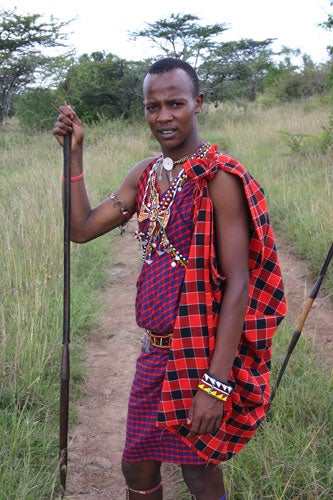
Within an hour of arriving I'd found myself heading out onto the plains, led by my guides James and Joseph. Despite their names, their style of dress was unmistakeably Masai: red plaid robes, complemented by the customary eremet – a double-ended spear-cum-walking stick that every warrior is given when young. They stopped to show me plants that I'd never have noticed had I been in a 4x4. "Put your nose up close and take a smell," said James, reaching forward to grab a flower from the acacia tree. I was greeted by a scent of rotting flesh that made me recoil in disgust.
"The smell is created by small ants which live in the tree," he said, laughing. "It prevents animals from eating the fruit that they live off."
I saw innocuous little holes in the ground, which I was told were in fact burrows dug by the poisonous trap-door spider; scuff-marks on the side of a dirt track were apparently made by aardvarks looking for ants. Even piles of dung had a story to tell.
"This one is from a giraffe; the reason why it is scattered over such a wide area is because it hits the ground from a great height," said Joseph, poking the little brown balls with his spear.
We crossed a muddy river the colour of tea, via a rickety rope bridge that looked like a prop from an Indiana Jones movie, as the landscape opened out before us as far as the eye could see. In the distance I spotted four giraffes lumbering across the horizon, surrounded by clusters of zebras and gazelle. It was hard to believe that these animals were free to come and go as they please.
James and Joseph gave me small insights into Masai culture along the way. At one point they sat me down under a giant strangler fig tree for an impromptu Masai naming ceremony ("we call you Olodo; it means tall") before showing me how they make fire using two sticks and dried elephant dung as fuel.
The great thing about the Porini Camps is that you can manage your own itinerary. If you want to spend all day in the bush with James and Joseph you can; if you'd prefer to laze about the camp with a good book, the wildlife will inevitably come to you.
I took a trip to Ilturisho, a nearby Masai village. The Masai way of life has remained relatively unchanged for thousands of years. Houses are built – by women – from a combination of mud, lime and animal dung, and remain remarkably cool despite the searing heat outside. After I'd been invited in, I groped my way along a pitch-black rabbit-warren of twists and turns that led to a central living area. This is where the meals are cooked, children nursed and stories swapped.
Everywhere you go after dark, you're escorted by local guides. Even the lions didn't faze William. He explained that they weren't interested in me; they were waiting for an old buffalo that had been coming here each night to graze.
"I am positive that they will make a kill here tonight," he said, escorting me back to my tent. After two hours, the buffalo had yet to arrive and the lions were forced into a waiting game. I lay in bed, trying to sleep, listening to them roaring into the night.
For information on Porini Camps, visit: (00 254 20 712 3129; www.porini.com). Porini Lion Camp Air Safari, from $1,190 (£680) per person for a two-night trip. Prices include Nairobi to Kiombo return flights, park and conservancy fees, day/night game drives in open 4x4s, sundowner, guided walks, and full board.
Alternatively, Fairmont Mara Safari Club (00 254 20 216940; www.fairmont.com) offers walking safaris with Masai warriors in full regalia, with the opportunity to see hippos, lions and spot over 70 species of birds, which thrive in the area. It is one of East Africa's newest luxury camps; each tent boasts a four-poster bed with a veranda overlooking a hippo and crocodile-filled river. Prices start at $213 (£122) per person, per night on a full board basis, including game drives.
Join our commenting forum
Join thought-provoking conversations, follow other Independent readers and see their replies
Comments
Bookmark popover
Removed from bookmarks