A tale of two cities: Biarritz and Bayonne
Only eight kilometres apart and proudly individual, the cities of Biarritz and Bayonne revel in their rivalry
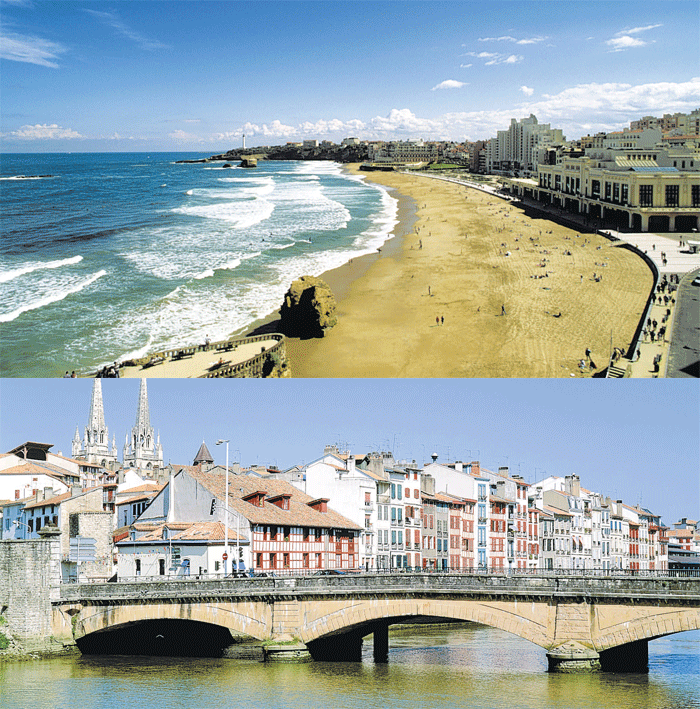
So close and yet a world apart. Biarritz, on the dramatic Atlantic coast of southern Aquitaine, is a former whaling village that became a gracious resort and more recently also morphed into a cool surfing centre. Bayonne, just 8km inland, is an intriguing little cathedral city of wobbly old timber-frame houses and extraordinary topography, set on the confluence of two rivers: the Adour and Nive. It takes under 15 minutes to drive from the centre of one town to the other – a remarkably short journey for a striking change in atmosphere and outlook.
The residents of these cities revel in their differences – and their rivalry. All of which adds to the appeal of a visit here. It’s rugby, they’ll tell you, that most neatly illustrates their contrasts. Any Bayonne resident will admit wistfully that their team is struggling, but will add with a big smile that it has a passionately strong following. Biarritz people, on the other hand, acknowledge with some sang froid that they are much less supportive of their players, although their team is far more successful.
What the locals do share is an enormous pride in being Basque. For you’re in the heart of France’s small Pays Basque here. Its rich heritage is reflected in restaurant menus; in the language, Euskara, that is fairly widely spoken; in the fast-moving games of pelota; and in the traditionally styled houses dotted around both towns. It was this time-honoured architecture that enchanted Victor Hugo when he visited Biarritz in 1843; then a cute little harbour village. Hugo remarked that Biarritz was bound to become fashionable soon. And it did, big time.
Napoleon III famously put Biarritz on the map when, in 1855, he built his wife Eugénie a summer residence on the seafront. Constructed in the shape of an E, the lavish palace remains an iconic landmark. It became a hotel in 1893 and, complete with marble-pillared lobby and chandeliers in the lifts, Hotel du Palais still exudes an imperial air.
The best way to survey the palace and the wonderfully low-rise town around it is to head for the 1834 lighthouse, unmanned but still in service, on Pointe St-Martin, which marks the northern extremity of town – for a €2 entrance fee you can climb the tower from 2pm every afternoon. Southwards, your view extends to Rocher de la Vierge, a dramatically craggy rock offshore, linked to the town by a footbridge and adorned with a statue of the Virgin Mary. Behind it is the colourful harbour of Port des Pêcheurs from where whaling boats once set sail. It is still used by local fishermen, their nets drying beside a couple of chic restaurants that have been established at this picturesque point. Adjacent is Port Vieux, a small sandy bay where the whales were brought ashore. Come rain, frost, or throngs of summer tourists, a local group meets here every day of the year to go swimming.
There are plenty of other beach options, from little Plage Marbella, a haunt of families, in the south, to Plage Miramar in the north. Best for people watching, though, are Grande Plage off the centre of town and Côte des Basques slightly further south. For these are where you’ll see most surfing action. It was back in 1957 that Biarritz became a surfing centre: Peter Viertel, Hollywood scriptwriter and husband of Deborah Kerr, arrived then to shoot a film and brought with him surf boards from Hawaii. With its big waves, Biarritz proved ideal for the sport – and an entirely new culture developed here.
But the town is now not only France’s capital of surfing: since the late 1970s, Biarritz has also become its foremost centre for thalassotherapy, with two large institutes each catering for up to 400 people a day and offering a range of seawater therapies.
All of which is, of course, a far cry – if a short drive – from pretty Bayonne. This fascinating old port city is the capital of the French Basque people. And it is the oldest bullfighting town in the country, with its arena north of the historic centre becoming action-packed every August and September. But there’s much more besides. Bayonne is charming and quirky in equal measure: you can, for example, stay on a barge-hotel on one side of the Adour river, and eat in a barge-restaurant on the other.
Bayonne is effectively three cities in one, each part divided by water. On the right bank of the river Adour is the Saint-Esprit district. Historically part of Gascony it is culturally very different from the rest of Bayonne. It was in this area that Jews escaping the Inquisition in Spain and Portugal were allowed to settle in the early 17th century. They brought with them cocoa beans and subsequently developed a thriving business of chocolate making, for which Bayonne is still renowned.
Opposite, on a peninsula formed by the Adour and Nive rivers, is Petit Bayonne, traditionally the Basque quarter. It has latterly become Bayonne’s cultural district, and offers two outstanding museums. Set in a wonderful old Basque house, Musée Basque offers an absorbing insight into local life and history, its beautiful displays ranging from Celtic looking tombstones to rural crafts and a large section on Basque sports. One street away is a little known art treasure: the Musée Bonnat. Housed in a striking |19th-century building, it contains the amazing collection of 19th-century painter Léon Bonnat, including works by El Greco, Delacroix, Gericault and Degas.
On the other side of the Nive river is Grand Bayonne, the ancient heart of the city, which is dominated by a gracious Gothic cathedral. It is set on hill above a warren of narrow, medieval streets lined with colourful little shops. Head to Port Neuf for an appealing combination of fabulous old properties – and enticing window displays of chocolate.
Join our commenting forum
Join thought-provoking conversations, follow other Independent readers and see their replies
Comments