A tale of two cities: In search of lost time
If you’re after history, La Rochelle has it all, but for enlightenment, think Poitiers, says Simon Calder
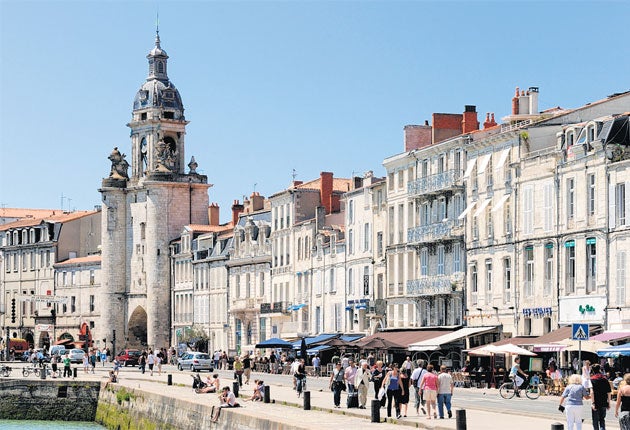
La Rochelle Rarely, in my experience, can you judge a city by its railway station and budget hotels. But in the case of La Rochelle, the maritime hub of Atlantic France, I am prepared to make an exception.
The TGV from Paris sighs to a halt in a transportational palace, with grand columns and inspirational murals that notify the new arrival that this is somewhere special – sense reinforced by the brace of two-star Ibis hotels in the city centre. The properties they occupy are way beyond the humdrum: one perched above a colonnade in the old town, and the other welcoming guest through the façade of St Nicolas’ church.
One of France’s most dynamic cities is embroidered with history and ambition. The grand designs reflect the enriching roles that La Rochelle has adopted over the centuries. It has missed few opportunities to prosper. For most of the city’s millennium-long existence, maritime transport provided the main lines of communication – and strong trading links were established with England and Flanders. Later, LaRochelle took up a role at the apex of the triangle of slavery, despatching ships to West Africa where a human cargo of despair would be loaded for shipment to the New World – bringing back sugar and spices to the port.
Many of the fine mansions in the old town were financed from the earnings from slavery. When migration became voluntary, La Rochelle acted as the main embarkation point for French settlers heading for eastern Canada and the American South. Poitou-Charentes is the motherland of the Acadian people, who still have thriving communities as far apart as the province of New Brunswick and the city of New Orleans.
The story of how farmers and fisherfolk were enticed to seek a brighter future on the other side of the Atlantic is explained in an exhibition inside the Chaine Tower – the middle brother of the three fraternal fortifications that guard the old port (and which are accessible on a single €8 ticket). The name of the Chaine derives from the chains that were hauled across the entrance to the harbour each night – secured to the big-brother tower that watches you from the far side. This is named after St Nicolas, and is the leaning tower of La Rochelle because of its unstable foundations; but the builders identified the pronounced tilt early on, and compensated for it on the higher floors – just as well, given the height from which you can look down upon a city smiling in the spring sunshine.
The third corner of the triangle is the Lanterne Tower, whose 170-foot tower you can climb for the best view of the patchwork of terracotta roofs in the old town. It served as a naval prison, and some of the historic graffiti survives – the work of men who, if they were lucky, faced only deportation.
As a hub for Protestantism, La Rochelle has endured its share of tragedy. The city was the target of Louis XIII’s Great Siege of 1627-28, aimed at sealing the supremacy of Catholicism. Three-quarters of the population perished before the city surrendered to Cardinal Richelieu.
The city endured a second siege of similar duration within living memory: La Rochelle was one of the most important German naval bases on the Atlantic coast. Because the city was outside the sweep of liberating forces, the Allies adopted a policy of containment – and even allowed supplies to be brought in for the civilian population. The surrender of the occupying German garrison came right at the end of the war. The U-boat bunkers, a study in the resilience of reinforced concrete, have survived over to the west of town.
The city’s set-piece attractions find their inspiration from the sea: France I is a floating maritime museum; the New World Museum is on rue Fleuriau; and the Aquarium celebrates its 10th birthday with a neat treat for children: any visitor born between 21 December last year and next New Year gets a present.
You can take a boat trip across the water on the bus de mer – which, in line with La Rochelle’s pioneering spirit, is powered by solar energy. Back in the old town, the Town Hall is an appropriately ambitious structure, all Gothic pomp and Imperial power, though currently and inconveniently embellished by refurbishment. Inevitably, you find yourself drawn back to the quayside – particularly as the afternoon sun beams down on the people who have wisely decided to seek refreshment at the waterside bars.
For a city that has made a speciality of despatching people by sea – and now, by rail and air – there are many reasons to stay in La Rochelle. And there are many characterful options, budget or otherwise, where you can do just that.
The Office de Tourisme (00 33 5 46 41 14 68; larochelletourisme.com) is on the waterside between the railway station and the city centre; it opens 9am-6pm daily (Sundays 10am-1pm).
Poitiers The map explains why the centuries have been kind to Poitiers. At first glance the city appears to straddle the main communications route between Paris and south-west France – indeed, it is only 90 grande-vitesse minutes from the capital. But when you look closer you see that the railway, as well as the old Route nationale 10 highway and the new A10 autoroute merely graze the western outskirts. When you arrive, you can understand why.
The core of Poitiers occupies an uneven triangle where the river Clain (a tributary of the Vienne, and, in turn, the Loire) throws a loop. And providing protection against everyone from foreign foes to bulldozer drivers, the city is perched on a plateau, as aloof to the 21st century as it has been to the previous half-dozen.
That’s not to say that there is any sense of decay. Indeed, the past is being nurtured for the future, which is why the visitor will find plenty of travaux in the Old Town, aimed at enhancing the pedestrian experience of the city. The work will continue into next year, but don’t fret: the great sights of the “city of 100 bells” are unscathed.
The best way to see the favours bestowed by geography is to leave the city, or at least its centre. Follow the Grande Rue down through the Old Town to the venerable bridge leading across the Clain. On the far side, a stairway elevates you to the Plateau des Dunes, from where the view is of spires rising from a subtle palette of honey-coloured stone. With your appetite stimulated, it’s time to make the most of the city.
Poitiers comprises spirituality in stone. At the church of Notre- Dame-la-Grande, look up at the west façade and allow your eye to roam in amazement. The zenith of the Poitou Romanesque style comprises a sculptural compendium of Old and New Testaments. From Adam and Eve (complete with serpent) to the towering Christ in Majesty, the 21st-century visitor can gaze upon the same stories as the 12th-century pilgrims who passed this way en route to Santiago de Compostela.
Poitiers is a key stop along the Chemin de St-Jacques, and pelerins will barely have put their boots back on when they reach the church of St-Hilaire – which I am assured is the only seven-aisle church in Europe. I haven’t checked them all, but I can confirm that St-Hilaire is an ecclesiastical Super Jumbo. It has the feel of an empty stadium, echoing with footsteps of pilgrims over the centuries.
If you have time or energy for only one more place of worship, don’t make it the cathedral of St- Pierre, because there is somewhere more spiritually singular.
The stones of many shapes (and many shades of honey) of the Baptistère St-Jean mark the oldest surviving Christian building in France. It has survived many threats. The Moors bypassed it when surging into France; they were defeated a few miles north of Poitiers. After the French Revolution, it was left to rot. By the 19th century, it was on the list for demolition until the Société des Antiquaires de l’Ouest saved the structure for the nation in 1834. The same society still cares for it.
Most of us prefer not to live by bread and Bibles alone. Fortunately, Poitiers is the hub of one of the most agriculturally productive parts of France. Breakfast where I stayed, Le Grand Hôtel, is a masterclass in locally sourced produce. You are informed where everything from the bread and butter (two kinds, one salted) to the apple juice and yoghurt are sourced.
Just a step away from the Hôtel de Ville, La Serrurerie at 28 rue des Grandes Ecoles is an excellent place to sample anything from a quick coffee to a three course feast of local ham, duck and cheese. And confounding the notion that provincial France can at times (e.g. Sunday evenings) seem drowsy, the bistro opens from 7am to 2am, seven days a week – with many of the customers being students from this centre of enlightenment.
Indeed, for a while Poitiers was part of a triumvirate of excellence along with Paris and Lyon. The city has reawakened (perhaps aroused by the synchronous chiming of those 100 bells) – and because the centuries have been kind to Poitiers, Poitiers will be kind to you.
The Office de Tourisme (00 33 5 49 41 21 24; ot-poitiers.fr) opens 10am-7pm (Sundays to 6pm) from 21 June to 21 September, and 10am- 6pm daily except Sunday for the rest of the year.
Simon Calder paid £101 for a one-way ticket on Eurostar (08705 186 186; eurostar.com) from London St Pancras via Paris to Poitiers. He paid €96 for a double room with breakfast at Le Grand Hôtel (00 33 5 49 60 90 60; grandhotelpoitiers.fr).
Join our commenting forum
Join thought-provoking conversations, follow other Independent readers and see their replies
Comments