Beguiling land of the Faroes
These tiny islands might be isolated, but they are easy to explore, says Tony Wheeler
How does it work? I've asked myself that question about quite a few places in recent years. How did those lucky Icelanders afford everything and why was the
Icelandic krona worth so much? Answer, they couldn't; it wasn't. Or Dubai: who buys all those town houses on artificial islands, probably destined to sink beneath the global warmed waves? Answer, well nobody who can afford them anymore.
I contemplate the Faroes as I drive through the two-mile-long tunnel to the village of Sumba at the southern end of the island of Suduroy. How, at a latitude of 62 North, about half way between Denmark and Iceland, do you pay for a two-mile road tunnel to save the 245 people in Sumba having to take the winding road over the mountains? For that matter how did the Faroe Islanders pay for any of their 14 tunnels? (There are 25 miles of them altogether.) Is it really possible to finance a mile of tunnel for every 2,000 islanders with nothing more than some super-fit mountain-climbing sheep and a bit of fishing?
Never mind, the tunnels (and some bridges as well) make getting around the 18 major islands a breeze, although I had to take a ferry south to Suduroy (a 12-mile-long tunnel is on the drawing boards). You could easily set up camp in the capital Torshavn and day-trip to anywhere else you care to visit. However, overnighting at one of the smaller settlements dotted around the islands gives you a feel for the remoteness of the place. Gjogv is a fine choice, a postcard-pretty village; its Gjaargardur Guest House/Youth Hostel is a delight. The restaurant and bar provide a cosmopolitan melting pot during the brief summer season, while the village shop sells a handy little walking map and local history guide to the headlands overlooking the village.
Just don't stroll too far out on that headland. Faroes walks tend to end at precipitous drops to rocky shorelines far, far below. Sample the stroll behind the village of Eidi; it climbs up to a headland looking down on the sea stacks known as Risin and Kellingin, aka the prince and the hag, or the giant and his troll. According to legend, this ill-intentioned pair had lassoed the Faroes and were trying to tow it away to Iceland, but they spent so much time squabbling they were turned into stone.
The weather can be short-sleeve sunny and then switch to howling gale in a flash. Usually several times a day. Bring your Gore-Tex, your sturdy walking shoes and in summer an airline eye mask if you plan to get any sleep at night, for this is midnight sun territory. Torshavn has everything from backpacker hostels to B&Bs and international hotels. Food runs the gamut as well, including one surprisingly glossy and adventurous outpost of designer cuisine, Glitnir. Foroya Bjor is the local brewery; try a Black Sheep or a Slupp, named after a local boat design.
Out of Torshavn the choices are limited, most of them only open during the brief summer season. There's a fine National Museum in Torshavn and the Faroes also have a surprisingly active arts scene, which can be viewed at the National Art Museum or at a handful of local galleries. Or turn up in July for the annual G! Festival, the Glastonbury of the Faroes, which in a good year attracts one fifth of the islands' population.
The island of Mykines is another good possibility for overnighting away from the capital. A regular ferry bounces across to the island from Sorvagur, off to the western end of the airport island Vagar. The 40-minute trip passes spectacular Tindholmur Island. It looks as if it started out as a fairly neat and green place with a slightly oval-shaped pointy peak – until someone came along with an axe and chopped it cleanly in half. It's quite surreal.
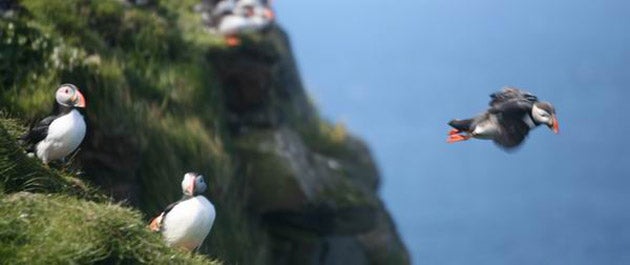
Mykines has a couple of fairly basic places to stay, one of them with a popular little café. From there a walking trail leads past a puffin colony to the smaller island of Mykinesholmur. Hovering just off the cliff edge, their wings whirring frenetically, puffins look like corpulent humming birds and they appear quite unconcerned if you settle down to watch their antics for a spell. A narrow footbridge crosses a deep gorge to the smaller island with its lighthouse and sea stacks populated by the Faroes' only gannet colony. That's as far west as you can get in the Faroes, next stop: Greenland.
Tony Wheeler is co-founder of Lonely Planet
Travel essentials: Faroe Islands
Getting there
The Smyril Line car ferry (00 298 345 900; smyril-line.com ) calls at Torshavn on its regular Denmark to Iceland run. Alternatively Atlantic Airways (00 298 341 000; atlantic.fo ) flies to the Faroes from Stansted during the summer and at Easter, and daily from Copenhagen.
Getting around
It's easy to explore with a hire car, or there are regular (though not exactly frequent) bus services to most villages. There are some excellent walking tracks, but despite the compact size, cycling isn't too much fun thanks to steep hills, fierce winds and claustrophobic tunnels.
Staying there
Gjaargardur Guest House (00 298 423 171; gjaargardur.fo ). B&B from Kr700 (£82).
More information
Visit Faroe Islands: 00 298 306 900; faroeislands.com
Join our commenting forum
Join thought-provoking conversations, follow other Independent readers and see their replies
Comments