Deià: Writers' retreat
Deià once seduced artists and writers including the poet Robert Graves. Frank Partridge finds it as charming as ever
Sign up to Simon Calder’s free travel email for expert advice and money-saving discounts
Get Simon Calder’s Travel email
In summer, it's impossible to park in Deià. Many of the hotels and restaurants are alarmingly expensive. The high street, being part of the coastal highway, is a traffic jam waiting to happen. There's no room for a tree-shaded plaça where you can drink wine and while away an afternoon, people-watching. Clinging to the dizzy slopes of Puig des Teix, it spends much of the day in shadow. The only beach is small and at the end of a precipitous walk. And the people who put it on every tourist map of the island are long gone.
Yet Deià is still pulling them in. Not exactly the same starry, bohemian crowd who came from England a generation ago to write, paint or hang out with its most luminous resident, Robert Graves, but a new wave of well-heeled settlers seeking an alternative lifestyle amid the safety of like-minded folk. At the last count, half of the village's 840 permanent inhabitants were British, basking in the knowledge that their investment in the Mediterranean's equivalent of Mayfair on the Monopoly board will provide them with a sure-fire nest egg.
Twenty years ago, Leonard Pearcey drifted into the village on a tour of Mallorca. It was dark when he arrived, and he felt fortunate to find a bed in this backwater, cut off from the rest of the island by the mountains. "The place was dead. The only illumination came from lightbulbs slung across the street." But the glorious prospect Pearcey unveiled when he opened the curtains the next morning, as the sun illuminated the sloping pine forests, the silver-grey peaks and the huddle of village houses, has remained with him ever since.
"I was awestruck," he recalls. "I casually asked the hotelier if there happened to be any local properties for sale. There was an instant reply. 'Yes. Two. You must come and look at them now.'" Leonard bought one of them on the spot and still lives there for about six months of every year. Which six months does he choose? "It changes from one year to the next. Mallorca has two springtimes – one in February and the other in May – and we've also spent New Year's Day on the beach under a warm sun."
Those of us who are merely passing through might find ourselves unwittingly sharing a café terrace with visiting celebrity – there was an enormous commotion in March when Andrew Lloyd Webber chose Deià for his 60th birthday celebrations, and Michael Douglas has bought property here – but the legacy of Robert Graves still defines the village. The celebrated poet and author of I, Claudius and Goodbye to All That lived one kilometre to the north of Deià for more than half of his 90 years. When he died in 1985, he was buried in the precincts of the parish church at the top of the hill, from where the coast and mountains can be seen at their majestic best.
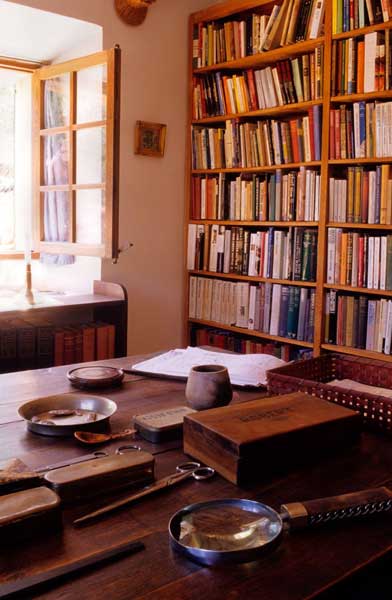
The church is now a highlight of Mallorca's heritage trail, along with Graves's house and garden, where his study is arranged pretty much as he left it, and a fine collection of books and letters is on display. Graves was prescient enough to realise that the surrounding land might one day attract the developers, so he bought an olive grove across the road and let it grow tall with wheat. This slice of land is more manicured now, but the view so cherished by the author remains undisturbed.
Graves swam with his family and friends at Cala de Deià, a shingle beach at the foot of a 300 metre drop. To get there, walkers take a dusty track through a wooded ravine; drivers follow a winding concrete road to a car park. It's a fascinating mix of old and new. At dawn, a handful of fishermen still go out to cast their nets, chugging past the luxury yachts that moor in the sheltered bay. At lunchtime, the smart set fill the tables at one of Mallorca's pricier fish restaurants. The other place to eat on the beach, with its kitchen built into a cave, is considerably plainer but does just fine for the rest of us. Deià might have priced itself out of our reach, but we can still enjoy the fantasy, for an afternoon at least.
Robert Graves's house, known as Ca n'Alluny, is just outside the village on the road to Sóller: 00 34 971 636 185; www.fundaciorobertgraves.com . Admission €5 (£4)
Subscribe to Independent Premium to bookmark this article
Want to bookmark your favourite articles and stories to read or reference later? Start your Independent Premium subscription today.
Join our commenting forum
Join thought-provoking conversations, follow other Independent readers and see their replies