Tirana: A city struggling to reach year zero
Albania was declared a capitalist state in 1992, but its leading city still has a lot of catching up to do if it's to make it on to the European tourist's map.
The receptionist is flustered. I have embarrassed him by asking what the must-do sights are. He's not sure if I am being facetious.
When he recovers his composure he offers the main square and the National Museum and then dries. This is Tirana after all – the capital of a country that managed to isolate itself by the end of the Cold War so thoroughly that it made Ceausescu's Romania look progressive. Tourism is still a novelty.
Tirana is probably the only European capital, accessible by direct flight from the UK, that is packaged in obscurity. I have no mental map and few preconceptions of what the city will be like. Tirana is there to be invented.
The slick new airport is named after Mother Teresa – Albania's most famous export and a Catholic treasure in a largely Muslim country. Religion is not the dividing line it is in other parts of the Balkans. You don't see burqas or hijabs on the city centre boulevards. "I am Muslim, but I eat pork, everything," says Bledi my cab driver. "I don't even have time for Ramadan. I have to work every day."
The dictator Enver Hoxha declared Albania officially godless in 1967. People have been free to worship as they please since 1990, but when asked, they often declare they are atheist Muslims, or atheist Christians.
Expats living here are quick to volunteer that Albania is no Bosnia or Kosovo. And insist Tirana is one of the safest cities in Europe. Which is not strictly true. Ask anyone who has tackled the anarchic traffic in Skenderbeg Square – the rambling L-shaped civic space at the heart of the city. Until 1991 only senior communist apparatchiks had access to motors; there were maybe 600 cars in the whole country. Now pedestrians play Albanian roulette with thousands of drivers, who are themselves negotiating an assault course of craters and potholes in the piazza. Crossing the road without injury is cause for celebration, but the next trick is to avoid being mown down by kids joyriding on hired quad bikes opposite the National Museum.
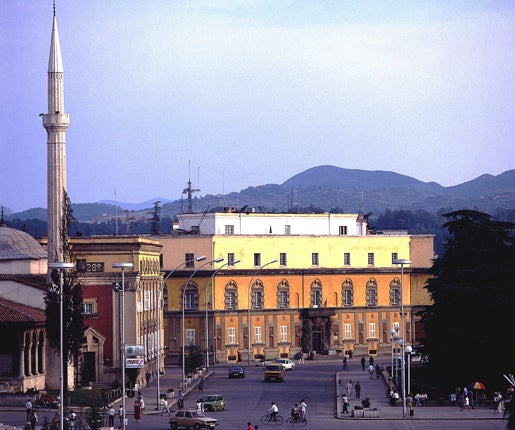
The square offers a crash course in history. The Et'hem Bey Mosque, described by one guide book as "perhaps the only real sight in Tirana", was completed in 1821 and is a testament to 500 years of Ottoman rule. The 1981 National History Museum, with its spectacular mosaic frontage depicting heroic Albanians through the ages, is in the grandiose style favoured by dictators of the Hoxha ilk. The government buildings at the opposite end of the square date from King Zog's time in the 1930s, and the boulevard leading off the square was created for ceremonial strutting by occupying Italian fascists during the Second World War.
Predictably, the centrepiece of the square is an equestrian statue of the national hero Skenderbeg who fought a war of independence against the Ottomans in the 15th century. Less predictably, facing him, just off the northern end of his square is a sign proclaiming the UFO University. There is surely a prosaic explanation for the acronym, but I prefer to picture the UFO Uni as a great academy of learned conspiracy geeks poring over ancient parchment copies of Erich von Däniken's Chariots of the Gods?.
In the Kompleksi Taiwan, a mini mall in Rinia Park, I meet American entrepreneur Mark Crawford who has been living in the city on and off since 1993. He can't explain why the mall is called Taiwan – it doesn't house a Chinese restaurant. Some questions are too Byzantine to unravel. But he speaks with enthusiasm about the changes he has seen. In recent years the Rinia Park itself has emerged from under a shabby hotchpotch of illegal bars and cafés to become a pleasant patch of green; the clean-up is credited to the former art lecturer and go-getting mayor of the city, Edi Rama.
Crawford worked for USAid in the mid-Nineties and remembers more tumultuous times when, as he puts it, "capitalism and anarchy got mixed up". He is referring to pyramid investment schemes that spread across the country before collapsing, leaving many destitute. Mobs raided military depots and went on the rampage. "People were driving around in tanks," he remembers. Mark was evacuated twice.
Times have changed. Albania joined Nato last year and Crawford, measuring his words carefully, says the country is now "the most dynamic of the Balkan states". Tirana is certainly full of entrepreneurs – not all of whom are sticklers for rules or, indeed, the law. It's all up for grabs. Offices, hotels, restaurants and malls are shooting up, many of them defying economic gravity. There are dark Balkan whisperings of corruption and money laundering.
There is a cheerful disregard for what is known in other parts of the world as "intellectual property". Jealously protected brands are hijacked. On Mother Teresa Square (there she is again) the logo of a hamburger outlet called Kolonat bears more than a passing likeness to the golden arches of another somewhat better known burger chain. Later in the Carlsberg restaurant I ask the waiter if the place has any formal link with the Danish beer company. He considers the question for a nanosecond and shoots back, "They should give us some money, because we give them publicity."
Similar logic presumably applies to the recently opened Vogue Bar, the latest flashy addition to the humming scene of the Block – an appropriately named part of the city centre. The Block was strictly off limits in Hoxha's time, an enclave in which he and his cronies could kick back and enjoy the communist high life in luxury villas while the country went to hell on a donkey. They used to live here, but now their heirs come to party. The Vogue building itself has a telling trajectory over the past 20 years. It was the villa of a politburo member, then the headquarters of the UN's development programme. Now it's matured into a cocktail bar and playground for the city's upwardly mobile capitalists.
There is no going back. There are almost no traces of the reviled dictator in Tirana – Hoxha's vainglorious statue in Skenderbeg Square was toppled, Saddam Hussein style, in 1991. The Pyramid (a museum glorifying him) is being refurbished as a theatre and, in a posthumous act of revenge, even his remains were turfed out of his mausoleum in the Martyrs' Cemetery.
Rubens Shima, the director of the National Gallery, shows me a painting called In the Studio that depicts the dictator and points out where it was vandalised by an angry visitor. Last year Shima turned over three of his gallery spaces to exhibiting Socialist Realism art, spanning Hoxha's time in power, from a cache of 5,000 works mouldering in storage. He expected a reaction. What surprised him was that some of the strongest opposition came from the artists who did not want their names associated with the period.
He points out a striking work from 1971 by Edison Gjergo. The painting The Epic of the Morning Stars has a dreamy quality and clearly owes a debt to Chagall. Though it features soldiers and peasants, its focal point is a beautiful woman holding a rose. It was created in a brief period in the early Seventies when the state relaxed its grip on artistic expression. That interregnum didn't last long. The work was denounced as having "a pessimistic outlook" and Gjergo was arrested in 1974. He died in prison.
We move on to the 1990s and the post-communist room where the subjects and style become more varied. The work, though, is clearly derivative, referencing Matisse, Brancusi, Motherwell almost to the point of plagiarism. "It's interesting, isn't it?" says Shima, "We get freedom and what do we do? We go back to where we left off – 50 years earlier."
On the way to the airport the sun is out and Tirana is trying to look pretty. Bledi points to a petrol station and says he would never fill up there. "The owners pay the inspectors off and then they put things in the diesel to make it go further." He riffs on about corruption and then maybe he feels he is being unfair to his country, "It will get better, I am sure. Maybe in 10 to 15 years. We start from zero." He pauses and adds, "No, no. Minus zero."
Compact Facts
How to get there
BA (0844 493 0787; ba.com) offers return flights from London Gatwick to Tirana from £204 per person based on departures in April. A double room at the Sheraton Tirana (00800 325 35353; sheraton.com/tirana) costs from £167 per night.
Join our commenting forum
Join thought-provoking conversations, follow other Independent readers and see their replies
Comments