Trail of the unexpected: Saint Nicholas in Puglia
A Turkish bishop adopted by an Italian port is an inspiration for shoppers.
Long, straight and skinny, like sticks of spaghetti, the streets of Bari should have been easy enough to navigate. But the sun had started to set behind a row of pink neo-classical houses, throwing a wintry shadow over my half of the road. And as the street-side Christmas lights twinkled into life, I realised I was lost.
According to locals, there was a very practical reason for designing this part of the city without bends. Throughout history, most of Bari's enemies have come from across the Adriatic, which wraps around Puglia, the heel of Italy's boot. So when defending against attack, being able to see the sea from your house offered a distinct advantage. You can still catch glimpses of the water from the far end of some downtown streets, but in the late 19th century, city planners started worrying more about art than war, plonking theatres and opera houses in the gaps left by their forefathers.
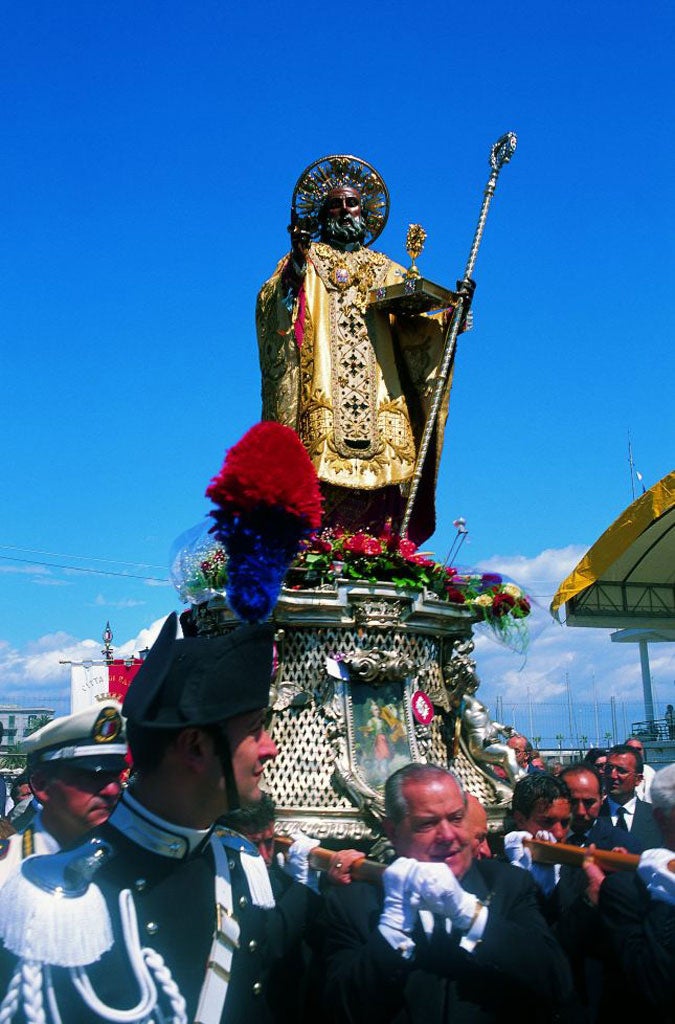
Enemies came and went, but the ocean brought heroes to Bari, too. Most celebrated are the 62 local sailors who returned with the relics of St Nicholas – the miracle worker who would eventually provide the inspiration for Santa Claus – which they'd plundered from his birthplace across the sea in Myra, part of modern-day Turkey.
Legend says the bones landed at a small bay 10km south of Bari in 1087, and were dragged by a pair of oxen towards the centre of the city. When the animals stopped outside a church, the people of Bari saw it as a sign and began transforming the building into a monumental basilica to house the bones.
I'd stood outside that vast Romanesque building – the Basilica San Nicola – earlier in the day, running my eyes along a sunlit white edifice flanked by two castle-like turrets. Carved carefully into the thick, stone walls were the names of those 62 sailors. Either side of the grand, arched entrance stood a stocky ox, chiselled out of limestone, holding the weight of a pillar on its back.
"Usually this is where churches use lions to symbolise the strength of faith," explained my guide, Anna. "But because of the story of St Nicholas, they decided to use oxen instead." Fearful of evoking any devilish imagery, the medieval sculptors deliberately left off the horns.
As we stepped inside, hoping for a glimpse of the ancient frescos and baroque ceiling paintings high above the pulpit, we heard a couple exchanging their marriage vows. Not dressed for the occasion (nor, indeed, invited), we descended straight down towards the cool, dark crypt, where the relics of St Nicholas are housed to this day.
It's a solemn, spiritual place, cloaked in wafts of rose-scented incense, and often filled with the rhythmic chants of the faithful. Like many here, they believe the old stories about St Nicholas dropping bags of gold down chimneys, saving girls from prostitution, and bringing children back from the dead.
Maybe they are just stories, but there are some genuine mysteries, such as why his bones continue to exude manna – a clear, fragrant liquid – more than 1,600 years after his death. Like most things these days, this liquid is for sale, and miracles have been reported by some of those who have left here with a bottle of it.
"Over the centuries, the miracles associated with St Nicholas have merged with others of people doing good things, especially giving gifts," said Anna, before leaving me to explore. "And that's where the idea of Santa Claus comes from."
Even in the streets around the basilica, the line between Saint Nick and Santa appeared to be getting blurry. I found myself lost among the narrow alleys of the Old Town.
While mopeds spluttered noisily between the cafés, bakeries and fish shops, I saw halo-crowned images of the real man next to cuddly red-and-white Santa toys: the true image of a Coca-Cola Christmas. Outside Bari's cathedral, crowds of worshippers chattered excitedly with one another as Eartha Kitt's "Santa Baby" echoed out across the piazza.
By the time I found my way out onto the main road, hunger had set in. I ducked into a café, ordering an espresso and a cartellate, a honey-drizzled pastry that is a Christmas speciality in this part of Italy. But if anything, its sweet, nutty flavour made me hungrier. I had a proper meal booked just across from my hotel, so I asked the surly waiter which way I should be heading. He shrugged, pushing out his bottom lip indifferently, and carried on polishing glasses.
I stepped outside, still lost, and disappeared into the crowd of Christmas shoppers. St Nicholas's practice of giving gifts seems to have caught on.
Travel essentials: Bari
Getting there
* Ryanair (0871 246 0000; ryanair.com) flies to Bari from Stansted.
Staying there
* The writer was a guest of the Italian Tourist Board (020-7408 1254; enit.it).
More information
* Basilica San Nicola, Largo Abate Elia 13, Bari, Puglia (00 39 080 57 37 111; basilicasannicola.it).
Join our commenting forum
Join thought-provoking conversations, follow other Independent readers and see their replies
Comments