Trail of the unexpected: Tempelhof Park, Berlin
Forget trees, in Berlin's newest park you can picnic next to a plane
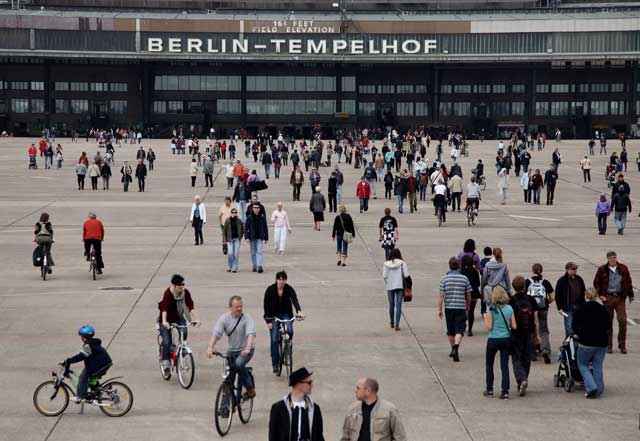
It's not every day you get to roller-skate down a runway or barbecue sausages in the shadow of an airport terminal. But both are everyday scenes in Tempelhof Park, Berlin's newest playground. Opened earlier this month, the city's biggest park has already attracted hundreds of thousands of Berliners, keen to survey the latest reincarnation of an area that was off-limits to locals for a century.
Until two years ago, Tempelhof was a fully functioning airport, located just a few kilometres south of the city centre. The authorities had repeatedly tried to close it down, and after a succession of court cases and appeals they did so in 2008. This left a space nearly three times the size of London's Hyde Park that has now been returned to the people.
Joining the crowds funnelling through the gateway, I am bowled over by the treeless extent of the space. Airstrips, meadows and concrete stretch out towards the horizon, shrinking central Berlin to a distant, mist-coated skyline. Picnic blankets are unfurled alongside yellow airport sign-posts, ice creams are peddled on the runway and children scribble chalk drawings where planes once queued for take-off.
With its carefully marked runways, its airport terminal and its 1970s sci-fi-esque radar tower, the park looks exactly as it did when the last passenger plane took off. The absence of flower beds and ornamental park features – a consequence of cash-strapped Berlin's tendency towards tardy decision making – have fuelled criticism. One German newspaper even joked it should be renamed "Tempelhof Wasteland". But, as the wide-eyed visitors to the new park testify, it is precisely this stuck-in-history feeling that gives it a unique edge.
Tempelhof played an essential part in the Berlin Airlift of 1948, with Allied planes flying vital foodstuffs into the divided city. Back then, hungry Berlin children gathered near the airstrip, hopeful that Allied "raisin bomber" pilots would toss down sweets.
Today, historical ghosts loom large in Tempelhof Park – not least in the shape of the bombastic Nazi-built terminal building overlooking the expanse. True to National Socialist's domineering aspirations, Tempelhof airport was designed to be the world's biggest terminal. Left largely unscathed by allied bombing raids, its labyrinth of corridors, hangars and halls now stand eerily empty.
In one corner of the park, a dilapidated plane is becoming overgrown by weeds; elsewhere, a hilly slope was formerly a US Army shooting range. City planners, in their only visible adjustment to the landscape, have dotted the site with billboards illustrating its history and future.
Despite their famously gruff manner, Berliners are visibly excited that the land is being handed back to them. Kites fly, footballs bounce and sausages are munched – sold from a beer garden created for the US military during the Cold War. "They knew how to live it up – but we Berliners were none the wiser," quips a waitress, pouring beer into a plastic cup.
The arrival of hordes of upbeat park-goers is the latest in a long chain of power shifts for the airport. After the Nazis were forced to abandon their ludicrously over-proportioned project, Soviet soldiers ransacked the building for valuables, even taking the radiators to Moscow. Later, Allied forces adopted the building.
Over the decades, normality returned. The inner-city airport checked in celebrity passengers including Marlene Dietrich, Kirk Douglas and The Beatles. It also provided an escape route for refugees from the communist East Germany who flew to West Germany, side-stepping GDR border controls.
Probably the best way of getting a feel for the airport's history is to sign up for a tour of the building itself. Depending on the guide, you will likely see walls riven with Second World War bullet-holes and a stylishly retro bar and basketball court built in a spare terminal room by the US military. Visitors also get to delve into the grim underworld of the cellar, where Berliners crammed into small, dank rooms to flee bomb raids.
Nicknamed "the mother of all airports" by Norman Foster – and more prosaically "the coat hanger" by Berliners (on account of its curved shape) – the building dominates the park. Given its listed status, it will continue to do so, even though it is now largely empty. Yet the airport-cum-park is set for a dramatic makeover. Some peripheral areas will be turned into new flats, but most of the site will be replanted and landscaped to host the International Garden Show in 2017.
In true Berlin style, plans are yet to be drawn up – but Tempelhof Park in its current form is something to be savoured. Soon flower beds and bandstands will distract from its history. Cycle down the runway and enjoy the panoramic vistas while you still can.
Join our commenting forum
Join thought-provoking conversations, follow other Independent readers and see their replies
Comments
Bookmark popover
Removed from bookmarks