Simon Calder: Relieving news for visitors to St Petersburg
Eastern Europe's communist house of cards (or, given the architecture that prevailed, spartan apartment block) began to tumble 20 years ago. Since then, countries from Estonia to Bulgaria have squabbled to lure British visitors, while cities such as Budapest (the subject of today's 48 Hours, see pages 14 and 15) have become increasingly dependent on tourism. But one nation remains aloof: Russia, for which procuring a visa remains complex and expensive.
The one sure way to circumvent the Kafkaesque bureaucracy is to visit Russia's most beautiful city as part of a Baltic voyage. You can step ashore in St Petersburg without all the usual red tape – so long as you arrive on a cruise ship. That is one reason cruises in the Baltic have overtaken those to Alaska as third most popular in the world (behind the Caribbean and the Mediterranean).
To continue the architectural metaphor for a moment: the city that Peter the Great built as Russia's "window on the world" is now a handy back door into the world's largest country.
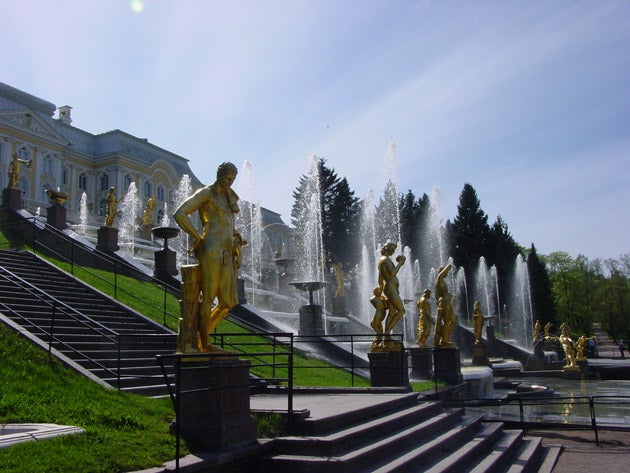
Many ships dock at St Petersburg for a couple of days, allowing visitors to make the most of the former capital. A standard programme involves visiting the summer and winter Tsarist haunts on successive days: the miraculous gardens of the Peterhof, followed by the collection of art housed in Catherine the Great's Hermitage. But thousands of cruise passengers adhering to the same itineraries put an extraordinary strain on the limited toilet facilities in St Petersburg's leading attractions.
Brian Eames, an Independent reader, was on a cruise to St Petersburg earlier this summer. At the Peterhof Palace, he reports that "Because huge crowds were on our heels, our guide and fellow passengers persuaded us to wait for the loos until the end of the tour." By then, the facilities were in turmoil: "The usually less-pressured gents were overrun by a dozen or more Japanese ladies unable to wait." At this time of year, with the fountains playing in full flow beneath the glittering neo-classical façade, you can hardly blame them. When Mr Eames and his wife reached the Hermitage, "Men were queueing as deeply as the women."
"The guided tour that prioritises Pushkin over peeing is a misguided tour," says Neil McGowan, who runs The Russia Experience. "St Petersburg is no more poorly served with public conveniences than any other big city, but you have to know where they are. The sage and sanguine tour leader has already worked out the routes they will use in the city, and predicated them on the availability of facilities along the way."
He reveals one of his recommendations of Where to Go in St Petersburg: "The Manezh Exhibition Halls, where the loos are located ahead of the ticket desk, so you don't need to pay for admission" – and suggests, as an afterthought, using the facilities "at KFC and McDonald's like everyone else".
Since capitalism took over, plenty of entrepreneurs have realised there are many roubles to be made from answering the basic needs of tourists. Portable loos have popped up around St Petersburg, enabling you to pay the equivalent of 50p to spend a penny. The last time I was in the city, a former bus had been parked permanently and plumbed into the water mains as perhaps the ultimate portable loo (for women only). The right kind of bus, says Neil Taylor – a guidebook writer specialising in the Baltic – can ease the problem for cruise passengers. With the cruise port being a long way from the city centre, transfer buses should be fitted with on-board toilets.
"Wise cruise operators would insist on these being used for their groups. They cannot do anything about the hopeless provision at Peterhof, except perhaps to delay the start of the tour so their passengers might benefit from all the toilets still being in working order." (The facilities apparently rapidly deteriorate as the day wears on.)
"I would not normally encourage visits to tourist shops, but those where cruise passengers are taken in St Petersburg have clean toilets and the 30-minute stop there ensures that everyone can use them in comfort and often have a glass of vodka as well. The relief provided by both of these facilities inevitably loosens wallets, so all sides are very happy with this arrangement."
Cuba's toilets face wipe-out
"You'll either have to get used to the feel of cold porcelain, or develop strong thigh muscles," instructed the Traveller's Survival Kit: Cuba. This guidebook warned 20th-century visitors to the Caribbean's largest island of the scarcity of toilet seats. Reports from the communist stronghold suggest that one further piece of advice in the travel guide still holds water: "Carry your own paper, since it is rarely supplied."
The highest sugar prices for 28 years are buoying Cuba's economy at present, but another commodity is in short supply: toilet paper. Travellers are warned that it has run out of toilet paper ranging from Andrex-grade to the cardboard that prevailed while the Kremlin ruled the roost.
As with so much at Casa Castro, flushing out the truth is tricky. No doubt jokes are circulating about using the official Party newspaper, Granma, or the local currency, in an emergency.
The travel guide's overall advice still rings true: "If you assume that all public toilets are disgusting, you will be pleasantly surprised when you find the odd one which is clean, has paper, a sink, soap and hand towels." The proletarian privy has some way to go.
Join our commenting forum
Join thought-provoking conversations, follow other Independent readers and see their replies
Comments