Tom Sutcliffe: Are we still backing the wrong horse?
The week in culture
There's a venerable story about the painter Constable which is often cited by writers who want us to recognise that he was a modern pioneer, rather than an exemplar of chocolate-box traditionalism. He was having an argument with a friend about conventions of representation in landscape painting. The friend was trying to persuade him to paint grass as Poussin did, in the honeyed tones of an antique violin. To refute him, it's said, Constable took a violin and laid it on the lawn, inviting him to make a direct comparison between the two. Painted grass should be the same colour as real grass, was his point.
I've always wondered, reading this story, whether the friend caved in immediately or whether he replied that painted grass isn't actually grass at all – and thus can be pretty much any colour the artist wants to make it. But I don't think you're meant to think that. It's really a story about clarity of perception triumphing over hidebound convention.
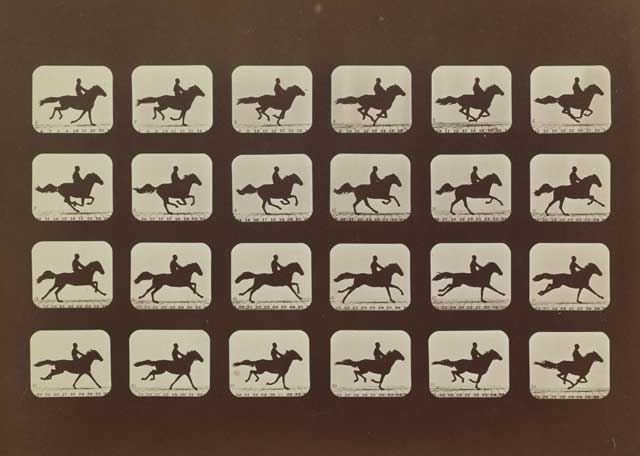
I encountered a variation on it the other day while walking round Tate Britain's exhibition of the work of Eadweard Muybridge, the Victorian photographer and pioneer – I guess – of stop-motion photography. In a newspaper article about his studies of motion, Muybridge once claimed that the painter Frederic Leighton had confessed that he burst out laughing when he first saw the photographs of horses galloping. He knew what a running horse should look like – from countless equestrian paintings – and alongside that preconception these photographs appeared comically wrong. Then, according to Muybridge, Leighton looked a little closer and realised that he would have to adjust his notion of verisimilitude. Like the Constable anecdote, it's a story that has clear-sighted truth triumphing over inherited tradition. It goes with the grain of a scientific notion of progress in which error cedes to discovered truth.
What it really points up, though, is how malleable and culturally directed our notion of the lifelike is. Leighton didn't move from a position in which he was thinking, "The real running horse is a clumsy and awkward-looking object which it is the duty of the artist to improve upon". He wanted to get it as right as he could and believed that artists had worked out a set of rules that would deliver that. It's even possible – given how obligingly human vision supplies what we think we should see – that when he looked at a real horse running he saw something very like a pre-Muybridge painting. But then the hard photographic evidence came along and artists stopped doing the Stubbs thing of having horses flying along with all four legs stretched out as far as they could go. And after enough time had passed, that started to look comical – instead of sharply, persuasively observant.
The temptation here is to think that photography had corrected and improved our conventions when in actual truth it had only replaced them with novel ones. To put it a different way, the overall stock of "lifelikeness" in art hadn't suddenly increased – it had just changed its livery and obliged most viewers to change with it. And though photography has a very powerful argument in favour of its version of realism (it can always say, "Look. No human hand involved. That is what it looks like") its supremacy has pulled some odd effects in its wake.
Take motion itself, for example, which comes to be depicted in some paintings as the kind of smear which the human eye (or human perception, rather) almost never sees – but which a camera all too often does. Or – an even better example of how even an optical deficiency can come to be a badge of optical authenticity – take lens flare, an effect now completely familiar to us from photography, but not an artefact of a human eye. Some hyper-realistic paintings occasionally include lens-flare, not because that's how the world looks to us, but because it is how it looks to cameras... and we broadly take it for granted now that they know better.
They don't of course – however useful they might be for detecting the exact sequence in which a horse's hooves hit the ground while at a gallop. And there may yet come a time when our prevailing notion of realism twists away from the photographic to something else again. It's no good trying to imagine what it might look like – because from this angle, like Leighton's first glimpse of Muybridge's galloping horses, it will almost certainly look preposterous. From the other side it will just look obvious.
Against the dying of the light
I encountered one of those odd little cultural echoes the other day – where an idea from one quarter is suddenly bounced back from an unexpected angle. The original shout, as it were, came from Seamus Heaney, whose latest book contains a poem called "The Baler". In it, he remembers the last visit of a now-dead friend, who said that he could no longer bear "to watch/ The sun going down" and asked to be put with his back to the window. It underlines the fact that a sunset is always a balancing act between visual grandeur and thoughts of loss – and that the balance gets harder to maintain the older you get. Then, a little later, came the reverberation: I read somewhere about the Japanese architectural firm who had been commissioned to build a house for an elderly man who did not expect to be occupying it for more than 15 years. His brief was for a modest building, with the added proviso that it should not have a view of the sunset, since he disliked its unavoidable symbolism.
Odd really – given how widespread this melancholy sentiment must have been throughout history – that there isn't a poetical form specifically dedicated to the feeling. We have aubades, after all, which deal with dawn. Perhaps the muse turned her back, too.
Watchdog's total misconception
How obliging of the Advertising Standards Authority to amplify the effect of a modest magazine advert by banning it. Very canny bit of marketing on the part of the ice-cream company and its ad agency, who presumably calculated that an image of a pregnant nun tucking in alongside the strapline "Immaculate Conception" would get the watchdog barking, and thus attract the attention of nearly every media outlet in town, who would then helpfully reprint the offending poster. It is a bit worrying to read the ASA's explanation, though, which says it felt that "the use of a nun pregnant through immaculate conception was likely to be seen as a distortion and mockery of the beliefs of Roman Catholics". What business of the ASA is it to police the doctrinal orthodoxy of adverts, or, indeed, to protect the devout from mild flippancy? Decency is one of its remits – but it isn't obvious to me that there's anything wildly indecent about the advert – unless the very thought of sexual congress having taken place is a disturbance to the pious mind. The banning of the ad is yet another extension of the Dictatorship of the Easily Offended.
t.sutcliffe@independent.co.uk
Join our commenting forum
Join thought-provoking conversations, follow other Independent readers and see their replies
Comments