Tom Sutcliffe: Is sentimentality an artistic crime?
The week in culture

Sign up for the View from Westminster email for expert analysis straight to your inbox
Get our free View from Westminster email
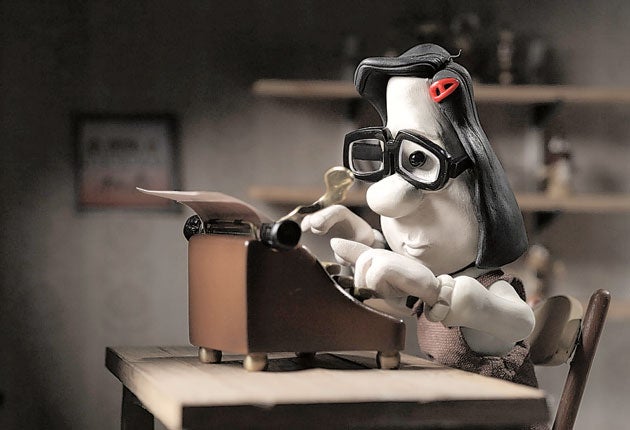
I encountered an odd coincidence the other day when, within the space of a few hours, I saw two very different works that had decided to end with exactly the same emotional flourish. One of the works was Adam Elliot's animated film Mary and Max, a winningly downbeat account of the friendship between a forty-something man with Asperger's syndrome and a lonely eight-year old girl marooned in a Melbourne suburb.
The other was Nina Raine's fine new play Tribes, about communication and miscommunication in a noisily bohemian family with a deaf son. While both of them appeared to share the view that emotional pain need not preclude comedy, they've come – literally – from opposite ends of the earth, they both chose to enlist the same passage from Puccini to bring down the curtain.
At the end of Mary and Max, after a bittersweet final scene, you get the "Humming Chorus" from Madame Butterfly – the haunting and beautiful tune that occurs just after Butterfly has seen Pinkerton's ship return but before she has learned that he is not returning for her. And exactly the same piece of music occurs at the end of Raine's play, running over a final scene of calculated sweetness and reconciliation.
The coincidence couldn't help but catalyse – or perhaps compound – a suspicion. Was it entirely seemly to do this thing? The end result wasn't in doubt in either case – or rather the message the music was sending, which was (to put it crudely) that it was alright to cry now. But the potency of that result was part of the problem – as was (for me) the coincidence. Because if lightning strikes twice, in such rapid succession and with such obliging timing, it's hard not to suspect that it may not be lightning at all – but rather a lightning effect, something that can be achieved at the press of a button and repeated as necessary.
Was that what had happened in this case? The film and the play had softened us up – expertly and wittily in both cases – but had the emotional bomb that was eventually dropped on us been outsourced to Puccini? The fact that the music is so famous as an expression of poignant and disappointed love didn't help. It couldn't help but seem a bit off the peg.
In the case of Raine's play quite a few of the reviews seemed to express that suspicion. To roughly summarise the consensus, the play was praised for its sharp, clear-eyed honesty while the ending was disapproved of for its sentiment. I think one critic even wrote "yick" or something similar – to convey the extent of her disapproval. I was pushed a long way in that direction too – not helped by the unexpected coincidence.
But then I found myself wondering about the accusation of "sentimentality" itself. That this can be an artistic crime I don't dispute but that any recourse to profound sentiment makes you guilty of it is surely more debatable.
Raine's play is in part about how you express deep feelings, and how language may not always be up to the task of translation. It's also about that complicated word "hearing", in which physical reception and intellectual recognition are inextricably mixed up. So it didn't seem improper to me to end with a moment against which, as an audience, we were effectively defenceless. And it owed at least part of its power (the part that Puccini can't take the credit for) to how fiercely resistant the rest of the play had been to the expression of hollow sentiments. By introducing the music at a moment when feelings overwhelm the characters on stage, it replicates a similar feeling of helpless submission in the audience. The whole point about it is that emotions are welling up as irresistibly as a familiar tune.
I can't help wondering whether part of the critics' reaction wasn't down to the disappointment at the perceived sentimentality in the play but dismay at finding themselves so susceptible to it. They shouldn't be ashamed and neither should Nina Raine. About Mary and Max , on the other hand, I'm still not sure.
Institutions must join art's counter-offensive
There has been a minor spike in stories about art causing affront and scandal, two recent cases being the removal of Rohinton Mistry's novel Such a Long Journey from Mumbai University's literature syllabus because it displeased an extremist political party and – rather less serious – the threat by a French aristocrat to take legal action against an exhibition of work by Takashi Murakami at Versailles.
It won't hugely surprise you to learn that I'm on the side of the artists. The speed with which Mumbai University caved in suggests a feeble commitment to intellectual and imaginative freedom (even allowing for the fact that Shiv Sena, the offendee, can get very nasty indeed). And the indignant aristo doesn't appear to have noticed that Versailles isn't exactly a model of restrained, classical minimalism: Murakami's manga explorations of contemporary kitsch actually fit the ridiculously baroque space rather well.
But in both cases I wonder if there isn't a tiny bit of the artist that isn't just a little grateful for this validating loathing. Murakami wants to provoke and Mistry intended to attack Shiv Sena. It's not good that Mistry appears to have lost the battle so quickly, thanks to the fact that his allies have taken to their heels at the first puff of smoke. But it would be even more depressing if the enemy didn't even think the battle was worth fighting.
An ominous sign of things to come
How fast can a film go wrong? I'd always assumed that every movie enjoyed at least a five to ten-minute period of grace when judgement would be suspended, for the simple reason that cinemagoers are essentially optimistic types. In any case you can't be sure what a movie has in mind for you, so the apparently ominous opening may turn out to be a clever trick. 'Burke and Hare', John Landis's film about the notorious Edinburgh corpse-vendors, overturned this cherished opinion.
Ten seconds in it dawns on you that you're in for a clunker when the title card, "This is a true story", holds on the screen for a few seconds too long to be followed by "Except for the parts that have been made up". Bit of a tired gag, you think. And then that's followed by a scene in which Landis achieves the unimaginable and makes Bill Bailey unfunny. From there, it's all as unstoppably downhill as the trundling progress of the "comedy" runaway barrel that features a few minutes later. Is this a record though? Inside 30 seconds the film suggests that it will semaphore every joke and drain the hilarity out of genuinely funny performers – and then it more than fulfils that early promise. I'd be curious to know whether any other movie can match it for the speed with which it lets you know what you're in for.
Join our commenting forum
Join thought-provoking conversations, follow other Independent readers and see their replies