These Belfast riots aren't over the flag - but the creation of a fairer society
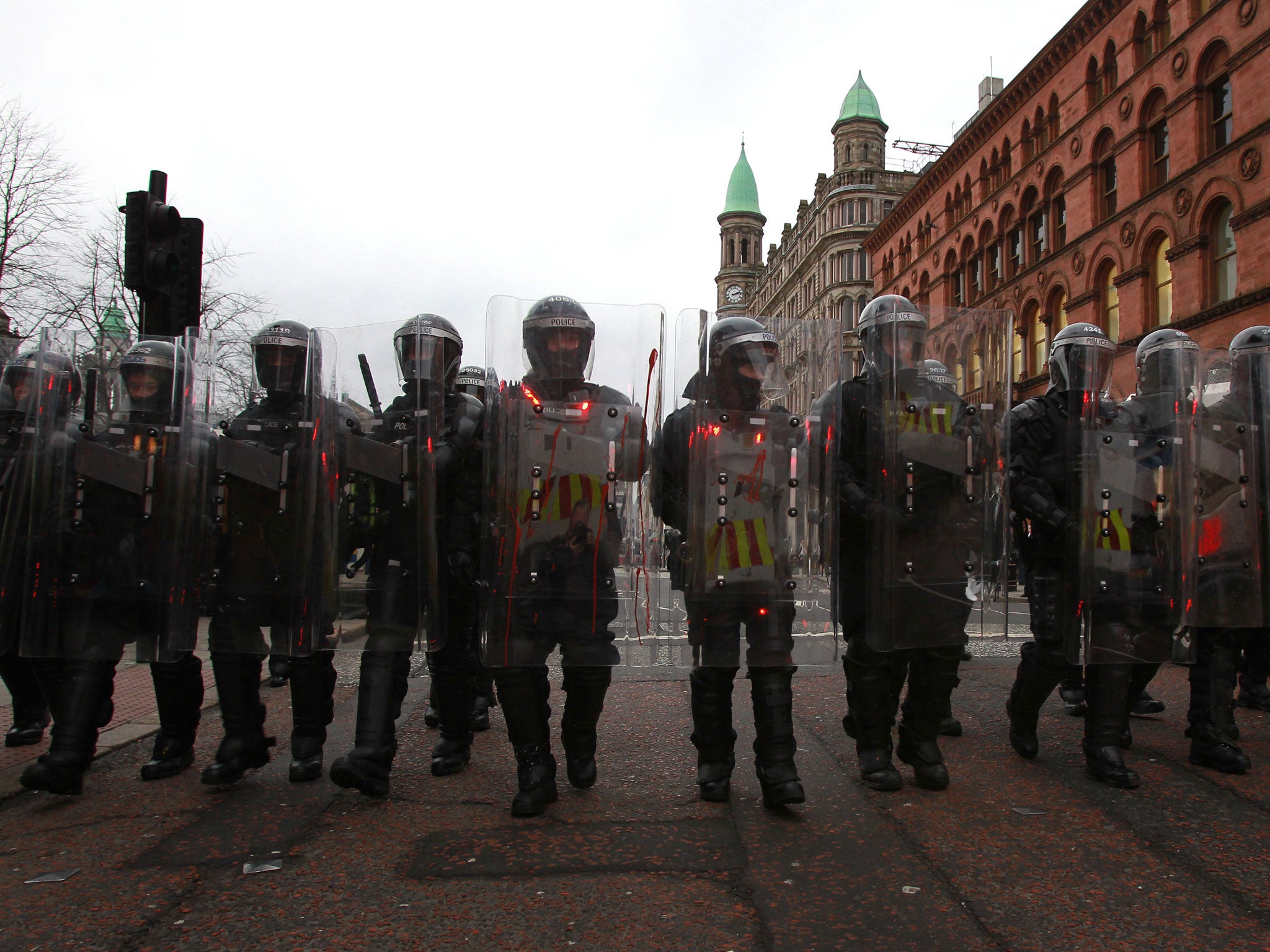
Both sides must now be wincing as they imagine the impact on tourism, investment of TV pictures showing petrol bombs raining down on police lines.
A woman called Georgina was so indignant about what police did as loyalist protesters streamed past a Catholic Belfast church that she contacted a BBC Belfast phone-in programme to complain. She was very angry, she said, because nine armoured Land Rovers had been lined up between the marchers and St Matthew’s church, a traditional flashpoint which has this week been a focus of rioting. In her interview she went on: “I was standing with a nine-week-old baby in my arms that was sleeping.” She had also taken to the scene two boys aged three and five: “I took the boys out and stood them on a fence to watch the protest,” she added.
Similar scenes could be seen at many of the hundreds of protests which for more than a month have bedevilled Belfast almost nightly. Hooded youths fling bricks and bottles at police who sometimes respond with plastic bullets and water cannon. Other Protestants often show up, sometimes wheeling prams, to block roads or, like Georgina, simply as spectators. Police say children as young as 10 go rioting, describing them as beyond parental control.
The disturbances are outside societal control as well, for appeals from political figures, clergy, community activists and other figures have fallen on deaf ears. The blood is up, and for some, tribal politics is triumphing over everything else.
Most of Belfast looks very well, with some sparkling modern buildings and major new initiatives such as the Titanic Centre which has attracted 650,000 visitors in nine months.
At a political level, unionists and republicans have been working together to attract tourism, trade and investment. A few weeks before the disturbances started, unionist Peter Robinson and republican Martin McGuinness led a 35-strong trade delegation to China.
All too familiar
But both politicians must now be wincing as they imagine the impact on Chinese decision-makers of TV pictures showing petrol bombs raining down on police lines. Visitors have witnessed disturbances at first hand. A month ago, a waitress at an upmarket restaurant was serving a table of businessmen from Korea when the first trouble erupted. “We tried to make light of it,” she related, “but that was hard when you could see masked men on top of police vehicles, bashing them with bricks. How can you explain something like that to outsiders?”
Those actively involved in violence number only a few hundred, while those blocking roads probably do not exceed a few thousand. They have been an all-too-familiar sight in post-Troubles Belfast, generally causing problems at least once a year. But they usually tire of it and go home after a few days.
This time it’s different: it has lasted over a month and shows no sign of fading. The mob lacks obvious leaders, reacting instead to calls from a few mavericks to keep up the protests. They affect the whole city. The police, apparently nervous about igniting even greater disturbances, are unable to keep major arteries open. As a result, downtown streets are often deserted: over Christmas, normally bustling stores and restaurants closed early. The financial implications of all this are huge. Policing costs alone are estimated at around £15m.
But while the spark came from the issue of flying the Union Flag over City Hall, the whole episode is evidence of a deeper malaise within loyalism. Northern Ireland is today run by a new political dispensation, pioneered by Ian Paisley, which brings unionists and republicans together in government.
Most Protestants and unionists support or at least tolerate this. They certainly overwhelmingly vote for it: few think it ideal, but it is regarded as infinitely preferable to the Troubles, and offering the chance of a whole new start. But that hope has for the moment been blotted out by a pall of depression. Just as there is a small section of dissident republicanism which violently opposes the peace process, the loyalist backstreets harbour a completely disaffected Protestant minority. There, young men are prey to a toxic mix: unemployment, drug abuse, heavy drinking, debt, squandering money on horse-betting and gaming machines, and recruitment into the remnants of paramilitary groups.
There are thousands of ex-prisoners, some commendably involved in community work, others steeped in criminality. There is extortion and enforced collection of protection money.
One of the deepest problems is a lack of regard for education. Jobs for Protestants in shipbuilding and heavy engineering used to be so plentiful that education was regarded as basically unnecessary; but loyalism has not adapted to new economic realities. Underlying all this is traditional sectarianism. Catholics are not welcome in their ghettos. Some have Catholic friends, but many of the enclaves feature not just Union Jacks but also murals of masked men with rifles: the message could hardly be clearer. Fearing that Catholics would move into one vacant housing estate, loyalists festooned it with graffiti, one crudely painted sign featured a rifle sight and the slogan “ATAT”. This stands for “All Taigs [Catholics] are targets”.
There is resentment meanwhile, about the fact that republicans have put together a strong political construct. Loyalists tried to emulate them and build a Protestant equivalent of Sinn Fein, but sadly their attempts came to nothing. A deep vein of resentment has been nurtured by the fact that, for more than a decade, Catholics have moved into the heights of political, administrative and legal influence. In the loyalist backstreets, they care little that posts such as Attorney General and Director of Public Prosecutions are today held by Catholics. But they are all too aware that Catholic numbers have grown substantially.
Protestant decline
Recent census returns showed that in the perpetual numbers game Belfast has undergone dramatic demographic change. A city which since time immemorial regarded itself as a proud bastion of a Protestant work ethic has now lost its Protestant majority. The Catholic population has grown, but large numbers of Protestants have also abandoned the city for satellite towns. This explains why the city council decided flying the flag should be reduced: unionist councillors were outvoted.
Since the loyalist narrative was already one of steady nationalist gain and steady Protestant loss, the reduction in flag-flying produced the rage among loyalists who saw in it a simultaneous loss of power and an attack on their Britishness. That rage has produced the red, white and blue mist which is now prevailing over the normal rules of society, pushing into second place any thoughts of better economic prospects, more jobs, freedom of movement and even personal safety. Instead, an extended bout of self-destruction is under way.
In the spring, Peter Robinson and Martin McGuinness are due to return to China. When they do, they may ruefully reflect that they are labouring under that ancient Chinese curse: may you live in interesting times.
Join our commenting forum
Join thought-provoking conversations, follow other Independent readers and see their replies
Comments