A pioneering Modernist who's in the frame again
He committed suicide forgotten, but Keith Vaughan is a master, says Adrian Hamilton
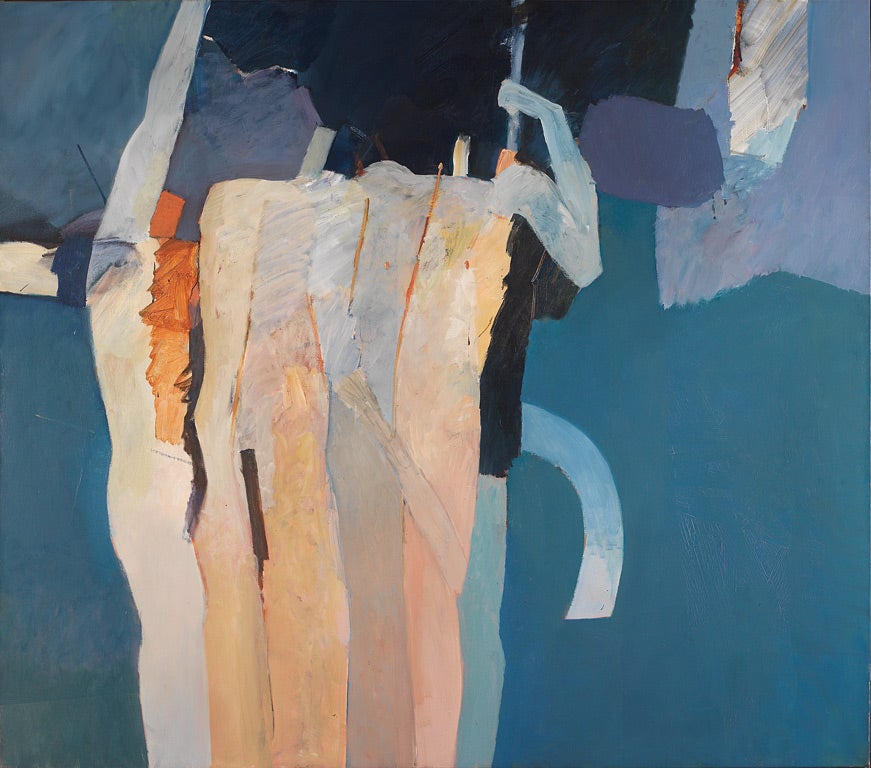
The glaring omission from Tate Britain's current show on Picasso's impact on British artists is any representation of Keith Vaughan.
More than any other British painter he embraced Picasso's return to classicism in the 1920s and 1930s and, together with the influences of the other great Modernists such as Matisse, De Stijl and above all Cézanne, forged his own path of figurative art in the postwar period.
That hasn't helped his reputation since. Once regarded as Britain's pre-eminent painter, his Modernism and his figuration were quickly overtaken by the brash Sixties and their excitement in popular imagery and commercial profile. Vaughan, introverted, obsessive and seemingly backward looking, was sidelined to die a suicide in 1977 aged 65.
A century after his birth, it is time to take a new look at this artist whose pre-occupation with the human figure and with sexual anxiety make him in many ways contemporary in feel. Pallant House Gallery in Chichester, near his birthplace in Selsey, has started the proceedings with a welcome and convincing retrospective. It's not large – just three rooms – but it covers most of his output from his early sketches as a conscientious objector in the Second World War through his best-known figures set in landscapes and includes the landscape pictures which, while lesser known, made up around half his output.
Through them we see him break out from his initial categorisation as a "Neo-Romantic" along with Graham Sutherland, John Piper and Michael Ayrton to develop a style very much of his own in his exhilarating Assembly of Figures series in the 1950s and 1960s to his final near-abstract landscapes. If it were just a matter of combining the line of Picasso's nudes with the form and structure of Cézanne's Bathers, Vaughan might be considered a somewhat limited artist. "I believe," he said, "a painter has only one basic idea which lasts him a lifetime. Mine is the human figure."
He was much more than that. But he was right in the sense that most of the better artists have continuously searched to explore the possibilities and seek to break the boundaries of particular forms. In Vaughan's case, what makes his paintings so original and, more often than not, so compelling is the tension he brings to his works – between man and nature, between flesh and form, colour and shape. For him art was a search for climax and release, as much sexual as intellectual, from the conflicts he felt in himself and exposed so frankly in his journals.
That he was homosexual had a lot to do with it. His figures are not openly erotic (although some of his private sketches were) but his concentration on the male nude and the extraordinary way in which he invests even the most abstract figure with a sense of flesh through his palette and brushstroke put him quite apart from any of his artistic heroes.
You can stand in the central room of the exhibition devoted to his figurative art and see how the muddy palette of the Cézanne-inspired Group of Bathers (1951) brightens up and pares down in the brilliant Assembly of Figures VII (1964), how he creates a moving, jostling mass out of paint patches in Crowd Assembling I (1967) how he reverts to blocks of colour in the Matisse-like Musicians at Marrakesh (1966-1970). It's the same in the next room with landscape as the early idyllic views of woodmen and children in the countryside are succeeded by the more Cubist Village in Ireland(1954) and the later semi-abstract Cenarth Farm (1962) and Mortimer's Farm (1971).
If Vaughan never reached the stature of the modern masters he so admired, he certainly took their lessons and made them his own.
Keith Vaughan: Romanticism to Abstraction, Pallant House Gallery, Chichester (01243 774557) to 10 June
Join our commenting forum
Join thought-provoking conversations, follow other Independent readers and see their replies
Comments
Bookmark popover
Removed from bookmarks