A right royal trip down the river
As anticipation builds for Sunday's Jubilee pageant, Adrian Hamilton visits an exhibition celebrating the glory days of London's mighty Thames
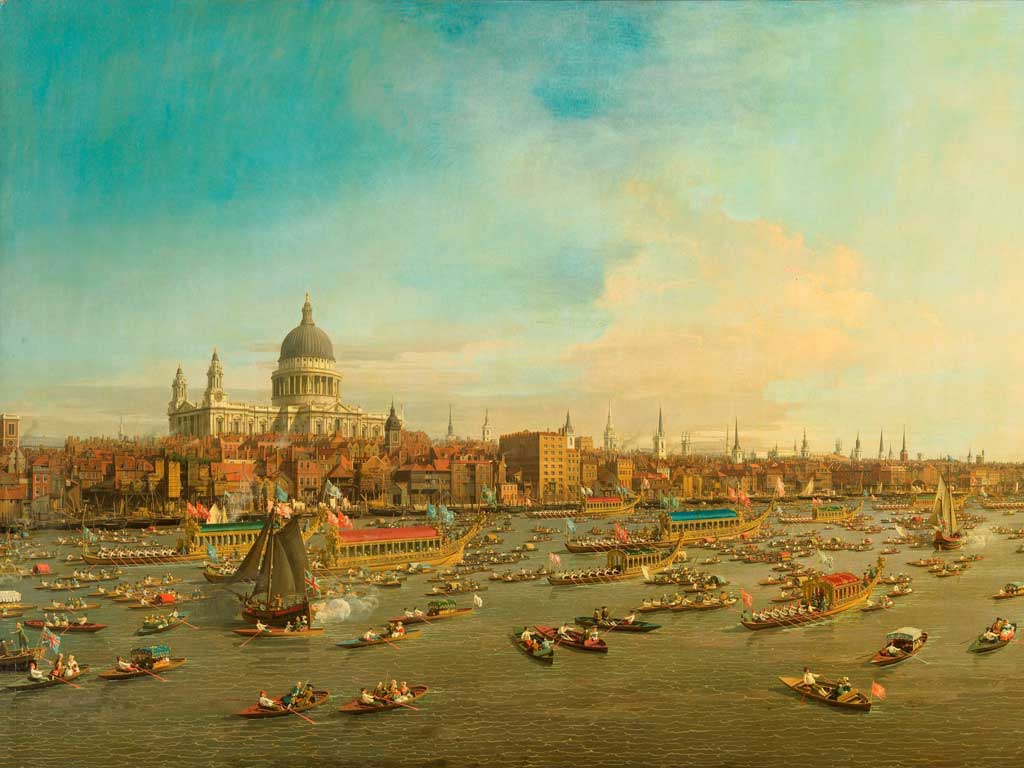
With all eyes now directed to the thousand boats processing down the Thames this weekend in honour of the Queen's Jubilee, the Royal Maritime Museum at Greenwich has come up with a neat exhibition: Royal River: Power, Pageantry and the Thames, curated by the ever-irrepressible Professor David Starkey.
One says "neat" because this is a very sanitised version of a very insanitary thoroughfare. For nearly 20 centuries after the Roman conquest London was the capital of the country and the river its main avenue of transport. The royals used it to get between their palaces, and the population turned out to celebrate their arrivals and their exits from the city. But, at heart, the Thames was the sweaty, rumbustious, filthy highway of a capital always growing and always bent on commerce.
The highlight of the show is the picture you see at the beginning. It is Canaletto's London: the Thames on Lord Mayor's Day, looking towards the City and St Paul's Cathedral, on loan for the first time to the UK (it comes from the Lobkowicz collection in Bohemia). It's a vision of harmony and serenity as dozens of small boats pull alongside the stately barges on a calm river. Painted between 1747 and 1755, it shows the Georgians as they wanted to see themselves, prosperous and peaceful commercial people.
The interesting thing, however, is that it is not a painting of royal or religious pageantry but of the all-too-worldly festivities surrounding the annual election of the Lord Mayor of London. Indeed it is the City of London rather than the Crown which supplies the most interesting items on display. The livery companies of London, flush with funds from the new prosperity of the late 17th and 18th centuries, flaunted their status with magnificent barges and even more magnificent pennants as the new Lord Mayor went from the City to take his oath at Westminster. Bargemasters sported huge silver disks of their livery on their arms. The rowers were all in uniform. Boats were packed with onlookers and stocked with drink to keep them well oiled. Serenity wasn't in it.
The Thames was certainly important to kings and queens. It was Henry VIII and the Tudors who recast the river from its medieval history to build fresh dockyards for the king's new navy and fresh buildings in Hampton Court and Whitehall for his pleasure. The great buildings on the banks of the Thames had been built in earlier times, many of them for the nobility and the new rich (Hampton Court was constructed for Cardinal Wolsey, Whitehall was originally the Archbishop of York's residence). Now it was the Renaissance monarch's turn to show his pre-eminence. A section of the show is devoted to the efforts to give legitimacy to Ann Boleyn as Henry's second wife with a lavish process up the Thames for her coronation. The same was done for the equally unpopular coronation of the Catholic James II.
But by the time of the Hanoverians, royalty was no longer centre stage on this great river. Britain had only recently emerged from a century in which two kings had been unseated. Charles II had returned on a warship originally called Naseby, for Cromwell's decisive Civil War victory, which had been hastily renamed Royal Charles. The Thames was a river of war, as the great naval dockyards of Deptford and Woolwich attested. It was also a river of trade as the ships clustered along its banks (there were few commercial dockyard facilities) with only one bridge, the ramshackle old inhabited London Bridge, to cross.
The Georgians certainly kept up appearances. There's the barge of Frederick, Prince of Wales, designed by William Kent with a mass of gilding, as well as the original manuscript of Handel's Water Music to remind you of it. But the greatest river procession of the time was not a celebration at all but Nelson's funeral flotilla conveying the admiral's body from Greenwich to Whitehall in January 1806. It took weeks of planning and endless arguments between City, Court and Admiralty, all determined to claim ownership. The family was pushed aside, the flotilla organised with military precision and proper priority. Newspapers were filled with advertisements offering, or seeking, privileged viewpoints. A total of 77 small boats decked in black made up the flotilla, the ships along the way dropped their ensigns to half mast as the barge carrying the body passed. All river activity ceased for a day.
Nelson's funerary voyage was repeated, more soberly and less splendidly, by Winston Churchill. Ever conscious of historical precedents, he had determined, as a former head of the navy, that his coffin would go by launch from the Tower to the Festival Hall. Those there at the time will not forget the sight of the dockyard cranes dipping their heads as the craft went by. But it was by then, as Churchill knew, a performance for television rather than the onlookers. The construction of a succession of bridges in the 19th century, a narrowing of the banks (partly to accommodate the sewage system built after the "Great Stink" of 1858, which had forced the evacuation of parliament), and the establishment of major new docks had all reduced the bustle and the life on the river itself. The last of the Lord Mayor's annual processions up the river to Westminster was in 1856. It had become too expensive for a commercial centre bent on profit to sustain.
To that extent this Sunday's Jubilee procession by the Queen is less of a reassertion of tradition than a newly minted occasion for the cameras. There'll be more than 1,000 vessels stretching over 7.5 miles, including everything from Dunkirk veterans to historic barges. But there will be none of the chaos and carousing that accompanied the Lord Mayor, when small boats were allowed to bustle around at will. Security considerations won't permit it. Nor will she pass the forests of masts and the throb of trade that marked the Thames of Dickens's day. It will be a tribute to her long reign, but not to the river which once made London what it was.
Royal River: Power, Pageantry and the Thames, National Maritime Museum, London SE10 (rmg.co.uk) to 9 September
Join our commenting forum
Join thought-provoking conversations, follow other Independent readers and see their replies
Comments
Bookmark popover
Removed from bookmarks