No Place Like Home: A diverse portrait of Jewishness in Britain
Q&A with photojournalist Judah Passow who has used his camera to document Jewish communities in the UK
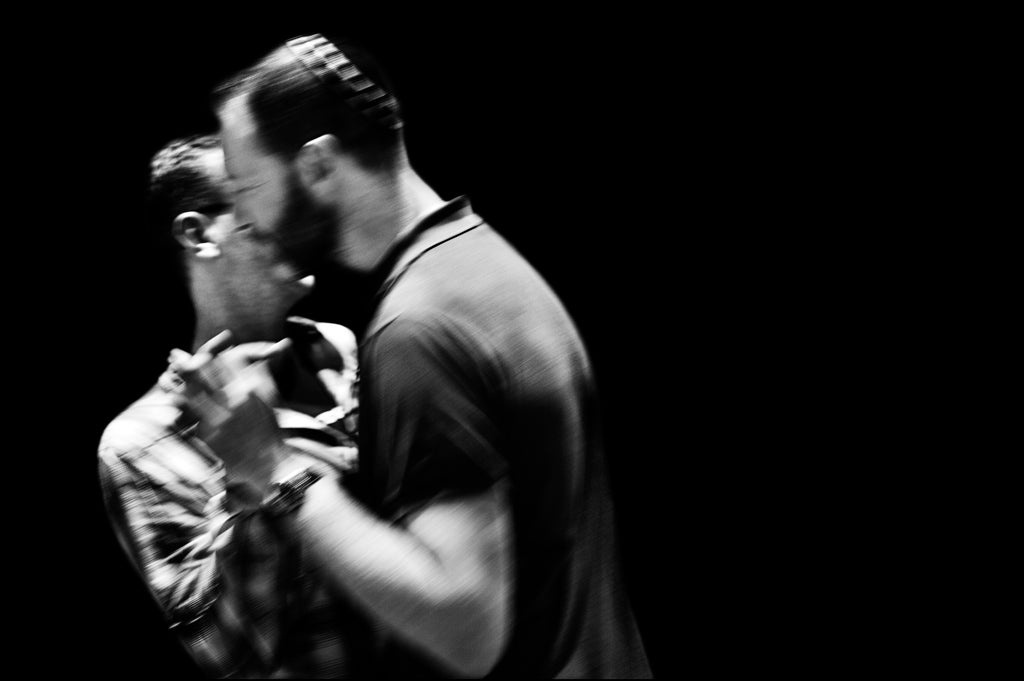
An openly gay couple dancing in synagogue and a Punk Klezmar fan in Regent’s Park are among the images of Britain’s thriving Jewish community currently on show at the Jewish Museum in London. The collection of contemporary black and white photographs is by eminent photojournalist Judah Passow, a four-time recipient of World Press Photo awards for his coverage of conflict in the Middle East, and a former artist in residence at the Institute of Contemporary Art. Israel-born Passow lives in London but was raised and educated in New York and Boston. His richly diverse portrait of Judaism in Britain is the culmination of extensive travel and inquiry over several years.
Here Passow speaks to Independent.co.uk about his exhibition, No Place Like Home:
What was your initial motivation for creating the work?
Well, I’ve been living here for 30 years and most of my work has been abroad. I’ve never really taken any photographs of England. So, I decided to work on project that would be here. Thinking about what I would most like to do, I decided to take a look at the community, of which I am in fact a part, which is the British Jewish community. That was it.
Did you start with London because it is your home?
What I wanted to do was to produce an essay that would show, in photographs, what it means to be British and Jewish in the 21 century. What are our values? What is it that drives us, both as Jews and as Britons? These are tough things to bring out in photographs and I had to satisfy myself that I could do this. London was the laboratory to prove the concept.
Did you decide to shoot in black and white from the outset?
Oh absolutely. There was never a question of it being anything other than. Black and white is the classical language of photojournalism. I think it’s a very intelligent language. There are nuances in black and white that I don’t feel are found in colour. Other photographers might disagree with me, but photography is all about these kinds of arguments.
How did this project compare to your previous work as a photojournalist, where you might have been capturing a specific event and more obvious story? Was it a different kind of story taking in this case?
Yes, but it’s still photojournalism. It doesn’t require explosive drama out on a street. Photojournalism is a technique and a style; an interrogative approach and passionate and observant stance. There doesn’t have to be gunfire out on the street. Photojournalism is a way of asking questions with a camera, which is why it works in this case.
Do you think that even though you’ve lived in Britain a long time, not being a native gives you different perspective on the British Jewish community?
It does. It’s difficult to quantify what that difference in perspective is precisely. I think there are frames of reference, there are patterns of behaviour, there are social norms which are all part of your cultural DNA. I’m a product of the American culture, there’s no getting away from that. The fact that I’ve worked here for 30 years doesn’t alter the fact that a lot of who I am and what I am was shaped by the place where I grew up, which was not here. To that extent I am a little bit of an outsider, which allowed me to look at the community in which I’m living with a slightly different perspective. It has its journalistic advantages.
How have visitors responded to the exhibition (which opened last week) so far?
The response has been uniformly positive. The overwhelming reaction has been marvelling at the diversity within the community that the photographs capture. The response has been: “I never fully realised what being Jewish in Britain meant”. People seem overwhelmed at the different ways different people around the country find to give expression to their Jewishness.
It does seem incredibly progressive. For example, the photograph of the gay couple dancing together in Synagogue.
Yeah, and the little girl blowing the Shofar on Rosh Hashanah, the Jewish New Year’s – the Shofar is typically a male preserve. Part of the secret, well it’s not a secret, part of the reason for the historical durability of Britain’s Jewish community is its ability to constantly re-examine, re-evaluate and reinvent itself. There’s a real drive with the community, a kind of intellectual drive, to stay relevant to the times and demands of the larger community of which it’s part. That’s what this project captures.
Click here or on "View Gallery" for a picture preview
No Place Like Home – Photographs by Judah Passow is until 5 June 2012, www.jewishmuseum.org.uk
Join our commenting forum
Join thought-provoking conversations, follow other Independent readers and see their replies
Comments