Covent Garden woos younger audience for ballet
Royal Ballet showcases the work of a 23-year-old choreographer
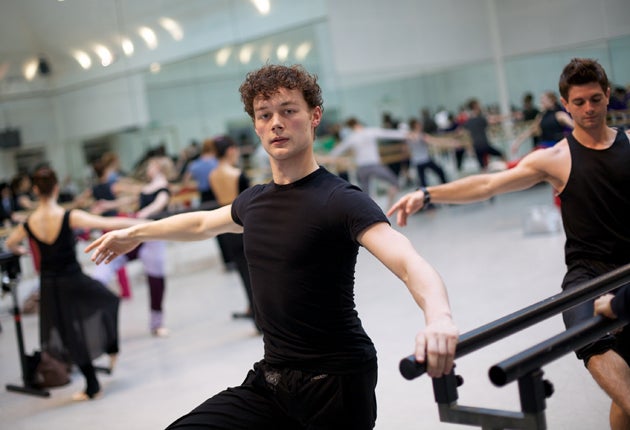
As a humble member of the corps de ballet, Liam Scarlett is more used to providing the backdrop for Covent Garden's biggest names than bossing them around. But that is what the 23-year-old has been doing these past two months ahead of a dance premiere that will make history at the Royal Opera House this week.
Scarlett will become the youngest choreographer to see his steps come to life on the world-famous main stage when the curtain goes up on Asphodel Meadows on Wednesday. What's more, some of ballet's most famous stars, prima ballerinas such as Tamara Rojo and Laura Morera, from Spain, and the Argentinian Marianela Nunez, will be dancing them.
The Royal Ballet hopes the work, part of a triple bill, will help to attract a younger audience – the often illusive quest pursued by Britain's dance companies. The main stumbling block, in perception if not reality, remains ballet's elitist image, especially compared with the vast bulk of shows on offer in London's West End.
Scarlett, who is hiding any nerves when we meet after his first run-through on the main stage, acknowledges he has a job on his hands, particularly when his abstract work is competing with the likes of Andrew Lloyd Webber's crowd-pleasing Love Never Dies. "The ballet stereotype is really imprinted in some people's minds," he says. His job is to convince the 8.6 million theatregoers who plumped to see a musical last year – more than half of the record 14.2 million people that spent £500m watching West End shows in 2009 – that ballet is not all about "tutus and glitter".
Indeed, Asphodel Meadows, which takes its name from a section of the Greek underworld where ordinary souls spend their eternity, is a tutu-free zone. Set in neutral colours against a black-and-white-lined set that looks straight out of Tate Modern, and drawing on music by the early-20th-century French composer Francis Poulenc, the work is a "schizophrenic" affair, according to Scarlett, who has danced since he was four. He is reticent about revealing whether the short work has a message, saying only: "There's a sense of human emotion in there. I'd just like people to take away a little bit of who I am; then I'll feel I've achieved something."
Although, at £55, the Royal Ballet has kept the price of the best seats low by its standards, it knows it can't take anything for granted when it comes to selling the tickets. On top of the West End, ballet these days has to compete with football matches, pop concerts and cinematic milestones such as 3-D movies. In addition, this month sees the onset of music festival fever.
Alistair Spalding, artistic director at Sadler's Wells, is conscious that even his company, which has a much wider dance remit than the Royal Ballet and has doubled its audience in the past five years, finds it hard to entice younger fans to the more classical works. "It's quite a challenge for ballet to get to a younger audience, because it's perceived as something that's slightly elitist and for the older generation ... We've found it easier to find a younger audience for forms that aren't ballet. There's no doubt about it, when you present ballet, the age range goes up to about 45 and over," he says.
Not that he minds having older fans. "They are an audience, but you need to introduce a younger generation to theatre in order for them to want to come later on as well."
Scarlett adds: "The Opera House is doing a really good job at broadening the horizon for ballet, especially when you get these triple bills. They are a great opportunity to get three different aspects of a ballet. Even if you leave critiquing something, hopefully, out of three works, people will like one."
Despite this week's Royal Ballet premier, not everyone thinks it is doing enough when it comes to expanding ballet's repertoire. Wayne Eagling, the director of the English National Ballet (ENB), thinks the Royal Ballet should be doing more full evening ballets. "They are very expensive to make, so people don't take the gamble very often, but it should be part of its duty, even if they are not successful."
He thinks television shows such as Strictly Come Dancing help to increase ballet's popularity by showing how skilled dancers have to be. "It's very, very exciting for the public to understand how things are produced and choreographed, and how difficult it is. Watching Olympic athletes struggle with steps helps them to appreciate the art form."
Eagling is ultimately positive about the attraction of ballet. "If something is good, it tends to compete very well. Ballet's advantage is that there is a very long tradition of classical dance and there's always a new generation of theatregoers. Last Christmas, the ENB had its best-ever season at the London Coliseum."
Join our commenting forum
Join thought-provoking conversations, follow other Independent readers and see their replies
Comments