Wardell Quezergue: Highly esteemed New Orleans producer, arranger and bandleader
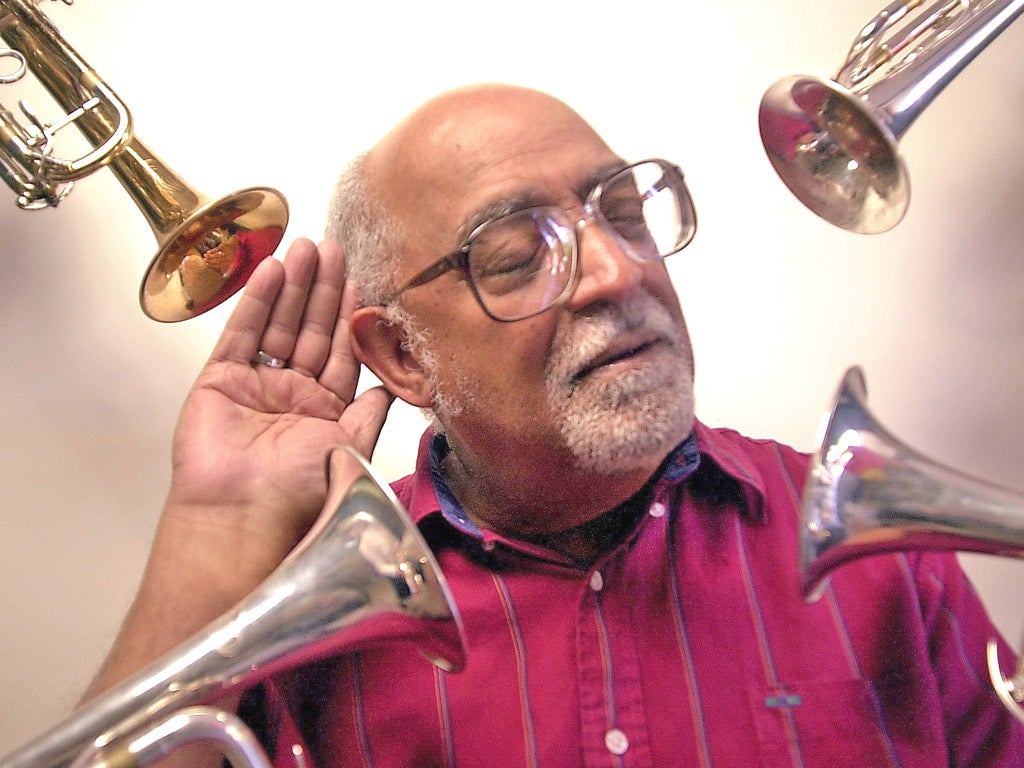
Wardell Quezergue was something close to a musical legend in his home city of New Orleans, where for decades he brought verve and sureness of touch to the recordings of artists from Louisiana and further afield. He led a band and sometimes composed, but most of all he arranged and produced songs for dozens of performers and groups.
Though he was known for his modesty, films of him at work in the recording studio illustrate that he was a maestro – so authoritative, in fact, that he was sometimes called "the Creole Beethoven". His arrangements often brought horns to the fore, lending pace and attack to the work of many soloists and bands. To the end of his long life – he was 81 when he died – one of the words most often used about him was "funky".
Wardell Joseph Quezergue was born in New Orleans in 1930. His father, mother and older brother all played instruments, and while still in his teens he was composing and performing in public. In 1951 he left high school to join the army which, recognising his talents, sent him to Japan during the Korean conflict to direct and make arrangements for an army band.
What happened next had a lifelong effect on him. During a performance he was told to bring the concert to an immediate end and return with his band to their base. Then the entire unit was ordered to report to the front line, but on their way to the airport an officer stopped their convoy of trucks and asked if Quezergue was on board. When he identified himself he was told to get off the truck and report back to base, where he was needed for the army bands which were remaining in Japan. Quezergue later learned that the man who replaced him was killed in action shortly after arriving in Korea. On hearing this, he went to church and promised God he would compose a work of thanksgiving for his deliverance; it was to take him more than half a century, but he finally made good on his promise.
While in Japan he met Yoshi Tamaki, who he went on to marry, and with whom he eventually had 13 children. After the war he returned to New Orleans to embark on a career in music, and formed bands such as the Royal Dukes of Rhythm, later Wardell and the Sultans, as well as teaching music and founding a record label.
He came to concentrate on working with artists, helping produce many hit songs. In addition to local performers these included Paul Simon, the Supremes, the Pointer Sisters, BB King, Stevie Wonder, Willie Nelson and the Neville Brothers. Notable hits included "Groove Me", "Mister Big Stuff" and, for the girl group the Dixie Cups, "Chapel of Love".
In explaining his composing method Quezergue made it sound easy. "I hear with my eyes," he told a local newspaper. "I can look at something and, before I write another part, I scan it with my eyes. My eyes read, then I hum the other part. That way I can look at one part and write another."
Allen Toussaint, another New Orleans musical veteran, said of him: "He was just a magnificent man in every way. He was a superb musician and bandleader – he always inspired the best out of people who were playing with him."
It was in 2000 that his work A Creole Mass, which he had begun after the Korean war, was finally ready to be performed. It involved 241 musicians, including a symphony orchestra and classical choir, a New Orleans brass band, a southern Baptist church chorale, a children's choir and numerous solo vocalists.
In his last decade of life Quezergue encountered two serious misfortunes. First he lost his sight as a result of diabetes, and then he lost all his musical scores and archives, together with other belongings, when his home was badly damaged in the floods caused by Hurricane Katrina in 2005.
His wife Yoshi died in May 2011, after more than 60 years of marriage. He is survived by eight daughters and five sons. As the Times-Picayune newspaper related: "He is also survived by 32 grandchildren, 15 great-grandchildren, three great-great-grandchildren and a host of nieces, nephews, cousins and other relatives and friends."
Wardell Joseph Quezergue, musician: born New Orleans 12 March 1930; married Yoshi Tamaki (died 2011; five sons, eight daughters); died Metairie, Louisiana 6 September 2011.
Join our commenting forum
Join thought-provoking conversations, follow other Independent readers and see their replies
Comments