The hedonist and the occultist: how two queer artists responded to the mundanity of England between the wars
Twin exhibitions at Tate Britain on Edward Burra and Ithell Colquhoun show their similarities as artists along with striking contrasts in their work
Tate Britain offers us two exhibitions for the price of one in paired surveys of enigmatic and highly idiosyncratic British artists. The duo are near exact contemporaries, both at their most active in the inter-war period, both queer and both closely related to Surrealism. The similarities end there. Where one (Edward Burra) has his inimitable signature style in place almost from his first painting, the other (Ithell Colquhoun) conceals her artistic identity, and indeed her personality, beneath a carapace of self-conscious mysticism.
Edward Burra
★★★★★
Burra (1905–1976) is one of the great mavericks of 20th-century art. A chronic invalid, martyred to rheumatoid arthritis and anaemia, who presented his life via his paintings as a non-stop bender through the flesh-pots of Europe and North America – Barcelona, Harlem, Marseille to name but a few – yet spent most of his time living quietly in his family home in Rye on the Sussex coast.

Pimps, gangsters, striptease artists and sailors strut their stuff through Burra’s crowded bars, cabarets and ballrooms in an atmosphere of tumultuous, slightly sinister hedonism that remains consistent wherever the artist roved in the world – though social and cultural details were always meticulously observed.
French Scene (1925-6), completed when he was only 21, shortly after graduating from London’s Royal College of Art, gives a good idea of the Burra approach, with its teeming scene of a flower market in the south of France. Every square centimetre is crowded with figures on buses, riding horses, in a heated, exotic atmosphere that feels positively Latin American; though Burra, hailing from an impeccably respectable upper-middle-class family, has inserted his fashionably dressed mother and childhood nanny into the foreground of the painting. The self-consciously blank expressions recall those mordant chroniclers of Weimar German decadence George Grosz and Otto Dix, alongside touches of the cubistic machine-figuration of the great French modernist Fernand Léger. That’s a heady combination of elements in a work that couldn’t even at this stage be mistaken for any other artist.
Burra, who hadn’t yet visited southern France, based his impressions on French literature and film. The further stylised The Two Sisters (1929), showing two distraught-looking identical women in blue hats, is based on promotional material for the Hungarian-American film entertainers the Dolly Sisters. The Tea Shop (1929), with its near-naked waitresses spilling tea on goggle-eyed elderly customers, is clearly fantasy. Such works would have attracted the epithet “surreal” even if Surrealism had never existed. Yet while Burra’s paintings were shown in several Surrealist exhibitions, he showed little interest in being part of any movement.
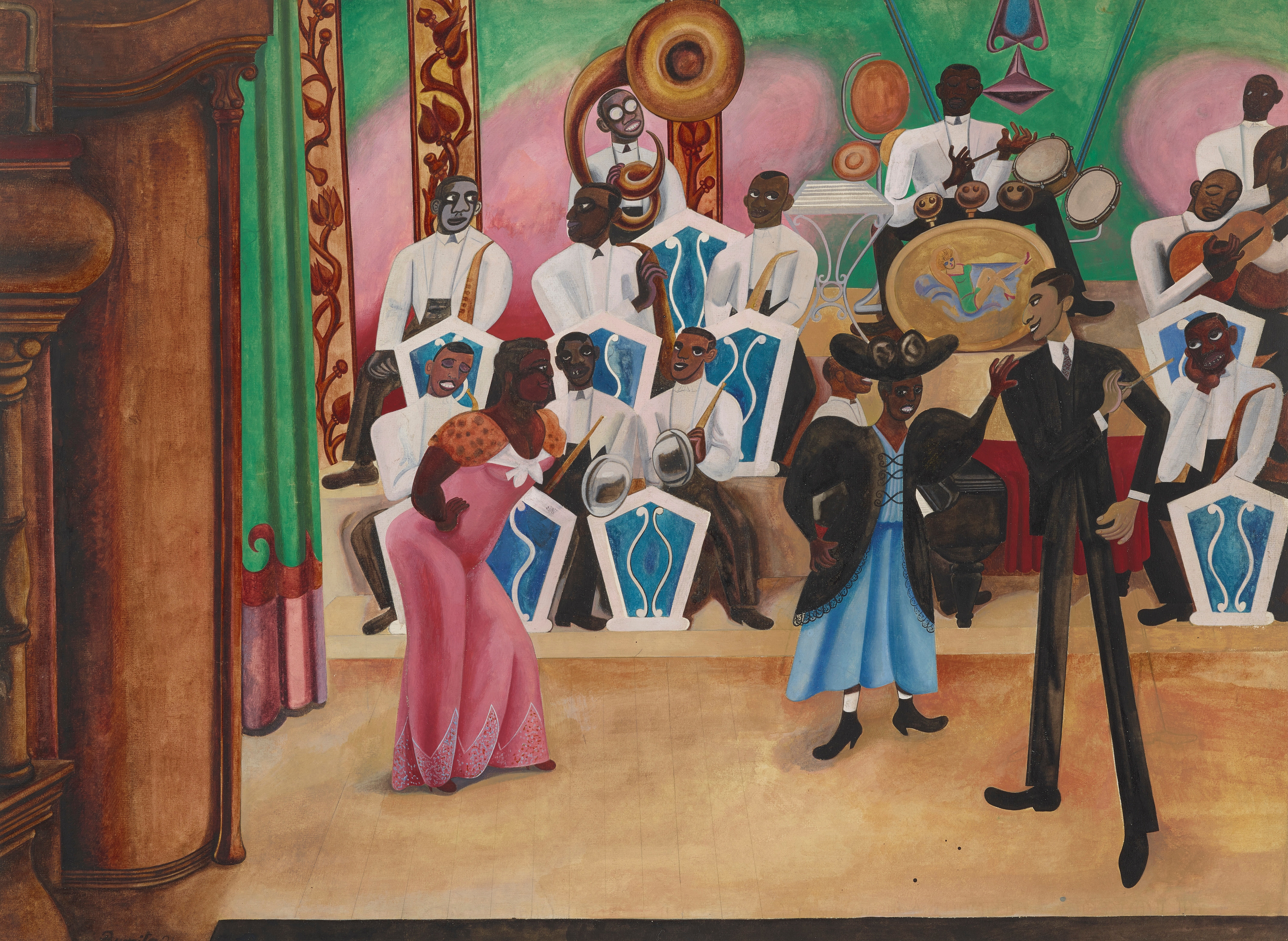
And the fact that many of his paintings were completed from memories and drawings back in the tranquillity of Rye doesn’t mean that Burra didn’t put in plenty of time in edgy environments that vibrated for him with the possibility of forbidden sexual encounters and the opportunity to identify with fellow outsiders. This is especially evident in his images of Harlem nightspots such as Savoy Ballroom, Harlem (1934). To see a white English artist capturing his sense of wonder at this exuberant all-Black scene (“I’ve never seen such wonderful dancing,” he wrote to a friend) without a trace of exoticising distance, in 1934, is remarkable in itself. But it’s the jewel-like colours, the energy of the lines and the fierce richness of the textures that are electrifying in these paintings. And with a few exceptions, Burra achieved these effects with modest watercolour and gouache – hardly the most sumptuous of mediums – as oil paint fumes aggravated his respiratory difficulties.
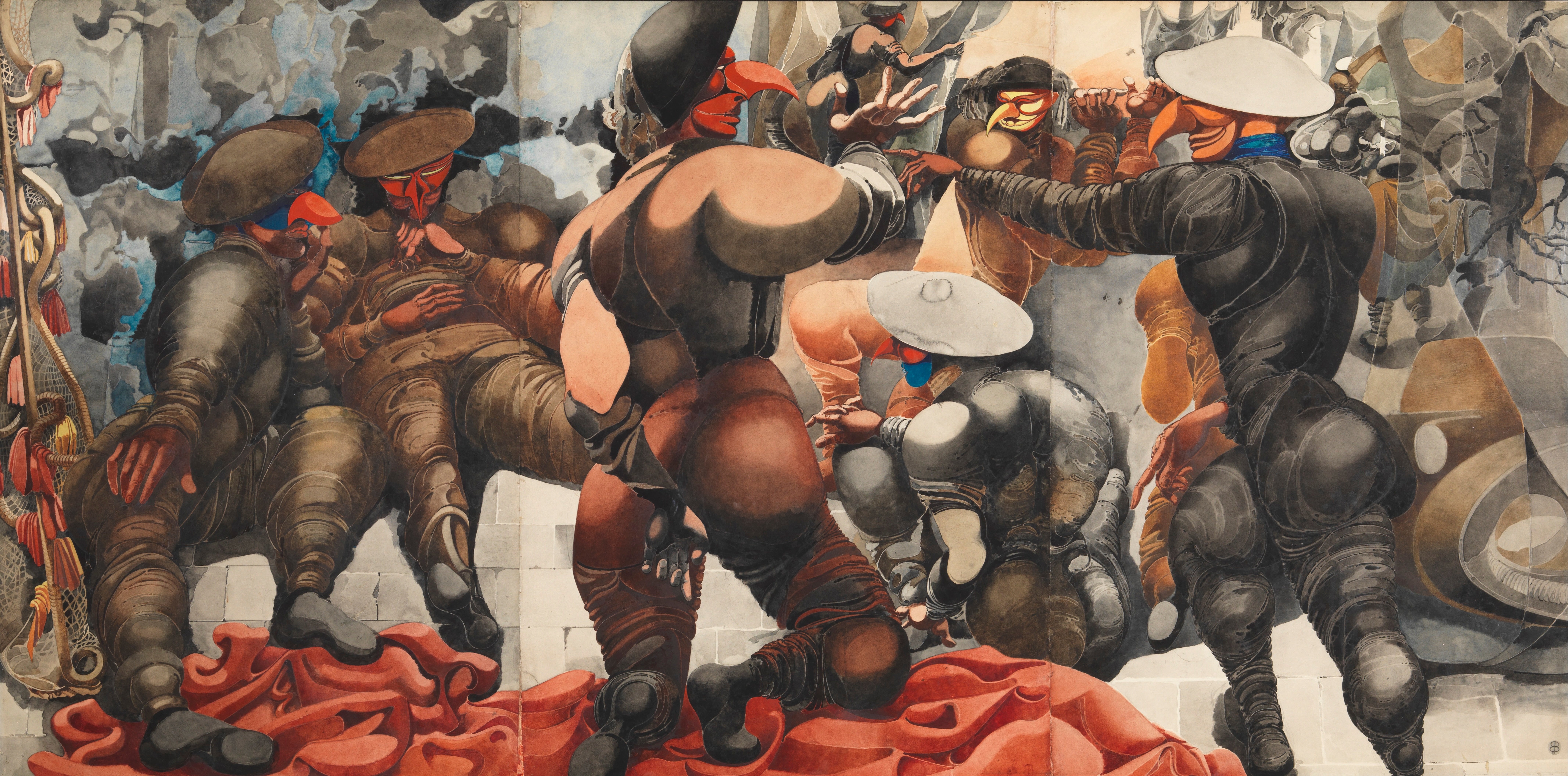
When Burra’s trans-European partying hit the brick wall of the Spanish Civil War in 1936, the ambition of his painting moved up a gear. Terrified by the “constant strikes, churches on fire, and pent-up hatred everywhere”, but refusing – typically for this least judgemental of artists – to take a side, Burra increased the scale of his images from intimate to monumental.
In the extraordinary and very large Bal des Pendus (1937) – over 5ft high, gigantic for a watercolour – huge and majestically muscled figures look down on the construction of a gallows in a town square, as a hooded man is lynched from a tree immediately below us. The cubist spatial disorientation in this stunning work and the frankly erotic overtones of the faceless, impassive figures were clearly even more disturbing to Burra than they are to us.
This large-scale and emotionally charged moral ambiguity continues compellingly through his works of the Second World War. In Soldiers at Rye (1941), a scene of conscripts relaxing in Burra’s hometown seems to turn into a homoerotic bacchanal. So it’s almost disappointing to emerge into peacetime and enter rooms devoted to his theatre and ballet designs, and landscape-dominated later works. Burra being Burra, however, not even a view of barren hills escapes a faint sense of the sinister and the mysterious.
Ithell Colquhoun
★★★☆☆
-1938--Tate--Spire-Healthcare-Noise-Abatement-Society-Samarita.jpeg)
There’s a lot more than a mere sense of mystery in the work of Colquhoun (1906–1988), one of a number of neglected British women Surrealists – others include Leonora Carrington and Eileen Agar – who are being brought back into the limelight to considerable acclaim. If Colquhoun is described in her exhibition’s introductory text as a “visionary artist, an innovative writer and a practising occultist”, visitors may end up feeling this list of distinctions came in a reverse order of priority in her own mind. Born in Shillong, India, the daughter of an imperial civil servant, Colquhoun moved back to England, where she attended Cheltenham Ladies’ College and the town’s art school. This move from intense sensual experience to English mundanity was responsible, the exhibition implies, for her lifelong leaning towards the esoteric. She adopted Surrealist practices such as automatism (freely improvising without conscious intention) and decalcomania (smearing paint between sheets of paper and letting chance determine the result) after meeting the Surrealist leader Andre Breton in the early 1930s.
Yet where Surrealist artists employed these radical methods to undermine what they saw as the complacent bourgeois order, for Colquhoun they were a means of accessing hidden realms of reality defined by occult groups such as the Ordo Templi Orientis and the Hermetic Temple of the Golden Dawn with which she was fascinated from an early age. Yet perhaps because of these extra-mural interests, Colquhoun never quite developed a distinctive visual language of her own.
.jpeg)
Gouffres Amers (1939), showing a flayed male figure rotting on a headland, with a flower projecting from a flaccid pipe in the genital area signifying impotence, is nowhere close to as disturbing as it might sound. The work’s companion piece, Scylla (1938), is more successful because it’s based on observed reality rather than an abstruse text. Two vaguely phallic rocks protruding from a still sea are revealed as the knees of a woman whose submerged form is visible beneath the water – “what I could see of myself in the bath,” Colquhoun recalled. In Attributes of the Moon (1947), a fantastical figure standing in a flesh-like cave, clearly suggesting vaginal walls, manages to invoke pagan goddesses, the lunar cycle, alchemy and the Virgin Mary, but still ends up looking like a piece of clunky sci-fi illustration.
Yet if Colquhoun never quite comes into focus as an artist or a human being, it’s hard not to respect her sheer commitment. A set of abstract tarot cards created with randomly smeared enamel paint, from as late as 1977, feel like a classic modernist project, and are rather beautiful, though their gnomic titles – The Lord of Material Success and The Lord of Success Unfulfilled are fair examples – may leave the non-initiate feeling as if they’re not quite getting the point.
But fair dos. If Burra’s appropriation of popular imagery prefigured Pop Art, Colquhoun was living out some of the wackier aspects of the hippie dream a good half-century before the event.
‘Edward Burra – Ithell Colquhoun’ is at Tate Britain from 13 June–19 October 2025
Join our commenting forum
Join thought-provoking conversations, follow other Independent readers and see their replies
Comments
Bookmark popover
Removed from bookmarks