Rob Lowe, Snow White and the mortifying night that nearly killed the Oscars
In dire need of a rebrand for their annual ceremony, the Academy Awards sought help from a lavish film producer famous for his caftans. The mortifying result, writes Clarisse Loughrey, nearly broke Hollywood. But more than 30 years later, the 1989 Oscars may teach us a few things about awards season spectacle
There was once an Oscars so bad, so haunting, so mortifyingly dark-sided, that it made people question whether the annual ceremony should be put out of its misery. It was 1989, and the Academy were keen for a shake-up. Chevy Chase had just come off a second consecutive year as host to a rash of negative reviews, with the LA Times branding the whole affair “parched, drab, and leaden”. For the 1988 ceremony, there were no real shocks or upsets to speak of. Bernardo Bertolucci’s sweeping historical epic The Last Emperor had been predicted to win – and it did, in all nine of the categories it was nominated in.
So, when Allan Carr – a Hollywood producer known for his wardrobe full of caftans, his work on 1978’s Grease, and his taste for outrageously kitsch house parties – claimed he could deliver “the most elegant production ever on television”, the Academy jumped at the opportunity. What would actually take place, on the night of 29 March 1989, would unleash a moment of such infamy that it would lead the New York Times’s Janet Maslin to remark: “The 61st Academy Awards ceremony began by creating the impression that there would never be a 62nd.”
Today, though, the 1989 Oscars has something unexpected to teach us: a cringe-inducing ceremony may be disastrous in the moment, but it’s also memorable, sticking around in the cultural memory far longer than any of the more sober, tasteful affairs of recent years. Hollywood is, inescapably, a little self-indulgent and delusional. And do we really want the Oscars to be cool, or would we rather they just be honest?
The most authentically Hollywood telecast in Oscar history begins with Snow White. Eileen Bowman, a 22-year-old unknown in a bouncy wig and a Bob Mackie-crystallised princess dress, rushes her way into the auditorium. And, then, in a strangulated rendition of Snow’s birdsong squeak, she performs a take on the old standard “I Only Have Eyes for You” while attempting to grasp the hands of various seated A-listers.
Sigourney Weaver, in a smoothly calculated move, readjusts herself to avoid Bowman’s touch. Tom Hanks isn’t so lucky. He shakes her hand with a bemused look on his face. Michelle Pfeiffer pulls away the moment she’s able to. In fact, the only actor who shows any investment in the bit is Martin Landau, who would later tell The Hollywood Reporter: “It wasn’t her fault. I empathised with her. Poor Snow White. She didn’t have the dwarves to support her.”
On stage, the curtains rise on a recreation of LA’s famous Cocoanut Grove nightclub, as talk show host Merv Griffin bursts into a rendition of “I’ve Got a Lovely Bunch of Coconuts” – delivered in a fake British accent, of course. Meanwhile, an army of dancers awkwardly shuffle a crowd of old Hollywood stars in and out of view, including Vincent Price, Dorothy Lamour, and Cyd Charisse.
Then, Snow is introduced to her “blind date” for the night: Rob Lowe, at the time a member of Hollywood’s “Brat Pack” and someone with genuine cultural cachet – up until this very moment, at least. Together, they launch into a parody of Creedence Clearwater Revival’s “Proud Mary”. She delivers reworked lyrics such as: “used to work a lot for Walt Disney /starring in cartoons every night and day”. He sounds like he’s coughing up a furball. Tables sprout legs and start dancing behind them. Briefly, the camera pans by Robert Downey Jr out in his seat, his smirk speaking elegantly for the entire crowd’s contempt.
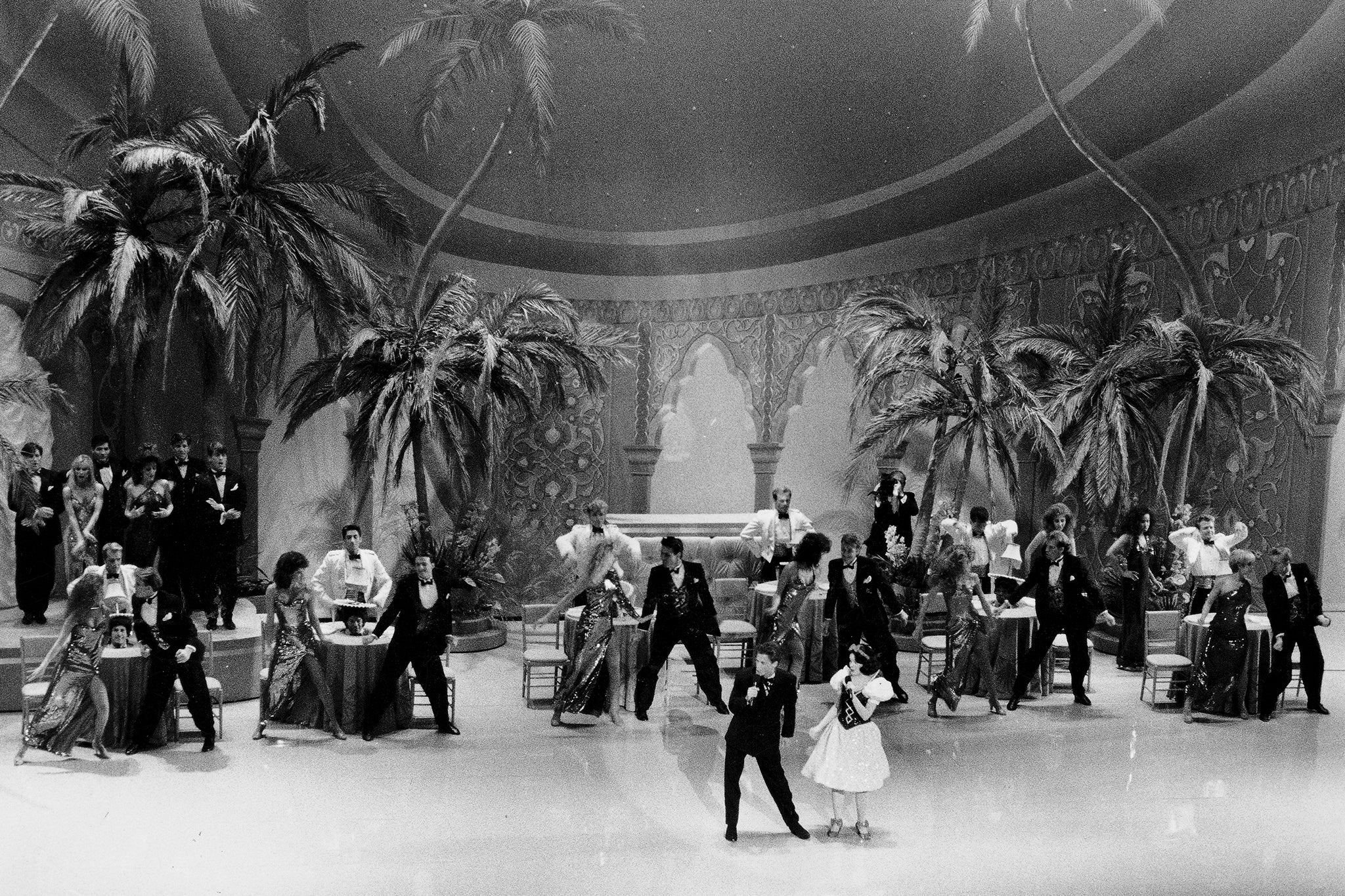
Somehow, it isn’t over yet. Another curtain rises, this time on the famed Grauman’s Chinese Theatre and a chorus line of ushers dancing to “Hooray for Hollywood”. Snow eventually re-emerges with the cinema’s gaudy entrance balanced on her head, out of which magically appears Lily Tomlin, doing a bit where she accidentally loses a shoe and a background dancer crawls awkwardly to retrieve it. “A billion and a half people just watched that,” she announces, as the segment finally comes to a close after 12 minutes of agony.
Another excruciating musical number happened later, with Bob Hope and Lucille Ball introducing a 10-minute sequence dedicated to the “stars of tomorrow”, in which Christian Slater sword-fought and Corey Feldman was forced to imitate Michael Jackson (supposedly because the choreographer, Kenny Ortega, became obsessed with the fact he’d worked with the musician).

Watch Apple TV+ free for 7 day
New subscribers only. £9.99/mo. after free trial. Plan auto-renews until cancelled.
ADVERTISEMENT. If you sign up to this service we will earn commission. This revenue helps to fund journalism across The Independent.
Watch Apple TV+ free for 7 day
New subscribers only. £9.99/mo. after free trial. Plan auto-renews until cancelled.
ADVERTISEMENT. If you sign up to this service we will earn commission. This revenue helps to fund journalism across The Independent.
“These are going to be the people winning Oscars way into the next century,” Hope teased. It’s a bizarre number, premised entirely on the idea that a statuette is all but an inevitability for the likes of Adventures in Babysitting’s Keith Coogan and Page Hannah, sister of Daryl and star of Creepshow 2. While there are a handful of recognisable names here, including Patrick Dempsey and Hairspray’s Ricki Lake, none of these “stars of tomorrow” are yet to even earn a nomination.
Reaction to the 1989 Oscars veered from mockery to outright objection. A letter, signed by 17 industry powerhouses, including Paul Newman, Billy Wilder, Julie Andrews, Gregory Peck, and William Friedkin, denounced the ceremony as “an embarrassment to both the Academy and the entire motion picture industry”. Disney, meanwhile, launched a copyright infringement suit against the Academy, claiming that the unauthorised use of Snow White “unintentionally creat[ed] the impression that Disney had participated in or sanctioned the opening production number on the Academy Awards telecast”. The LA Times called it “absolutely moribund”.
Carr’s name was already on the decline, his Oscars coming on the heels of flop sequel Grease 2 (1982) and, two years earlier, a pseudo-biography of the Village People titled Can’t Stop the Music. His hope was that producing the Academy Awards would help propel him back into the industry’s warm embrace. Instead, he never worked in Hollywood again, and died from liver cancer a decade later, aged 62.
“I remember vividly looking out in the audience and seeing Barry Levinson, who on that particular evening was the belle of the ball with Rain Man, and I could see him very clearly popeyed and mouthing, ‘what the [expletive]?’” Lowe told The New York Times in 2018. “But to be a successful actor, you have to have a big dollop of self-denial, so I managed to convince myself that I’d killed it.” Several months later, he’d become involved in a sex tape scandal that derailed his career. Bowman, meanwhile, claims she was made to sign a 13-year gag order, which prevented her from uttering a word about her experience. When she finally broke her silence to The Hollywood Reporter in 2013, she stated: “All I can say is what Rob Lowe said, ‘Never trust a man in a caftan.’”
In fairness to Carr, his Oscars weren’t all bad. He instituted several changes that are still in effect today, namely the extended red carpet coverage kicking off the show, the individual presentations for the Best Picture nominees, and a swap of the phrase “And the winner is…” for “And the Oscar goes to…”.
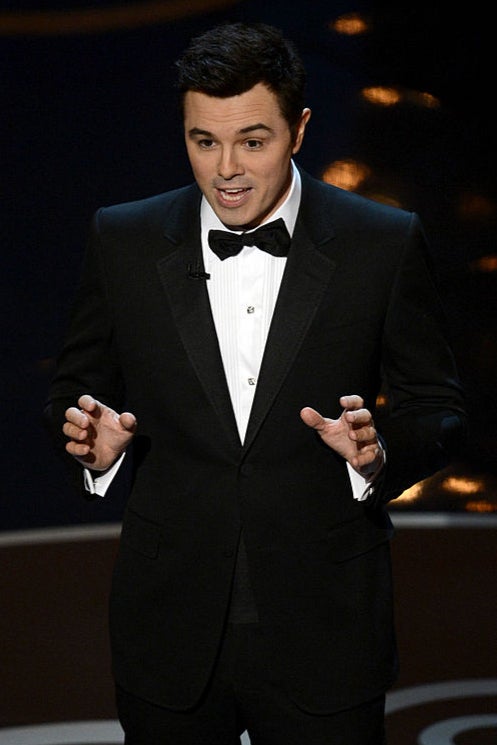
And, for balance, the Carr debacle is hardly the only time the Academy’s reputation has come under question. When Family Guy’s Seth MacFarlane hosted in 2013, he performed a number called “We Saw Your Boobs”, in which he pointed at various famous women in the audience and named any of their projects which featured on-screen nudity – “Jessica Chastain, we saw your boobs in Lawless, Jodie Foster in The Accused, Hilary Swank in Boys Don’t Cry, Penelope Cruz in Vanilla Sky”. In both The Accused and Boys Don’t Cry, the characters in question are being sexually assaulted.
MacFarlane defended the bit, claiming it was really a satire on what the public expected him to do. It was a brand of detached irony that could only truly exist in the early 2010s, and the comedian found himself lambasted by feminist lawyer Gloria Allred, but defended by the year’s Best Actress winner, Jennifer Lawrence (“I loved the boob song, I thought [Seth MacFarlane] was great!”) His stint was succeeded by a swift return to geniality: Ellen DeGeneres and her viral, celebrity selfie; Neil Patrick Harris doing magic tricks; and Jimmy Kimmel surprising an auditorium full of the unsuspecting public with director Guillermo del Toro and a gigantic sub sandwich.
But the irony of it all is that cringe does sell, whether we care to admit it or not. The 1989 telecast reached 42 million people, reversing a five-year decline in numbers. And, now, with the rise of social media, a clip of Ariana DeBose enthusiastically rapping the line, “Angela Bassett did the thing” at last year’s Baftas has far more mileage than a few, nice lines of patter from a late-night comedian. If there’s ever an Oscars opener as mortifying as the Snow White routine again, at least it would get people to talk.
Join our commenting forum
Join thought-provoking conversations, follow other Independent readers and see their replies
Comments
Bookmark popover
Removed from bookmarks