The record label wanted another ‘California Girls’. The Beach Boys gave them a song that changed the world
Amid political unrest and label pressure, Brian Wilson became consumed by his ambition to create a song that distilled a feeling of pure positivity, leading to what was, at the time, the most expensive single ever recorded. Sixty years since its inception, Mike Love and biographer Peter Doggett speak to Mark Beaumont about the making of ‘Good Vibrations’

Mike Love left it to the very last minute to make his contribution to what was, at the time, the longest, most elaborate and expensive pop recording in history. “I’d taken my time doing the lyrics, because it kept changing from studio to studio and version to version,” Love, one of two of the Beach Boys’ surviving original members, recalls. “So finally, this is it, the day of recording the vocals, so that’s when I dictated the lyrics to my ex-wife, Suzanne, on the way to the studio.”
Love’s studio-based Beach Boys bandmate Brian Wilson, who died in June last year, aged 82, had spent seven months, around 20 sessions over four studios and between $10,000 and $50,000 – the equivalent of half a million dollars today, making it the most expensive single song ever recorded – obsessively perfecting the backing track of his ultimate teenage symphony to God. But, plucked from the air on the 20-minute drive from Burbank to Columbia Studios in LA in September 1966, Love’s lyrics were a bolt of sheer flower-powered inspiration: “I love the colourful clothes she wears, the way the sunlight plays upon her hair…”
“That song was done at a time when the Vietnam War was going on,” Love tells me of “Good Vibrations” – the global Number One hit that was started 60 years ago today and finally finished as Love drew up to the studio in September 1966. “There was student unrest in the US. We were all concerned about our draft status. Carl Wilson became a conscientious objector. The FBI wanted him to join the military but he wasn’t about to do that. There were all kinds of terrible things, as there always are all around the world,” Love says. “But I wanted to accentuate the positive. I wanted to make it about peace and love and a girl who was into nature and love and positivity.”
His legendary chorus hook – “I’m picking up good vibrations, she’s giving me excitations” – gave Brian similar feelings; a summation of the deeply rooted poptimism he’d been trying to satiate for most of the year. “His mom said that animals, particularly dogs, pick up vibrations that human beings don’t,” Love says. “So I think the idea of a vibration just appealed to him. It was kinda mystical, mystical and abstract. And Brian was very capable of getting extremely mystical when it came to music. That was what separated him from so many others.”
Like so many legendary singles, “Good Vibrations” was the result of a record label hearing a work of brilliant, undiluted artistry and demanding the band whack a hit like the last one on it. Having retired from touring with The Beach Boys to concentrate on studio composition in 1964, Brian Wilson had laboured long – his piano in a sandbox to feel the beach at his feet as he wrote – to make 1966’s Pet Sounds his melancholy masterpiece. Lashed with the lustrous textures of The Wrecking Crew – the loose collective of around 30 top-class LA session musicians behind dozens of Sixties hits – and some of Wilson’s most heart-stopping melodies, the record would inspire The Beatles to greater heights of creativity. Today it is considered one of the greatest albums ever made.
Capitol Records, however, didn’t hear a hit. “They had played the album to their promotional department, and they didn’t know what to do with it, because it was such a departure,” Love says. “And [Beach Boys A&R man] Karl Engemann, the nicest guy that you ever could possibly want to meet, he said, ‘Gee, guys, this is great. But couldn’t you come up with something more like ‘California Girls’, ‘I Get Around’ or ‘Fun, Fun, Fun’?’”
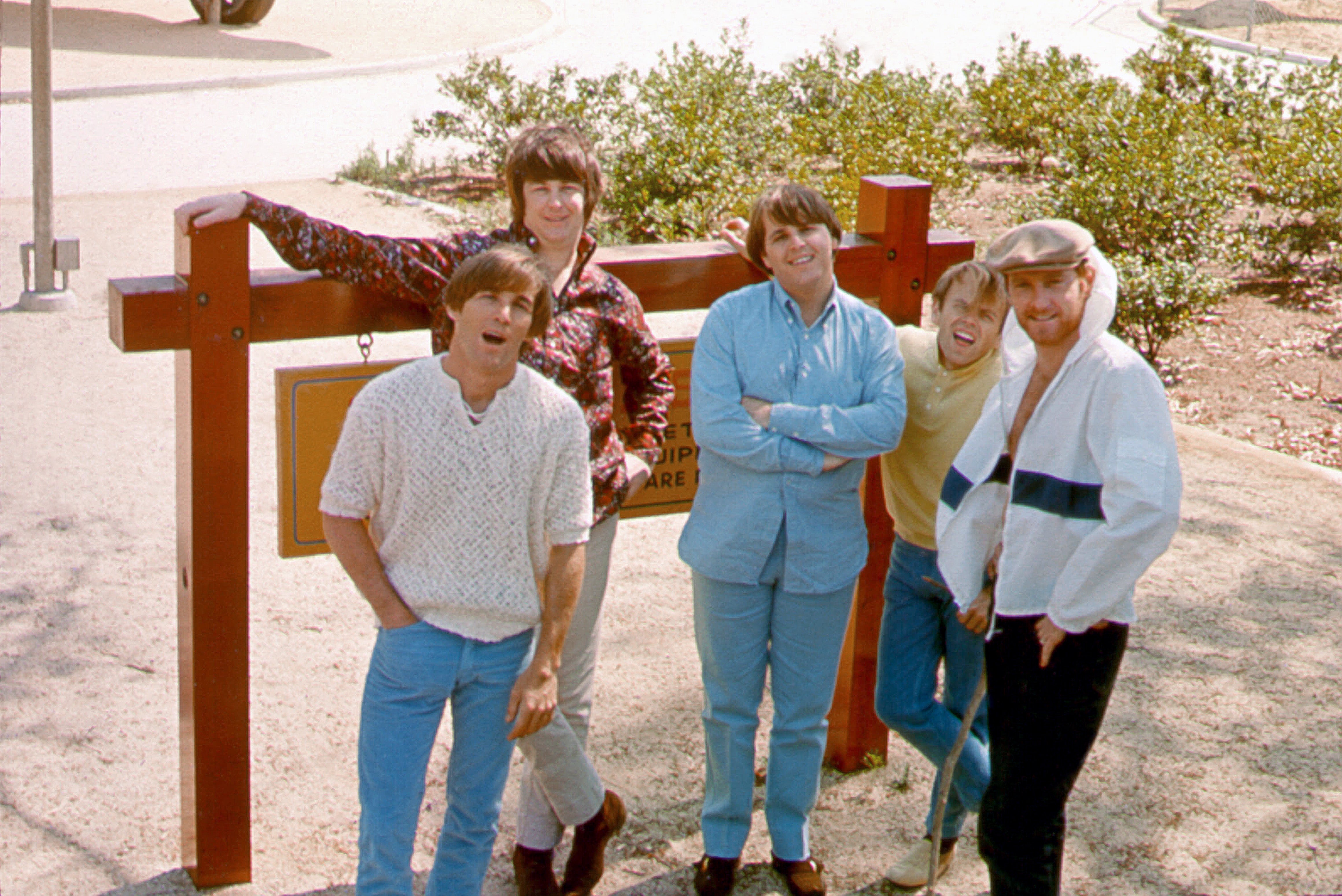
An early version of “Good Vibrations” was suggested, but its upbeat tone didn’t suit the more ruminative feel of Pet Sounds. “It doesn’t fit thematically, it doesn’t fit lyrically and it certainly doesn’t fit musically,” says Peter Doggett, author of last year’s Wilson biography Surf’s Up: Brian Wilson and the Beach Boys. “It’s much more of an R&B-flavoured feel. Very early on, as soon as he’d cut the backing track, [Brian] was talking to friends about giving the track to Wilson Pickett or maybe Marvin Gaye.”
Instead, Wilson kept the song for himself, and over the course of 1966, while his bandmates embarked on their first tour of Japan, it became a source of intense obsession as he strived to realise the climactic sounds he could hear in his head. “Obsession was the name of the game for Brian Wilson by ’66,” says Doggett. “It certainly seems, in personal psychological terms, the song represented something to him beyond a Beach Boys record. There was something about this ethereal idea of good vibrations that completely took him over because it was what he was trying to make out of music and what he was experiencing through the various chemical and herbal concoctions that he was taking into his body at that point as well.” Wilson would later admit that “Good Vibrations” was first written on marijuana and something of an ode to his experiments with LSD. “The problem with the record, for him,” says Doggett, “was how do you capture an overwhelming feeling rather than a particular song?”
It certainly seems, in personal psychological terms, the song represented something to Brian beyond a Beach Boys record
The more Wilson tried to record it, shepherding The Wrecking Crew from studio to studio over the coming months, the more he realised the song needed to be constructed in sections rather than as a single complete recording. “I wanted to write a song with more than one level,” he said, midway through 1966, “so that the song can be more meaningful. A song can, for instance, have movements – in the same way as a classical concerto – only capsulised.”
Doggett points to “Eleanor Rigby” as another song of the era that aimed to shift previously disposable pop music in the direction of high art, but with its multiple, shifting sections – its playful opening, its theremin-driven chorus, its pop-stretching interludes and its classical choral climax – “Good Vibrations” was a far more ambitious and fully realised symphonic enterprise. “When Brian starts using the fragmentary process and the collage basis, he has fallen headlong, without realising it, into the tradition of modernism,” says Doggett. “He’s using techniques and theories that had become standard in literature and in the visual arts and film as well. But he was really the first person to apply those particular high-art principles to pop.”
A sign of the genius mind, to so avidly pursue a vision? “Absolutely,” says Love. “It’s brilliance by Brian. Between that and the Pet Sounds tracks, it’s the apex of his creative abilities, there’s no question about it.” Love recalls nicknaming Brian “Dog Ears” at the time. “Because he could hear things that other people couldn't. When we did maybe 25 takes on one section of ‘Wouldn’t it Be Nice’, I said, ‘That’s perfect, Brian’. He said, ‘No, do it again’. So the vibration of those vocals, when listened to by themselves, they’re literally amazing. It amazes me and I was in the group.”
Despite their concerns about the song’s cost and commercial prospects, The Beach Boys were blown away by the finished product. “Absolutely, it was worth the effort,” says Love. “It was brilliant. It was unique. It was so avant garde. I think it’s still avant garde, and it came out in 1966. And [it] was such a perfect thing for the time, which was so contentious worldwide, as it is now… Finding something positive, in light of all the things that were going on at the time, is what made it special.”
The world agreed. Dubbed a “pocket symphony” by their publicist Derek Taylor, “Good Vibrations” became The Beach Boys’ first million-selling Number One hit and had an immense impact on the immediate 1960s pop scene. Coming from a band as big as The Beach Boys, it validated the emerging hippie counterculture and laid the beach blanket on which the following year’s Summer of Love would make like a daisy-clad Eyes Wide Shut. And its revolutionary multi-part construction, in such a massive hit record, opened the door for a generation of progressive pop visionaries – it’s thanks to “Good Vibrations” that we got “A Day in the Life”, the Abbey Road medley, “Bohemian Rhapsody” and “Paranoid Android”.
For Wilson himself the song was a mixed blessing. Arguably his peak artistic achievement, yes, but one that hobbled the art to come. “What happens when you demolish the structure of the popular song, and still get it to communicate?” Doggett asks. “After that point [Brian] lost the sense of what a song was.” He points to “Heroes and Villains” – the single that emerged from Wilson’s increasingly erratic studio session for the subsequent, abandoned Smile project, which involved Wilson starting a fire in the studio and a visiting Paul McCartney reportedly chewing vegetables on one track – as an example of Wilson’s loosening grip on his own genius. “’Good Vibrations’ marks the end of the moment when Brian Wilson knew exactly what he was doing in the studio and exactly how to achieve it,” he says. “For psychological reasons, for band politics reasons, health reasons, financial reasons, it’s a real dividing line in the Beach Boys’ story. It’s almost so perfect that it kills what [came] next.”

The song endures, though, as one of the most ambitious, influential and uplifting pieces of music of all time. Love was overjoyed to see the song top a list of the happiest songs ever recorded, scientifically compiled by music psychologist Dr Michael Bonshor in 2023. The song beat “House of Fun” by Madness, Billy Joel’s “Uptown Girl” and The Village People’s “YMCA”.
“He really researched it and did it scientifically,” Love says, pleased that he helped create such a beacon of good vibes in an otherwise bleak world. “It was a true collaboration, Brian’s brilliance and my spontaneous lyrical offerings, I was able to make. And it just happened to result in probably one of the most successful recordings we ever made. And we’ve made some good ones, too.”
Join our commenting forum
Join thought-provoking conversations, follow other Independent readers and see their replies
Comments
Bookmark popover
Removed from bookmarks