‘With Lily Allen, we blacked out and had an album’: How songwriters help artists make their most personal music
The behind-the-scenes content shared from Lily Allen and her team for ‘West End Girl’ gave the public a rare insight into the usually unsung work of songwriters. What is it like to be involved in such an immensely emotional and personal project, Hannah Ewens asks Lily Allen co-writer Chloe Angelides, and Jessie Ware and Perrie Edwards co-writer and singer-songwriter Nina Nesbitt
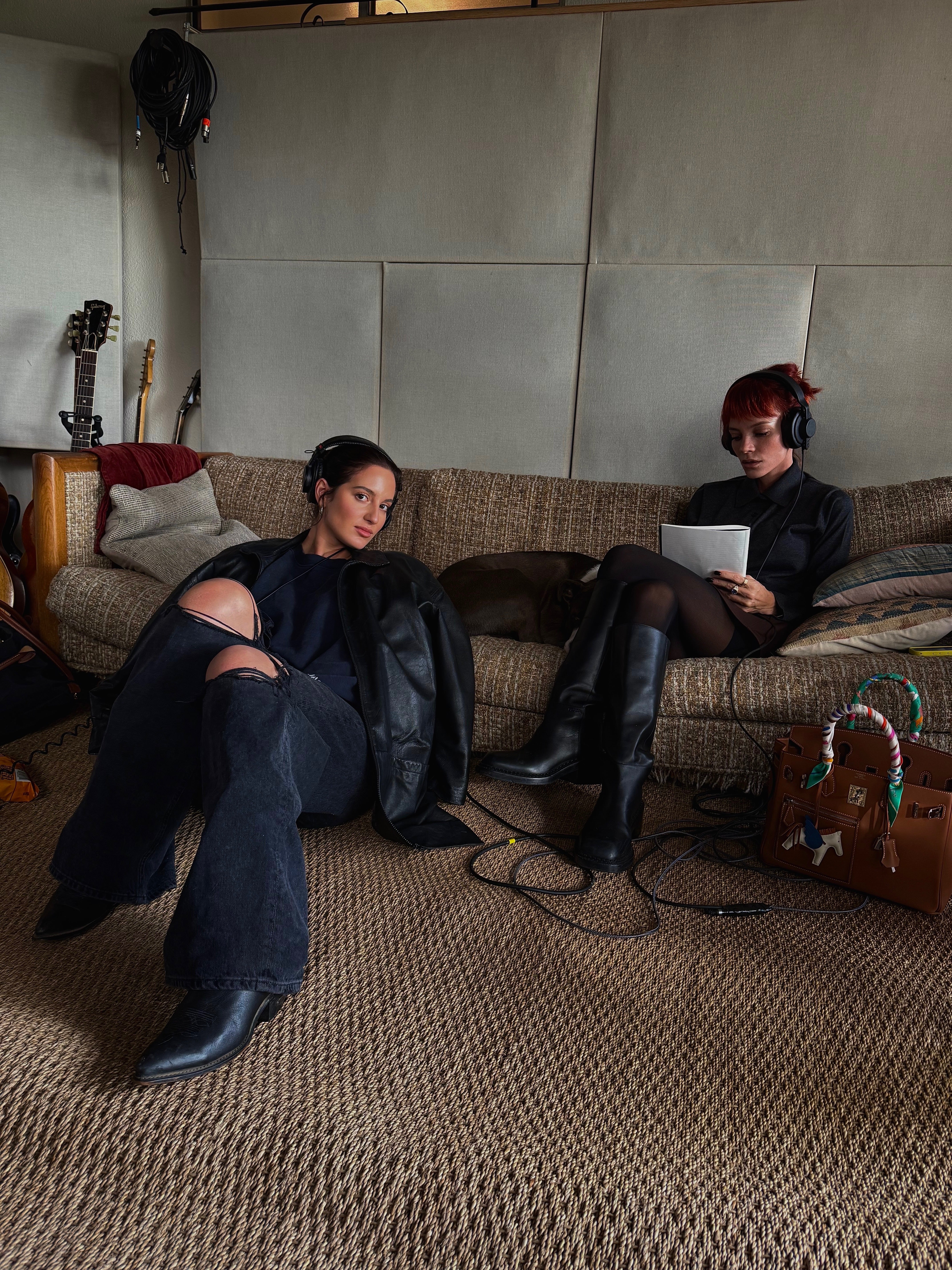
I saw the word “vasectomy” and was like, ‘This is going to be insane,’” remembers 33-year-old songwriter Chloe Angelides, co-writer of multiple songs on Lily Allen’s excoriating divorce album West End Girl. The British pop singer had brought her diary entries to the studio for inspiration and was continuing to jot notes down. “[Producer] Blue May started playing the most heartbreaking guitar chords and I was taking words she was writing down and making them rhyme.” The result was the painfully vulnerable ballad “Just Enough”, written by Allen and her team in an hour. “I don’t know anyone else in [pop music] opening up about feeling old and hoping that a facelift holds and talking about vasectomies,” says Angelides of Allen.
For music fans and the general public, the creation of Allen’s West End Girl has been a source of both mystery and envy. There’s a tabloidy undercurrent to it all, of course: it’s a messy album about two very public figures, inviting listeners to speculate about what’s true and what’s an exercise in artistic licence. The record was apparently made in just 10 days. Photos, videos and captions the team have shared make the process look both fun and intense; Allen writing down song titles from a cave-like apartment with light and palm trees outside; everyone dressed chicly in leather and black, lounging in front of recording equipment during the day, dancing or drinking wine while perched on mid-century furniture at night.
This behind-the-scenes material has lifted the curtain on the work of songwriters. Most people rarely think about them, except perhaps to criticise an over-produced pop song or to marvel at stories of creative sparks: think of Adele’s “Rolling in the Deep”, which emerged from Paul Epworth banging on a broken drum, or Max Martin’s misunderstanding of American slang, which led to the faintly confused yet instantly iconic “hit me baby one more time”.
Allen’s album is fiercely idiosyncratic, rooted in a very specific situation to her. It feels like we’ve grown up with her and now we’re hearing a new, painful chapter in her story. But she had help when it came to conveying her innermost feelings to her audience. So what is it like to be a songwriter on such an immensely emotional, deeply personal project like West End Girl? Do songwriters have to give more or less of themselves in those circumstances, compared with writing “for pitch”, where songs are offered up for anyone to buy?
For Angelides, though the album’s creation is fresh in recent memory, it’s difficult to break down exactly how it came to be. “With Lily, I feel like we blinked and blacked out and we had an album.” Ahead of writing it, the team spent a day talking about Allen’s story, which was crucial to the writing. “She’s the most straightforward, honest, open person,” she says, “and it didn’t leave room for any confusion or questioning.” Every day they’d ask her how she was feeling and which idea she wanted to focus from a list she’d come up with. Bar a couple of songs, most of what they wrote together made it onto the album, which is rare odds. Many of the vocals were done in one take, with no re-recording.
“Pussy Palace” sticks out in Angelides’ mind as a highlight. Blue May was playing a synth chord progression that made her start “freaking out” – they wrote on top of that. “By the end of it, Blue bought out a light machine that shines bright-ass lights on the wall, and a fog machine. The room was filled with fog and colourful lights and we’re blasting ‘Pussy Palace’ 50 times in a row,” she recalls. That night she drove back home across LA, knowing the song was special, but wondering about the reception it would receive. “I just helped a legendary artist write a song called ‘Pussy Palace’. Is this gonna do well or will people be like, ‘How dare you contribute something like that?’”
![Songwriter Chloe Angelides: “Once I’m done writing with [artists] I just get to go home and be me.”](https://static.independent.co.uk/2025/12/23/22/05/766964_0006.JPEG)
A songwriter on an intimate project like this isn’t just a writer: they’re a therapist, a sounding board, a friend, a philosopher, a conduit for their vision. Entering into someone else’s world, processing their emotions with them, requires self-care. “My shower is the way I do it,” says Angelides. “I will just take a shower when I get home to mentally wash off.”
It’s rare that songwriters will be possessive over the material they help write. Most don’t have their own projects or release seriously under their own name. Angelides does, but like the vast majority of songwriters, she prefers to be behind the scenes. “I’m 33 and maybe I’ll change but I am who I am and I hate being on stage and having a spotlight on me,” she admits. For her, the writing of songs is the biggest high, as is the songwriter lifestyle of writing and hanging out with musicians: “Once I’m done writing with them, the artist has to go tour it, they have to go shoot the videos. I just get to go home and be me.”
Nina Nesbitt, a chart-topping Scottish artist who also writes for performers including Perrie Edwards and Jessie Ware, says she feels excitement rather than envy for the artists she writes for – though it depends on the kind of songwriting she’s doing. Co-writing directly with an artist is one thing; writing “for pitch” is another. She admits she has occasionally felt defensive of her creations: “Honestly, it’s like someone trying to steal your child,” she laughs.

Enjoy unlimited access to 100 million ad-free songs and podcasts with Amazon Music
Sign up now for a 30-day free trial. Terms apply.
ADVERTISEMENT. If you sign up to this service we will earn commission. This revenue helps to fund journalism across The Independent.
Enjoy unlimited access to 100 million ad-free songs and podcasts with Amazon Music
Sign up now for a 30-day free trial. Terms apply.
ADVERTISEMENT. If you sign up to this service we will earn commission. This revenue helps to fund journalism across The Independent.
On one occasion, she fell in love with a song she had co-written that was put on hold for Rihanna. “Obviously I’m never going to stand in the way of everyone getting a Rihanna cut – we all have equal percentages here, people have to pay their bills and feed their kids,” she recalls. “As much as I loved it, I’d rather Rihanna sing it.” When the song didn’t materialise, however, there were talks of it being passed to other artists. “I felt devastated at the thought of not putting it out myself.” She eventually persuaded the team to let her keep it, and her gut instinct was vindicated: “Is It Really Me You’re Missing” went on to become one of her biggest hits released under her own name.

Being an artist in her own right allows Nesbitt to help other artists create their music with no ego, she says. While working with them on something particularly sensitive, she often asks: “Do you want to personally, actually, release this as a song, or is this just something you’re wanting to get off your chest?” From there, she facilitates and steers without overstepping: she writes words or phrases the artist is sharing in a notebook, hums melodies and says gibberish lyrics, until they capture the feeling they’re describing and can build a song around it. “Whatever happens in the room stays in the room, so it really is a safe space,” she adds.
Professional songwriters, Nesbitt says, have a sixth sense for identifying what went into a song when they hear it, even down to the country it was written in. “I can hear if there are four writers on a song, I can hear the conversations that they’ve had about cutting the pre-chorus in half or the chorus needing to go to this note,” she says, citing Katy Perry’s “Never Really Over” as an example of a pop masterpiece, a mathematical equation that is “very written”, surely the product of many minds. After our conversation, I looked it up: a total of nine songwriters are credited for “Never Really Over” including Norwegian singer Dagny, whose 2017 track “Love You Like That” was a huge inspiration for Perry’s hit.
“Then I can also hear when there’s just one or maybe two writers. It feels very unedited, like a stream of consciousness,” Nesbitt adds. Neither type of song is better than the other, she argues, they’re just different mediums. In the same way that you can appreciate Fleabag or Girls as being the slightly demented product of a solo star and Succession or The Thick of It as a group tennis match between intellectuals, you understand that they’re all equally impressive for separate reasons, not even remotely attempting to do the same thing.
And yet, both Angelides and Nesbitt describe a kind of collective flow state – one that can emerge between an artist and a group of collaborators – allowing everyone to move together towards a shared vision that reveals itself simultaneously to all involved. This is how multiple writers can lock in with an artist and create something as intimate, painful, and funny as West End Girl, sounding, if anything, even more like Lily Allen than if she’d written it alone.

It’s also why, when it comes to working out splits on songs, who gets paid what percentage or even who wrote what can be incredibly complex. In a paper called “Working Out The Split: Creative Collaboration and Assignation Of Copyright Across Differing Musical Worlds”, Dr Phillip McIntyre and Justin Morey write: “The combinations of collaboration seem to be limitless. Most often, most writers are not too concerned with who does what or how it happens that the song is created. Until of course it’s time to work out the ‘split’ or financial remuneration for the work involved. Then a number of complex financial, legal, moral, social, cultural, ideological, discursive and, dare we say, mythological factors become very important.” The development of AI and its use in the music industry will likely complicate this. As Nesbitt says, “I wonder if I’ll be able to hear ChatGPT in a song soon.”
After the music is made, much of a songwriting career involves waiting for someone to buy your songs, and for the sting of rejection to fade. Angelides has “thousands and thousands of songs that could find a home at any second”, either under discussion or sitting in a bank for her publishers to place. “I had a song with Carly Rae Jepsen come out eight years after it was written,” she says. “When they sent the email about the songwriting splits, I’d forgotten which song they meant because it was so old. But it came out. So even if it’s a ‘no’ at first, songs can find a home eventually.”
Perhaps the most important skill for a working songwriter is learning to relinquish control, whether that’s control over how a song is made, who sings it, how it’s delivered, or what it becomes after release. That final surrender has been almost psychedelic for Angelides when it comes to West End Girl. An album she played constantly in her car during the writing process went viral: it was memed, obsessed over, and was suddenly everywhere.
At Thanksgiving, while eating and playing board games with her extended family, “Pussy Palace” played quietly in the background. She felt herself moving differently to the music, heard the production anew, and realised it could function as ambience. “I try to let whatever I’m making become what it is,” she says. “Like, ‘Pussy Palace’ is playing when my grandma is next to me and she has no idea what we’re saying in the song, but it’s just a good beat. That is so funny to me.”
Join our commenting forum
Join thought-provoking conversations, follow other Independent readers and see their replies
Comments
Bookmark popover
Removed from bookmarks