‘I’d broken out of the cult’: How Oasis, addiction and Gary Barlow pushed Robbie Williams into quitting Take That
Thirty years ago, the irrepressible pop star caused chaos by leaving the UK’s biggest boyband, Take That, and embarking on a solo career. Mark Beaumont charts the behind-the-scenes issues – from addiction to resentment – that led to the split, and speaks with experts about the moment’s lasting cultural impact

The hair was spiked and crusted with peroxide. The eyes were dark, hooded and glazed by fatigue. The outfit was pure Adidas Lad and he appeared to have a tooth missing. Resembling the delinquent love child of 2D and Murdoc from Gorillaz, the geezer – arguably the pinnacle of the form – looked for all the world like a drug dealer who’d jumped the fence and somehow blagged his way backstage pretending to be Robbie Williams from Take That.
Yet this was indeed the formerly clean-cut, cheeky-grinning boyband heartthrob, snapped relentlessly at that fateful Glastonbury of 1995 by the eager papparazzi – beer bottle in hand, cigarette in gob and either throwing an arm around Noel Gallagher or receiving a smacker from Liam. “Because I’m in the sort of band I’m in, people are looking at me like, ‘You’re not supposed to be here’,” he told the news cameras, seemingly unaware of the disapproving storm brewing back in the real world, too.
In just a few photos, Williams – by curling his Pilton-encrusted fingernails through the flimsy façade of squeaky-clean boyband perfection – exploded the great pop myth more than any Beatle beard. Within weeks of waggling his backside onstage with Oasis, he was ejected from Take That and the band was set on course for collapse, splitting just seven months after his departure. Yet Robbie’s rebellious departure – 30 years ago today – was more than just a heartbreaker for fans and a huge upheaval for the pop world. It stands today as arguably the ultimate expression of Nineties lad culture and a definitive image of the hedonistic abandon of the age.
For Williams himself, his real-me emancipation had been a long time stewing. “I’d broken out of the cult,” he said in last year’s Boybands Forever documentary. “[Oasis] were the antithesis of Take That and that very much appealed to me … There were lots of rules and eventually when there’s that many rules, you’re gonna break rules.”
A keen stage performer as a child (his Artful Dodger reportedly stole the show at a school production of Oliver!), Williams was just 16 when a typically endearing wink at the end of an otherwise underwhelming audition for manager Nigel Martin-Smith landed him a place as the youngest member of Take That. The band had been put together largely as a vehicle for the songs of Gary Barlow, and Williams soon found himself relegated to the lower end of the band’s hierarchy. “Gary was Nigel’s cash cow,” Williams said. “I was resentful.”
Lacking a dance background, Williams struggled to learn the band’s overly intricate dance routines, and when he dared to add a rap verse to a song, he was warned not to ask for any publishing income from it. “You learn your place,” he said, and his place was shaky from the start. He claimed he was warned by Martin-Smith that he was easily replaceable if he messed up: “It made me feel like my place within the band was never safe and guaranteed,” he said. He was left feeling “not loved, not even liked. And I was 16.”

Williams likened his experience in Take That to William Golding’s Lord of the Flies, not least due to the animosity that developed between him and Barlow. Tensions were stoked by the fact that it was the younger, 18-year-old singer, not his controlling, self-serious bandmate, who fronted the band’s first top five hit, a hi-NRG cover of Barry Manilow’s “Could It Be Magic”.
“I knew that he didn’t like me or felt threatened by me,” Williams said. Barlow explained further in a 2024 podcast: “My friends were Jason [Orange] and Howard [Donald], it was the three of us, we were the older ones, we got on,” he said. “Mark [Owen] and Rob were always a bit removed for us. They were cool, younger … and they were the naughty ones … always off doing something else.”
The immense fame that the success of Take That brought only compounded Williams’s insecurities. “The tremendous gift that was bestowed on me and the other boys turned into a nightmare,” he said. “There’s something psychically that happens with having immense notoriety. It’s the opposite of breaking the fourth wall, it’s going back through and inhabiting this strange place that wasn’t what you thought it was … Nobody goes through that level of fame and comes out the other side completely sane or not mentally affected.”
Age-old story: by his early twenties, Williams had turned to drink and drugs. Until then, Take That had operated as a relatively strict, hermetic, almost monastic group. “I said to the boys right from the beginning to build a wall around the six of us,” Martin-Smith told news crews early in their career. “When, for example, girlfriends started getting involved in what should be happening with the band, that’s when I’ve seen so many bands start falling apart.” This one fell apart, however, because one member needed to escape. “My particular brand of seeking salvation and safety came in the form of substances and alcohol,” Williams said. “I’d become feral. Lots of coke, lots of darkness, lots of comedowns that were hellish.”

As his substance abuse intensified and Williams entered what he’d later describe to the BBC as “a nervous breakdown, my first of many”, he began missing rehearsals, or turning up in no fit state to perform. “I was ingesting everything I could get my hands on,” he told a 2023 Netflix documentary about his life. “I [was] literally drinking a bottle of vodka a night before going into rehearsals.” His bandmates would pull him up for letting the side down. “I was told this is not how you behave in a boyband,” Williams said. “The sense that I wasn't ready or capable to fulfil the role that was being asked of me was palpable.”
“We’d all had our different journeys,” Barlow said, “but it had just [got] too much for him. The day in, day out, the work, the stress of it all, me leading everybody and telling them what to do, it… I was unbearable. They put up with a lot [from] me. I was right all the time and I was the leader all the time. That original role I’d been given, I didn’t give any of it up as the years went on. The band needed to end.”
A fateful meeting in the summer of 1995, addressing Williams’s behaviour, proved the breaking point. “It felt like I was in some sort of burning building and I needed to get out,” Williams recalled. “I was like, ‘OK, I’ll do this tour and then I'll leave.’ And they actually went, ‘Actually, if you're going to leave, can you go now?’.”

His Take That bandmate Donald points to a fundamental lack of understanding and empathy behind the decision. “To have someone close to you that you can speak to about your feelings, that's one of the things we never ever did in the Nineties, hence why Robbie left,” he told the Daily Express. “We never discussed what he was feeling before he left that room. We look back at that moment and [wish] we could have talked more. I wonder if it could have saved him [from] leaving.”
“ROBBIE: I QUIT TAKE THAT!” The Sun splashed. The outpouring of grief among fans at the news of Williams’s departure was unprecedented for the age. “One of my friends was off school for days,” one fan recently posted; “I cried for a week,” admitted another.
“It was a big shock to us all,” Donald told the ITN cameras as the band regrouped as a four-piece, while Barlow assured viewers: “We’re gonna be here as long as the fans want us here.”
What Robbie Williams did by leaving on his own terms – and in such a dramatic way – was to set himself up for a much better future than the rest of the band
“It was pretty seismic,” says music writer and columnist Mark Sutherland, who was working for Smash Hits at Take That’s peak. While it wouldn’t be until the final split of the band the following year that helplines would be set up to counsel distraught fans, Sutherland argues that Robbie leaving was the bigger moment. “The chemistry had been unbalanced by Robbie leaving. And what he actually did by leaving on his own terms – and in such a dramatic way – was to set himself up for a much better future than the rest of the band. When Take That eventually fizzled out, they were left a bit flat-footed. Robbie was already off and running.”
Indeed, Williams’s solo career would become a late-Nineties phenomenon. Launching out alone with a cover of George Michael’s “Freedom” just as his old band were disintegrating, he’d soon have huge hits with singles such as “Let Me Entertain You”, “Millennium” and “Angels” and go on to sell 75 million records worldwide as one of the best-selling artists of all time. Within years, he’d become the blueprint for successfully escaping the pop band shackles.
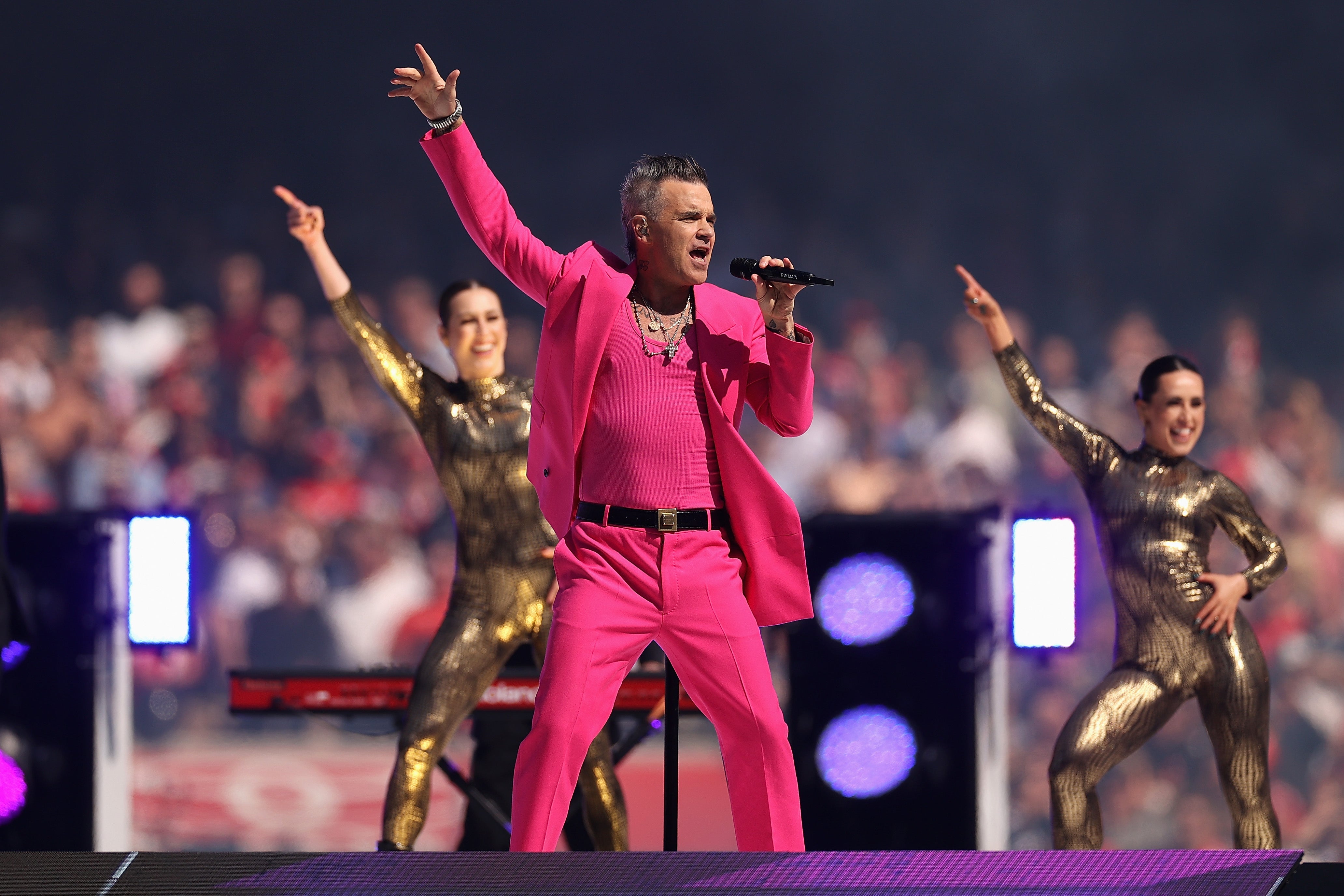
“Robbie paved the way for members of other Nineties groups to leave, like Geri Halliwell, Louise, and Brian McFadden,” says Simon Jones, who has worked as a publicist for some of the country’s biggest pop acts, including the Spice Girls and One Direction. “I can remember being in record company meetings years later where the question would always be: would their solo career end up ‘doing a Robbie’?”
Jones recalls Williams offering help and advice to other singers who felt like the odd one out in their own bands: “Louise [solo artist and former member of the R&B group Eternal] has spoken openly about how Robbie was a kindred spirit for her.”
Perhaps the greatest impact of the manner of Williams’s fall from pop-god grace, though, was in exposing forever the myth of the squeaky-clean boyband image. In that black-toothed Glastonbury grin lay all the human strains, pains and failings so often glossed over by the pop machine. It was only after his Glastonbury breakout, for instance, that the Spice Girls could put on such a genuine and forthright front, and George Michael could own his 1998 arrest for cottaging in LA in the self-mocking lyric and video for subsequent single “Outside”.
The butter-wouldn’t-melt image of the Nineties boyband was always an illusion, Sutherland says. “If you worked for Smash Hits you kind of knew that the gap between the public image of these people and what they were really like was quite wide. But there were a lot of music industry resources devoted to making sure the public never became aware of that gap.” By shattering the facade, though, Williams forged a new level of trust and connection with his fanbase. They unequivocally knew that in his cheeky, charming yet knowingly flawed performance, they were getting the real Robbie – untamed, unfiltered, and defiantly off the chain.
Join our commenting forum
Join thought-provoking conversations, follow other Independent readers and see their replies
Comments
Bookmark popover
Removed from bookmarks