Domingo Hindoyan leads an energetic Royal Liverpool Philharmonic Orchestra through Dukas and Ravel – review
Meanwhile, Carolyn Sampson has just the right soprano vocal weight for Canteloube’s beautiful folk arrangements
.JPG)
There are very few better places to listen to an orchestra than Liverpool's Philharmonic Hall. Opened only months before World War II was declared, its wonderful art deco features and elegant auditorium have survived to outclass all of the concert halls built in Britain since. The old hall burned down in 1934, but how lucky we are that its successor was designed when it was: a perfect fusion of modernity and attention to music's best interests.
For the concert of French music by Ravel (Mother Goose Suite), Canteloube (Songs of the Auvergne) and Dukas (Symphony in C) its acoustics make the music so immediate it’s as though we’re wearing headphones. Paul Dukas, born in 1865 (so a decade or two later than Ravel and Canteloube), was such a perfectionist that he destroyed a huge proportion of his work. Among the survivors are some of the loveliest songs in French from the time, while his portrayal of The Sorcerer's Apprentice – not on tonight’s menu, for once – became so popular he probably wished he’d destroyed that, too.
His only symphony dates from the 1890s and is very rarely heard live, so it is to the great credit of Domingo Hindoyan and the RLPO that we have been given this chance. The three movements, rather than the usual four, are substantial and use the full resources of a late Romantic orchestra. The trouble for its reputation is that it is so close in mood and texture to the only symphony by Belgian composer César Franck, written at much the same time and played far more often, so the reminders are constant. Taken on its own terms, though, Dukas’s work is impressive and does not deserve to languish unheard as much as it has done.
So many of our orchestras have added the prefix Royal to their names that it has become dulled by inflation. Liverpool's orchestra managed perfectly well without it from the foundation in 1840 (making it far older than any of London's orchestras and 18 years older than the Hallé up the Ship Canal in Manchester). The Liverpool Phil went Royal in 1957, but frankly that now feels very un-Liverpudlian. After all, their headquarters sit on the same street as the Everyman Theatre and the lures of the Philharmonic Pub. The city is nothing if not down to earth and democratic, a quality that imbues the orchestra and hall too. Meanwhile, the hall itself is a place where the sound of the music is true: clear without being dry, resonant without sounding like a cathedral.
Liverpool as an area has been lucky with its conductors too. There was Sir Thomas Beecham from up the road in St Helens, who gave the first concert in the hall, and Sir Adrian Boult from across the Mersey in Birkenhead – the two disliked each other, not always cordially. Then, when Boult was too frail to manage a whole concert, he shared his last in London with a young man who had started in the Merseyside Youth Orchestra, Simon Rattle, now also knighted and one of Europe's greatest. That pioneer of youth orchestras celebrates its 75th anniversary this month in the hall, though it has morphed into the Liverpool YO, presumably to enhance its connection to the senior ensemble.
The luck, or more likely good judgement, has carried over into the choice of Chief Conductors in recent decades, including Marek Janowski, Libor Pesek and Vasily Petrenko. The latest in the line is Domingo Hindoyan and he is an excellent fit. There is no nonsense, no unnecessary dancing around, but there is plenty of energy and he gives his players the clear cues they need. The result is togetherness. This is so essential in the Mother Goose Suite from Ravel's ballet and the RLPO's wind section demonstrates it with immaculate precision.
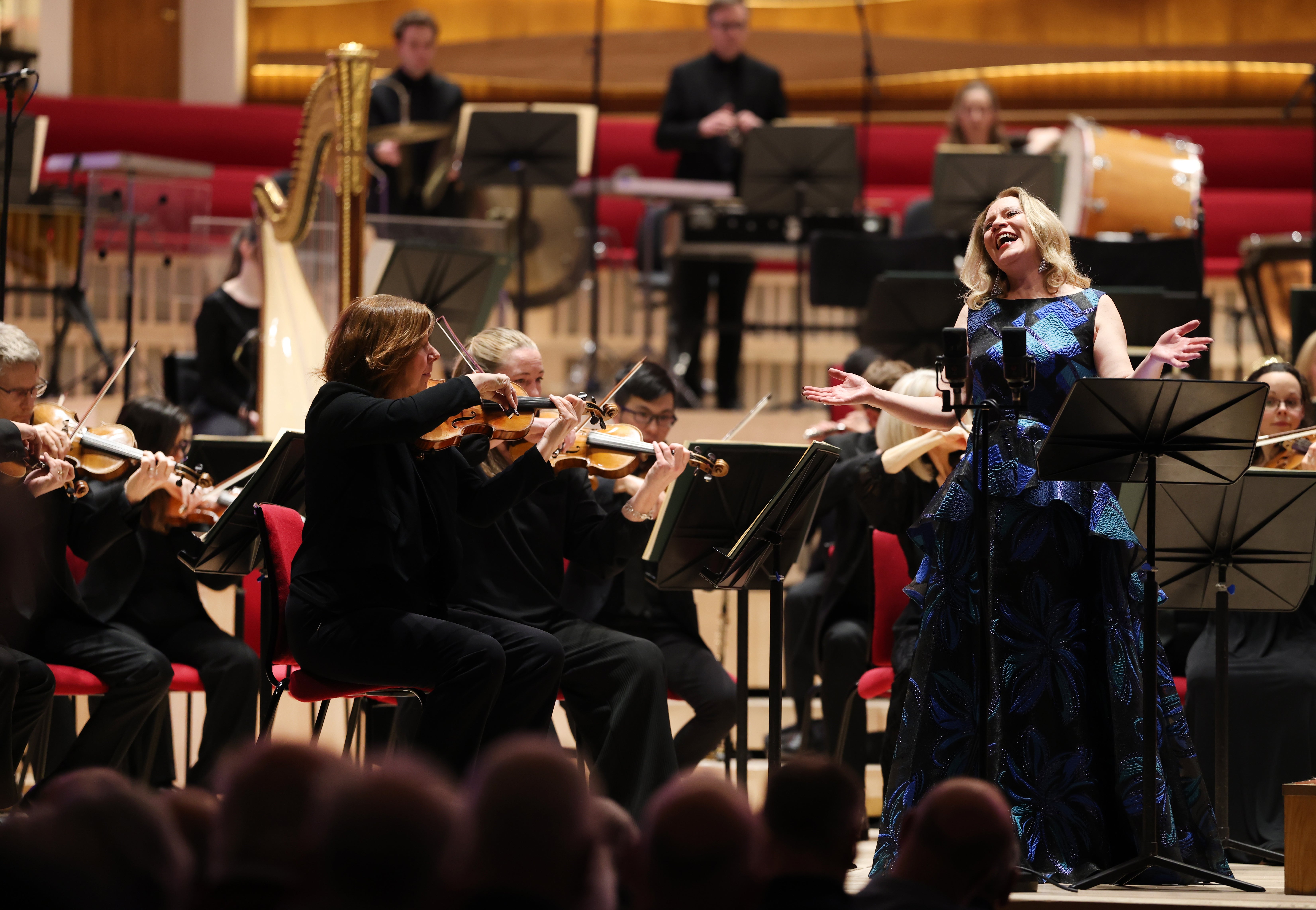
That sense of ensemble is important too in the complicated orchestration of the seven Songs of the Auvergne, set by Ravel's contemporary, Joseph Canteloube. The most beautiful and famous of these folk song arrangements are the third, the haunting Baïlèro luring a young shepherd across the river, and the fifth, the lullaby Brezairola. The words are in Auvergnat, a variant of Occitans, to the bemusement of those expecting Parisian French. Carolyn Sampson has just the right soprano vocal weight for these – light enough not to be too operatic, strong enough to portray a countrywoman in her prime. She sings with all the passion the songs imply but still keeps the feeling that we are hearing them float across from a hillside in the semi-distance.
BBC Radio 3 will be broadcasting the concert during the evening on Tuesday 10 March.
Join our commenting forum
Join thought-provoking conversations, follow other Independent readers and see their replies
Comments
Bookmark popover
Removed from bookmarks