Four decades is a long time in political satire: Jonathan Lynn on the return of Yes Minister
The hapless Jim Hacker and Sir Humphrey are back for one final outing, 40 years after ‘Yes Minister’ first came to our screens. Its creator Jonathan Lynn, who has worked with everyone from Matthew Perry to Monty Python, tells Nick Curtis about writing political satire in the age of cancel culture, and why he’s happy to cause offence

Race, sexuality, cancel culture, the idiocy of Brexit... all these subjects and more are addressed by former prime minister Jim Hacker and former cabinet secretary Sir Humphrey Appleby in Jonathan Lynn’s new West End comedy, I’m Sorry Prime Minister.
This is the final chapter in the long-running screen and stage satire that began life as the BBC Two sitcom Yes Minister in 1980. But where Lynn and his late writing partner Antony Jay previously avoided making direct reference to hot-button issues, mocking the process rather than the pith of government, at 82 he seems to have thrown caution to the wind. Some of the politically incorrect stuff reeled off by the two men, now in their seventies, is pretty near the knuckle.
“I’m not bothered about being cancelled,” says Lynn, when I meet him in his hotel suite round the corner from the Apollo Theatre, where the play is running. “I’m probably going to cancel myself soon.” Lynn was diagnosed with Parkinson’s disease six years ago: he is in a wheelchair and frail, his voice a whisper. It was a struggle to get to London for rehearsals with Rita, his Canadian wife of 59 years, from the Long Island home they share with their son, his wife and his two children. I’m glad he did, because he’s a beadily entertaining interviewee, whose extraordinary professional life incorporates everyone from the Pythons and the Goodies to Marisa Tomei and Matthew Perry.
Lynn insists there was no particular political impetus to write the new play – it was penned before the pandemic, and he’s been waiting for a theatre and a suitable star. “I wanted to write about old age, and thought I might as well use characters the audience knows and loves. And I wanted it to be a stage play, because it’s a single story about what happens to them as they get old, and sad, and lose power, and lose friends, and lose everything really.”


.jpg?quality=75&width=230&crop=3%3A2%2Csmart&auto=webp)
Lynn and Jay began working on Yes Minister during the last days of Jim Callaghan’s government in 1979. Back then, the dynamic between professional civil servants who ran the country year in, year out and the often ignorant and short-lived ministers parachuted into their departments, chasing votes or advancement, was not so well understood as it is now.
Though Jay had insider knowledge of the Conservative opposition under Heath and Thatcher, their main advisers on how government worked were Marcia Williams and Bernard Donoughue, who had both worked in Downing Street under Harold Wilson. “We didn’t mention either to the other, as they disliked each other profoundly,” says Lynn.
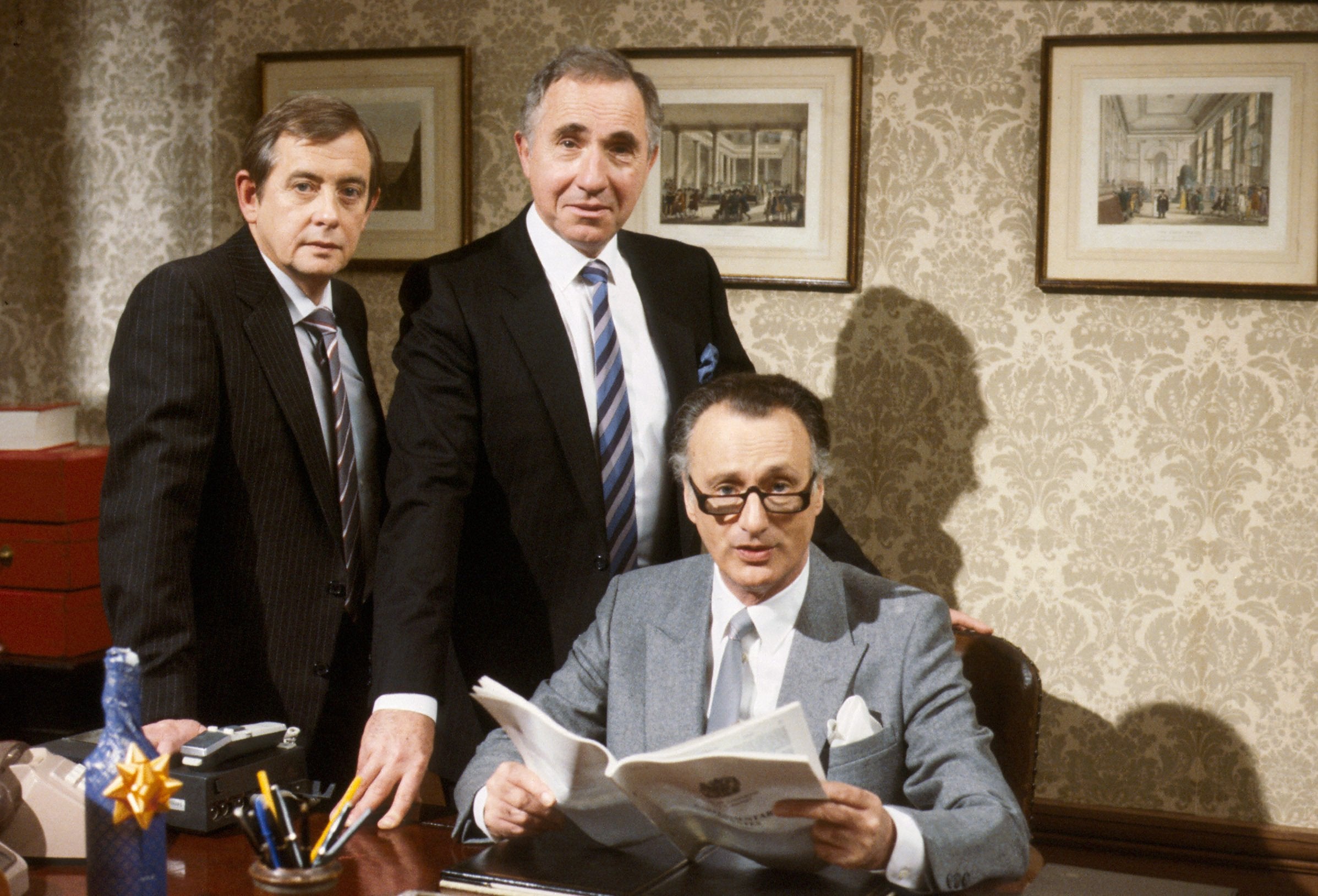
One of the strengths of the sitcom, alongside the performances of the late Paul Eddington and Nigel Hawthorne (the roles of Hacker and Sir Humphrey are now played by Griff Rhys Jones and Clive Francis, respectively), was that it scrupulously avoided party politics: “We didn’t know if it was cause for concern or celebration when Mrs Thatcher told Tony [Jay] it was her favourite show.” Similarly, politicians and civil servants each thought the joke was on the other camp.
In the new play, Hacker is facing expulsion as master of the Oxford college he founded, as a result of some off-colour remarks made in private. Sir Humphrey has escaped from a home for the “elderly deranged” where he’s been placed by a conniving daughter-in-law. Both are widowed, and both are subject to the indignities of age, including weak bladders and weaker memories.
Hacker’s a defender of empire and of statues of Cecil Rhodes, and he tells his impoverished, Black, female, gay caregiver that she’s lucky as she “ticks all the boxes”. Sir Humphrey says Brexit was all about “fear of Muslims”, and dismisses the relocation of government and BBC departments outside London as “a complete waste of money and effort”.

“I’m sure it reflects some of my views,” Lynn says impishly, “but I didn’t set out to write anything controversial. Tony and I never did that, we just wrote to amuse. But if I offend somebody with good reason, then I’m pleased.” He didn’t need inside informants for this script – an insomniac, he listens to Radio 4 and the World Service overnight – and he doesn’t think joking about politics has become any harder. “It hasn’t changed much – it cannot, because it’s still about the search for power.” He does concede that social media and the fevered demands of 24-hour news have “hyped up” and“turbo-charged” politics.
“How many prime ministers have we had in the last seven or eight years? How many cabinet reshuffles?” he says. “Clearly the civil service is running the country.”
Lynn was born in Bath to Jewish parents, his father a doctor and his mother a sculptor, and studied law at Cambridge, where Eric Idle invited him to join the Footlights drama club. He was part of the revue, Cambridge Circus, that went to New York – “but then all the others went on a tour of America with David Frost, and I came home to get a job in rep, to try and be a proper actor. I thought of myself as a future Alec Guinness.”
I didn’t set out to write anything controversial... but if I offend somebody with good reason, then I’m pleased
He was in the original London production of Fiddler on the Roof in 1967 – the year he married Rita, having met her when she performed at a festival of US culture he helped to mount at the American embassy in Grosvenor Square. But by the late 1960s, he was working in Selfridges’ record department and began writing sitcom episodes and sketches, sometimes collaborating with Oxbridge contemporaries including Michael Palin, Terry Jones, Graeme Garden and Bill Oddie. Garden is the only one he is still in touch with: “Most of the others are really rather angry with one another.”
He continued acting throughout the 1970s, fell into directing at the request of other Oxbridge buddies, and had a spell running the Cambridge Theatre Company, until Yes Minister happened. It was not initially a critical success. “But the political press were interested, and they got people like [Labour grandees] Roy Hattersley and Gerald Kaufman to write about it,” Lynn recalls. “Then the TV critics became aware of it, and we were surprised to find we were suddenly a mainstream, popular show.”
Meanwhile, he co-wrote the film Clue (based on the board game Cluedo) with John Landis, after various people, including Tom Stoppard and Stephen Sondheim, withdrew, and ended up directing it when Landis dropped out in 1985. “I said yes because I fancied seeing LA and I’d never flown first class,” Lynn recalls. Though not a hit at first, it has become a cult favourite, and a stage version has been produced many times since 2017, “a sort of passive pension”.
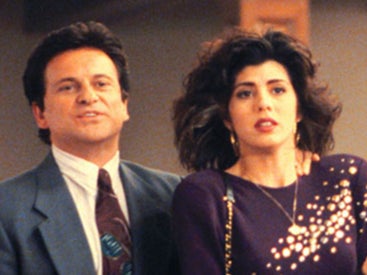
Subsequently, the relative success of Nuns on the Run (1990) led to an offer to direct My Cousin Vinny (1992), starring Joe Pesci. After every prominent Italian-American actress turned the part of Vinny’s girlfriend down, he cast an unknown Marisa Tomei, who famously won a Best Supporting Actress Oscar for it. “I thought, this woman can really act, so I showed her to Joe Pesci and he thought she was great. Fox [the studio] didn’t want her, but they hate having a disagreement with the star... I’m pleased she’s done well.”

In 2000, Lynn directed crime comedy The Whole Nine Yards, Matthew Perry’s big-screen break – when Friends was at its height – opposite Bruce Willis. Perry was “very funny, very creative. I didn’t know about his drug problem: it became clear as we were shooting, but it didn’t affect anything. He got ill: liver diseases, other things. And [later] he gradually just seemed to lose touch with the world. I would have been happy to go on working with him for most of my life.”
Willis, less so. “One doesn’t want to speak ill of the demented, but he was not easy,” Lynn says tactfully. (Willis, who has now retired from acting due to frontotemporal dementia, could be famously uncommunicative on set: Richard E Grant told me Willis wouldn’t look at him when they acted together on Hudson Hawk.)

Since then there have been a few more movies, a book called Comedy Rules, and a 2016 play about de Gaulle and Petain. In 2010, Lynn directed a new stage version of Yes Prime Minister, with David Haig and Henry Goodman in the leads, which was then re-adapted for TV. Paul Eddington died in 1995, Nigel Hawthorne in 2001, Antony Jay in 2016.
As Lynn brings the story of Hacker and Sir Humphrey to an end on stage, I wonder what he thinks of the fragmented TV landscape of today, compared with the medium he conquered in 1980. “Oh, there’s lots of good programmes,” he says. “Bad Sisters, Shetland, The Night Manager, the one with David Mitchell about a detective... Ludwig! Very funny. But do I want to be a part of all that? No, not really. I’m old, and I feel I’ve done just about enough.”
‘I’m Sorry Prime Minister’ is at the Apollo Theatre until 9 May, then on tour
Join our commenting forum
Join thought-provoking conversations, follow other Independent readers and see their replies
Comments
Bookmark popover
Removed from bookmarks