‘Even he was surprised by some of the stories’: The making of David Attenborough’s Wild London
The 99-year-old naturalist explores his hometown of London in a one-off New Year’s Day special on BBC One. Louis Chilton speaks to some of the people behind this remarkable glimpse into the city’s hidden ecosystems
Think of a David Attenborough documentary, and certain scenes will inevitably come to mind. Elephants striding across the savanna; polar bears hunting atop a frigid tundra; vividly strange deep-sea fish zipping through a coral reef. The 99-year-old documentarian’s latest project, Wild London, confronts us with images that are both more and less familiar. A pigeon boarding a train on the London Underground’s Circle line. Two foxes fighting in front of a red Mini. Snakes winding their way along Regent’s Canal. It’s wildlife you’ve probably seen with your own eyes, captured with an intimacy you almost certainly haven’t.
“Throughout my life, I’ve had the good fortune to travel the world, witnessing many natural spectacles,” Attenborough says at the start of the programme. “But this is the place to which I’ve always returned. A sprawling megacity may seem no home for a nature lover like me, but there is a wild side to London.” It’s clear from the off that this is something of a more personal undertaking for the TV veteran, who has lived in London for nearly his entire life. It was, says Passion Planet’s Gaby Bastyra – an executive producer of Wild London – a “no brainer” to make this standalone programme with Attenborough, who has witnessed a century’s worth of changes to London’s ecosystem firsthand.
“We wanted to focus on the attitude towards nature that [Attenborough] can bring,” she tells me. “He’s been instrumental in that, bringing wildlife to the world, and I think even he was surprised by some of the stories.” It’s true: in one segment of the programme, we see Attenborough examine the successfully reintroduced wild beavers living in Ealing. It’s a development he never thought he would live to see. “If someone had told me when I first moved here that one day I would be watching wild beavers in London, I would have thought they were mad,” he says, emotively.
Working with Attenborough was “incredibly inspiring”, says Bastyra. “He’s so knowledgeable,” she continues, “and he’s still, if I dare say, so interested, and still learning and open to learning. I think he really enjoyed it, too.” Attenborough, she points out, more or less invented the nature documentary genre. “There’ll never be anything quite like a David Attenborough documentary,” she adds. “Even though this isn’t a long series, it’s slightly more intimate in some ways.”
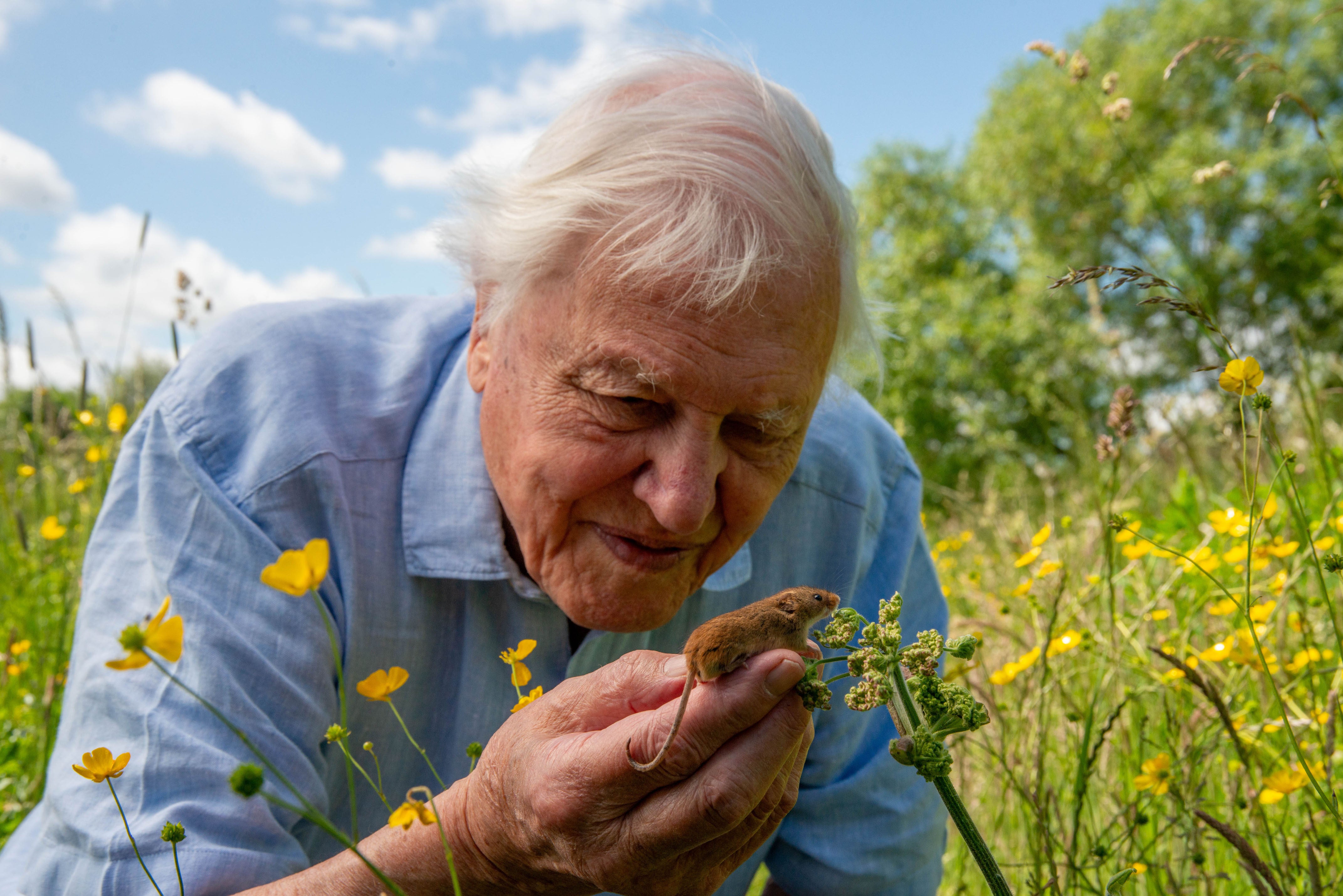
There is, it’s true, a real sense of the up-close-and-personal to Wild London. Attenborough is physically present on screen (not just narrating, as has been the case with some of his recent projects), and can be seen reminiscing, lying in the grass, and handling animals himself (including, for what is said to be the first time, a baby peregrine falcon). With just a few months left until his centennial, it’s spiriting to watch him speak with such enthusiasm and sincerity, still undulled by age and experience. And the specificity of London’s wildlife really does seem to mean something to him. “You just slightly assume that Attenborough lives somewhere in the countryside, with gambolling deer and bunnies coming up to him,” Bastyra says. “But he’s chosen to live in London, and loves coming home to it when he’s done with his travels. So there’s something really lovely about the connection to his home, that resonates through the film.”
Wild London is obviously not the first nature documentary to be shot within an urban environment. Recent Attenborough docs such as A Perfect Planet, The Green Planet and Planet Earth III have all featured episodes dedicated to the interactions between wildlife and the human world. Wild London is unusual, however, in this being its entire purview – and filming it involved its own specific set of challenges.
“Because it’s a city, there are a lot of people around,” says Bastyra. “And there are a lot of different permissions to gain. If you’re filming in Yellowstone [national park], you get a permit to film in Yellowstone, and that’s all you need, for many square miles. In London, you could be filming on one side of the road, and if the animal moves to the other side, it becomes a different authority, and you need a different permission. That’s part of the job, but it was just much more intense.”
To make matters more complicated, Wild London was produced on a short turnaround (for a nature doc), shooting having only begun in March; the unusually hot, dry summer was a stroke of good fortune, keeping the animal subjects visible and lively. (“When the weather’s bad, it doesn’t look good on camera, and animals quite often hide away.”)
Naturally, Wild London, co-produced by the London Wildlife Trust,will probably carry the most interest for the 9 million-odd people who live in the UK’s capital. But there are worthwhile messages here for everyone. The biggest misconception people have about London’s wildlife, explains David Mooney, the organisation’s chief executive, “is that there is no wildlife – or that the wildlife is just pests. But London is actually nearly 50 per cent green space. It’s a massive metropolis, and wildlife is thriving.

Watch Apple TV+ free for 7 day
New subscribers only. £9.99/mo. after free trial. Plan auto-renews until cancelled.
ADVERTISEMENT. If you sign up to this service we will earn commission. This revenue helps to fund journalism across The Independent.
Watch Apple TV+ free for 7 day
New subscribers only. £9.99/mo. after free trial. Plan auto-renews until cancelled.
ADVERTISEMENT. If you sign up to this service we will earn commission. This revenue helps to fund journalism across The Independent.

“In fact, as [Attenborough] says in the documentary, there’s actually more of a thriving ecosystem in some parts of London than there is in rural areas – because there are no pesticides. Intensive agriculture,” adds Mooney, “can do fast damage to the ecological ecosystem of the open countryside.”
Over the course of Attenborough’s seven-decade career as a nature documentarian, the focus has shifted increasingly towards the existential threats animals face because of humankind: the climate emergency is a glaring presence in every recent Attenborough project. Wild London is, though, a hopeful programme, one that tempers its account of ecosystems-under-threat with genuine success stories.
“It’s about making people aware of what’s right under their noses, as well,” says Bastyra. “It’s about coexistence. Foxes are a good example. Everyone gets annoyed – they rip your bins, and make noise, and leave rubbish everywhere. But they are this incredible animal, and they’re just trying to take dinner for their babies, you know? When you see a fox family rearing, and you see those beautiful little cubs, you just want them to do well and survive.”
“We’ve got to share this space,” she adds, “and we don’t have any more right to be here than them.”
‘Wild London’ airs on New Year’s Day at 6.30pm on BBC One and on iPlayer
Join our commenting forum
Join thought-provoking conversations, follow other Independent readers and see their replies
Comments
Bookmark popover
Removed from bookmarks