Trump claims he has a trade deal with India – but what has really been agreed?
Agreement leaves key questions unanswered as fine print and details remain elusive
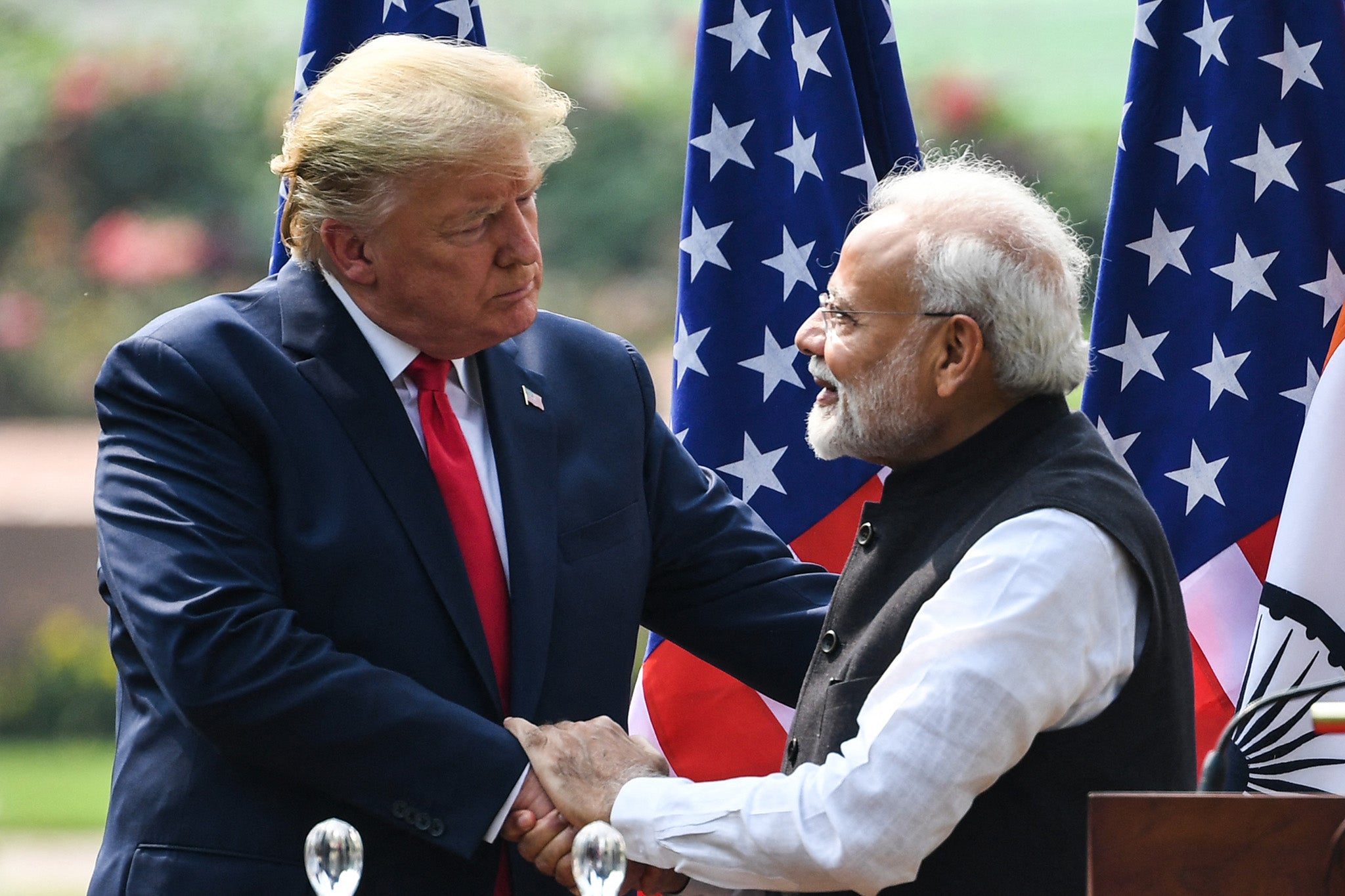
The US and India seem to have settled their economic disputes after the leaders of the two nations announced a long-delayed trade deal on Monday, capping almost a year of negotiations that had strained ties.
Details of the agreement remain scarce. Whatever is known so far has come largely from social media posts by US president Donald Trump, brief remarks by Indian prime minister Narendra Modi, and comments by mostly unnamed government officials in the two capitals.
What has not been released is the full text of the agreement, a joint statement or a detailed fact sheet, prompting observers to describe the outcome as a preliminary framework rather than a binding trade deal.
Mr Trump was the first to break the news on social media, declaring that the “amazing relationship with India will be even stronger” and announcing the US would lower the reciprocal tariffs on the South Asian country from 25 per cent to 18 per cent.
Mr Modi quickly responded on X, confirming the tariff cut and thanking Mr Trump but without elaborating on any wider commitments.
Here’s what we know about the new deal so far:
Tariff reduction
The clearest element to emerge so far is a reduction in import tariffs on Indian goods.
Mr Trump said Washington would immediately lower its reciprocal tariffs on Indian imports to 18 per cent. He also said India would stop buying Russian oil and, in turn, Washington would lift the punitive levy of 25 per cent imposed last year.
Indian exports to the US were facing a 50 per cent tariff rate since 6 August, when Mr Trump imposed an additional 25 per cent punitive duty over its continued purchase of Russian crude. The move burdened India with one of the highest US tariff rates of any country.
The punitive tariff would drop to zero as Mr Modi had agreed to halt purchases of Russian oil and instead significantly increase imports from the US, and potentially Venezuela as well, Mr Trump claimed.
“He agreed to stop buying Russian Oil and to buy much more from the United States and, potentially, Venezuela,” Mr Trump said on Truth Social. “This will help END THE WAR in Ukraine.”
A White House official confirmed the rollback of the punitive levy was contingent on India fully ceasing – not just reducing – Russian oil imports.
India’s silence
India’s import of discounted Russian crude since the war in Ukraine started has been a persistent source of friction in its ties with Washington, with the Trump administration accusing Delhi of helping finance Moscow’s war effort.
Though not a major buyer of Russian oil historically, India emerged as one of its top customers after Western sanctions caused Moscow to offer discounted supplies to countries like India and China.
The Trump administration’s efforts to stop these shipments have slowed the flow of Russian oil to India, but have not stopped it.
Mr Modi and his officials have stayed silent on whether India has agreed to halt the purchase of Russian oil. In his public response, Mr Modi focused solely on the tariff reduction, saying: “Wonderful to speak with my dear friend President Trump today. Delighted that Made in India products will now have a reduced tariff of 18%.”
He also said Mr Trump’s leadership was “vital for global peace, stability, and prosperity”.
Russia, meanwhile, played down the US claim. The Kremlin said on Tuesday it had heard no statement from India about halting purchases of Russian crude and that Moscow intended to continue developing its strategic partnership with Delhi. Kremlin spokesman Dmitry Peskov emphasised that Moscow valued its relationship with India and would continue to deepen it.
Michael Kugelman, senior fellow for South Asia at the Atlantic Council, said the claim that India would halt Russian oil imports “seems hard to believe”, noting that Mr Modi had spoken only about the tariffs.
“For economic, diplomatic, and strategic reasons, India is highly unlikely to stop buying cheap oil from Russia, one of its closest partners,” he said.
“But it has reduced its imports of Russian oil since new US sanctions on Russia were implemented in November,” he added. “That, coupled with a recent India-US natural gas deal and India’s increasing oil imports from the United States, likely addressed US concerns and helped the two sides get to the finish line.”
'Buy American' target
Mr Trump also made a bold claim that Mr Modi had committed to “BUY AMERICAN” and that India would spend more than $500bn on US goods including energy. He did not elaborate.
Analysts doubted India could commit to spending $500bn on US goods, viewing it as one of the more opaque aspects of Mr Trump's announcement, particularly since the Indian side made no mention of it in public statements.
Evan Feigenbaum of the Carnegie Endowment for International Peace called the target “kind of a stretch” in an interview to CNBC, saying India's economic constraints and the absence of clear timelines or sector-specific details cast doubt on its practicality.
Ajay Srivastava, founder of the Global Trade Research Initiative, said the $500bn figure was likely a “long-term aspirational number rather than a near-term commitment”.
An Indian government official told Reuters Delhi had agreed to buy oil, defence equipment and aircraft from the US, while partially opening its closely guarded agriculture sector under the deal.
Agriculture was one of the major sticking points during the 12 months of negotiations as even limited liberalisation could expose Indian farmers to fierce competition.
Small and marginal farmers, who make up the bulk of the country’s agricultural workforce, have long opposed opening up the sector, arguing the US producers, supported by heavy subsidies and high levels of mechanisation, would undercut domestic competition. Indian policymakers have been wary of such a move, given the potential impact on rural livelihoods.
Experts voiced scepticism that India could remove all barriers to US imports, as Mr Trump suggested. They pointed in particular to dairy, where the introduction of US products could provoke consumer backlash and threaten the livelihoods of roughly 70 million Indians.
Join our commenting forum
Join thought-provoking conversations, follow other Independent readers and see their replies
Comments
Bookmark popover
Removed from bookmarks