What should reporters make of Kanye West’s apparent bid for the presidency?
Keeping track of the superstar’s true political intentions is no small feat, writes Clémence Michallon

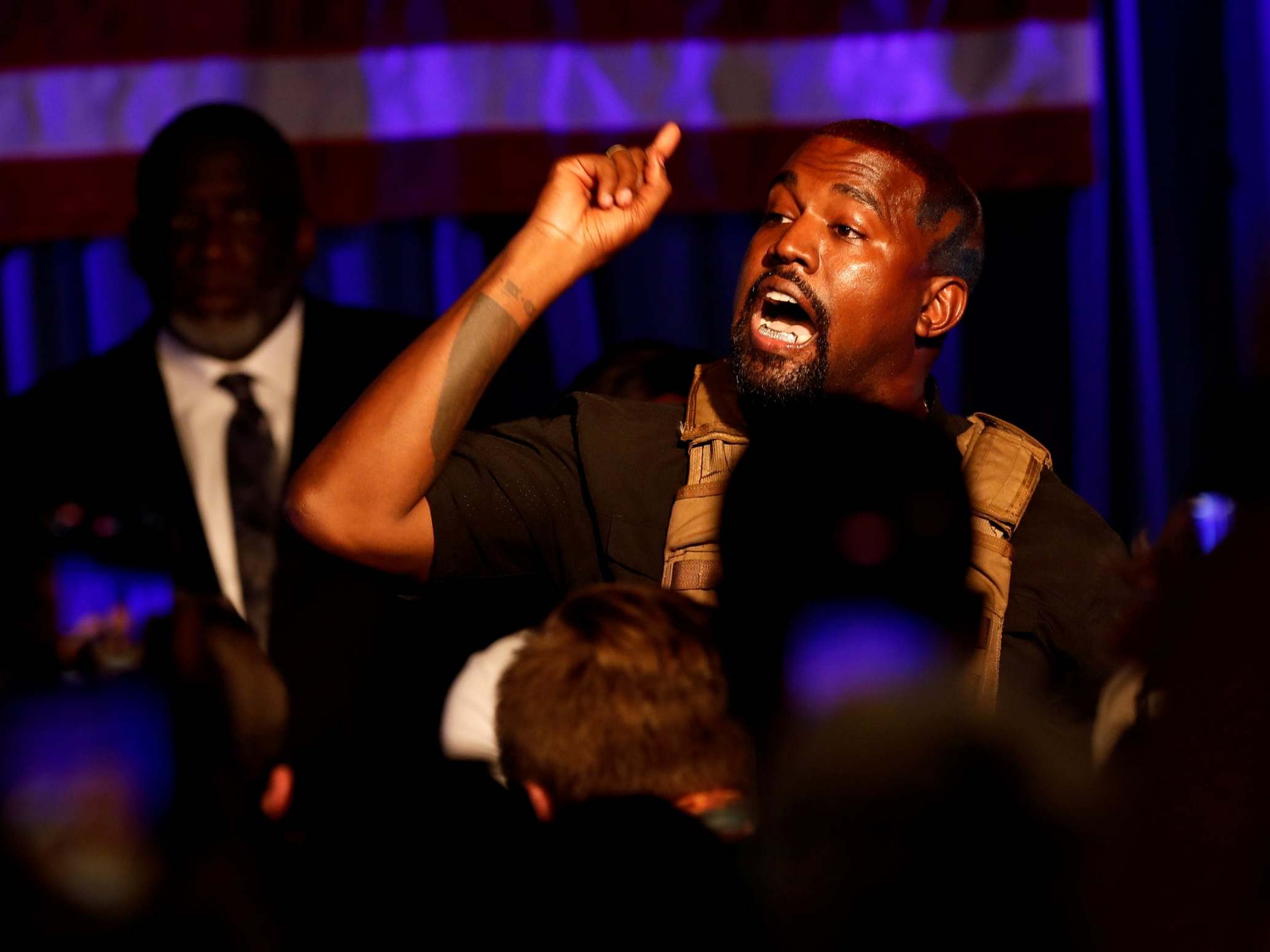
When Kanye West announced on 4 July this year that he was entering the 2020 US presidential race, the news was met with confusion. Was he serious? Could he even feasibly launch a campaign, less than four months before the vote? Should we be... curious? Concerned? A mix of both?
At first, it seemed like West’s presidential campaign would never become official. He hadn’t filed any of the necessary paperwork with the Federal Election Commission (FEC). Of course, West has never held political office, but “I’m not a politician” has become a rallying cry for a certain category of candidates looking to enter the highest echelons of the political field, so that in itself wasn’t a disqualifying factor.
It seemed somewhat absurd to imagine that the rapper and fashion designer would actually make it to the White House. Then again, there was a time when people thought the same of businessman and reality TV personality Donald Trump, and look where that got us.
FEC filings can be tricky to authenticate without official confirmation, but there does appear to be an official statement of candidacy in West’s name on the organisation’s website. And he has qualified to appear on the ballot in Oklahoma, while also missing filing deadlines in many other states. The Kanye West 2020 campaign exists, at least on paper, and if we’ve learned anything from the past four years, it’s that bad things happen in US politics when we decide something is too ridiculous to be worthy of attention.
This is why I have felt moved to cover the West campaign in my reporting. Specifically, I have been concerned with tracking filing deadlines, while seeking to answer that elusive question: is Kanye West actually running for president?
Some have worried that such coverage would lend legitimacy to West’s campaign, or amplify its message somehow (which ties into deeper concerns with media and neutrality). While I understand these concerns, I also don’t think a political campaign is something you can ignore while secretly hoping it goes away, especially when the person in question has a platform as big as West’s.
This was my stance for a while. Then the discourse surrounding West’s campaign started changing. After he held a rally in South Carolina this past Sunday, concerns emerged for his wellbeing (West has been diagnosed with bipolar disorder and has spoken publicly about the condition). There have been troubling social media posts, deleted tweets and, most recently, a plea for compassion from his wife Kim Kardashian. Some have implied that he may be in the throes of a crisis; others say that we should not dismiss his aspirations simply because he has been open about his mental health condition in the past.
I believe we need to talk about Kanye West. I also believe we don’t yet know how, precisely, to talk about Kanye West. I don’t know that our current social media landscape is conducive to, or equipped for, constructive, caring conversations about mental health.
What I do know is that we, the mainstream media, try our hardest to tackle these topics in a sensitive manner (without getting it right every single time). And I also know that we, the media, comprise human beings with our own experiences with mental health and the systems which surround such issues. Those experiences may well inform and shape our coverage – hopefully for the better. As we continue our journalism about Kanye West, we can keep that in mind as much as we keep in mind political nuance and West’s complex past relationship with figures like Trump and issues like abortion.
If you need me in the meantime, I will be on the FEC’s website keeping track of West’s filings.
Yours,
Clémence Michallon
US culture reporter
If you are experiencing feelings of distress and isolation, or are struggling to cope, The Samaritans offers support; you can speak to someone for free over the phone, in confidence, on 116 123 (UK and ROI), email jo@samaritans.org, or visit the Samaritans website to find details of your nearest branch.
If you are based in the USA, and you or someone you know needs mental health assistance right now, call National Suicide Prevention Helpline on 1-800-273-TALK (8255). The Helpline is a free, confidential crisis hotline that is available to everyone 24 hours a day, seven days a week.
Join our commenting forum
Join thought-provoking conversations, follow other Independent readers and see their replies
Comments
Bookmark popover
Removed from bookmarks