Security agencies investigating possibility coronavirus spread in Wuhan as early as October
Beijing’s Military World Games may have contributed to the start and spread of Covid-19, Kim Sengupta reports

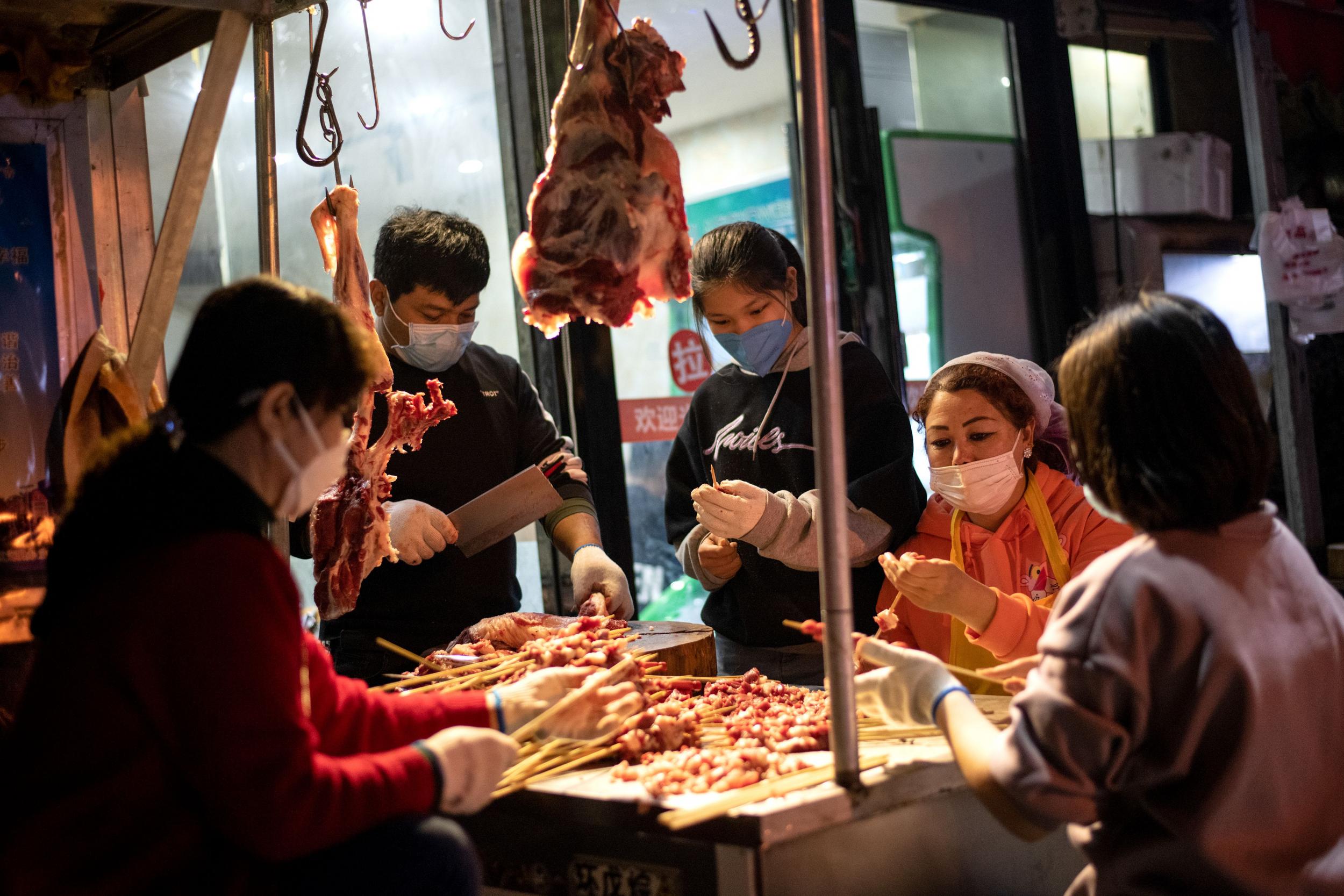
Investigations by international security agencies into the start and spread of coronavirus, and alleged attempts by the Chinese government to suppress information about it, are examining a time period in autumn when the Military World Games were held in Wuhan.
The event took place over nine days in October last year and 10,000 athletes from more than 100 countries participated. The Chinese authorities told the World Health Organisation three months later that they had seen “no clear evidence of human to human transmission of the novel coronavirus”.
There is now, however, growing evidence from scientific research that coronavirus was present in Wuhan in October and possibly prior to that as well.
The claim that the games may have been the source of the disease was first made by Chinese officials in March this year. Zhao Lijian, a spokesman for the foreign ministry, tweeted: “When did patient zero begin in US? How many people are infected? What are the names of the hospitals? It might be the US Army who brought the epidemic to Wuhan. Be transparent! Make public your data! US owe us an explanation!”
Allegations that the disease was introduced by a foreign person or persons has been a regular theme since then in social media postings on official sites as well as others believed to be connected to the authorities and the Chinese communist party. Some reports point to the residence of the US team being close to the Huanan Seafood Wholesale Market where the first known cluster of cases occurred as an indication of this taking place.
No real evidence though has been produced to back up the allegations and they have been regarded as part of China’s disinformation campaign to deflect blame for its handling of the epidemic.
However, the Chinese suggestion of the virus starting at the games raises questions about Beijing’s official timeline for the pandemic and the failure to warn the outside world of its lethality and spread until four months later.
Hitherto unpublished Chinese official data appear to show that the virus had begun much earlier and that the government has failed to be transparent about the spread of Covid-19.
The South China Morning Post, for example, has revealed that authorities had identified at least 266 people who had contracted the virus last year, with the earliest case on 17 November. An investigation by Associated Press this month found that China withheld vital information about the outbreak and waited more than a week before publishing the genome of the coronavirus in January.
More than a dozen European competitors, from Spain, Italy, Germany and France, reported being ill with symptoms which approximated to that of Covid-19. Many of them are now convinced that they had contracted the virus in some form while in Wuhan. It should be stressed, however, that there is no conclusive proof that was the case. It also remains unclear if those taking part from countries outside Europe had similar symptoms.
There are increasing claims from scientific research, security officials point out, that the virus was present in Wuhan in October. There is also interest in Beijing’s focus on the Military Games. One theory is that Chinese officials got out their version of events because they were aware that information about the early presence the virus was bound to emerge.
“To put it simply, there was motive, trying to put themselves in the clear, and the opportunity, with the presence of so many people from other countries in the games, of placing the responsibility elsewhere,” said a British security official. “The chronology of the virus and its spread is still being looked at and there will be claims and counterclaims. But October is certainly a period worth considering ... the Americans and agencies from a number of countries are looking into the information about Covid and a picture is emerging.”
He and other officials, British, American and French, have stressed that there is no evidence that coronavirus was produced in a laboratory, a claim based on poorly researched or discredited studies.
Donald Trump and Mike Pompeo have insisted that proof exists of the origin of the virus in a lab, but this been officially denied by US intelligence agencies. Mr Trump and the US secretary of state have also insisted that evidence would be imminently presented to back this up, but nothing has been produced in the six weeks since they made the claim.
The security investigations are, however, said to be looking at a number scientific research studies about the spread of the disease. Theses are believed to include one at University College London’s Genetics Institute.
The research, conducted with samples from 750 people infected with Covid-19, indicated that the virus spread quickly around the world between October and November last year. Researchers found almost 200 recurrent genetic mutations of the new coronavirus – SARS-CoV-2 – which showed how it is adapting to its human hosts as it spreads.
“Phylogenetic estimates support that the Covid-2 pandemic started sometime around October 6, 2019 to December 11, 2019, which corresponds to the time of the host jump into humans,” the research team, co-led by Francois Balloux, wrote in a study published in the journal Infection, Genetics and Evolution. The analysis also found that the virus mutated, as is normally the case, and that a large proportion of the global genetic diversity of the virus causing Covid-19 was found in all of the hardest-hit countries.
Another study, published in the Frontiers in Medicine, also held that Covid-19 may have existed in Wuhan since October. It may have been in latent form in early stages, spreading among the population in a random way without necessarily showing signs of an epidemic.
“An unidentified animal or animal parts contaminated by a virus initially originating from bats was brought into contact with humans in October-November 2019, starting a latent infection,” said the report. “In this latency phase, the infection remained silent, spreading in a stochastic way within the population, with no epidemic identified yet.”
The research, carried out among others by Jordi Serra-Cobo and Marc Lopez from Barcelona University, hold that the disease gained momentum in December with three major celebrations in China with exceptionally high demand for food, including the sale of live animals.
It said: “What unchained the epidemic was the simultaneous occurrence of two major celebrations – the Chinese New Year and the Great Family Feast – where many people who were initially infected were in contact and it provided the necessary amplification phase. Another key step, along with that, was mobility.”
A study by the Harvard medical school, suggests that Covid-19 may have been in Wuhan as early as August last year. Analysis of imagery discovered a “steep increase” in vehicles in the car park of major hospitals between August and December with five of the six hospitals having their highest daily volume of cars. The findings coincided with an increase in question on Chinese search engines, like Baidu, for coronavirus related symptoms like “diarrhoea” and “cough”, reaching a peak in Covid-19 cases early this year.
The Chinese foreign ministry described the claims in the Harvard study as “ extremely absurd”.
Join our commenting forum
Join thought-provoking conversations, follow other Independent readers and see their replies
Comments
Bookmark popover
Removed from bookmarks