Salt Bae’s empire is crumbling – but his £600 steak was a tourist attraction nobody asked for, or needed
He turned sprinkling salt into a global brand and a £600 steak into a status symbol. But with the UK arm reporting a £5.5m loss and US branches shut, Hannah Twiggs asks what Salt Bae’s downfall reveals about the end of food as flex – and the rise of quiet luxury


You know the video. A man in mirrored sunglasses, white T-shirt stretched tight, pinches salt between his fingers and lets it cascade down his forearm in slow motion to land on a slab of meat, like fairy dust for the rich. Even if you’ve never eaten at one of his restaurants, you’ve probably copied the gesture at your summer barbecue.
That man – Nusret Gökçe, better known as Salt Bae – built a global steakhouse empire off the back of that clip. His now-infamous London outpost in Knightsbridge opened in 2021 to viral fanfare, serving £680 wagyu strip loins and £50 gold-leaf baklava to footballers and finance bros. But this week, new filings revealed that his UK business had posted a £5.5m loss, despite turnover rising to just over £10m. His US arm is faring no better: it once boasted seven branches, but only two remain, in New York and Miami.
The rest – Beverly Hills, Dallas, Las Vegas, Boston, even another in New York – have all closed. Exceptional expenses from those closures total £6.6m, according to filings reported by Restaurant Online. The brand insists it’s “stabilising”. But for a man whose career was built on spectacle, the silence is telling.
Salt Bae’s virality was never really about food. Let’s face it, his videos went viral because they were, well, weird. Theatrical, sensual, faintly absurd. Few actually went to Nusr-Et for dinner; they went to see what a £600 steak and a viral man with a salt fetish looked like up close.
That weirdness made him famous. But weird rarely lasts. The same platforms that minted him now reward a different kind of content: useful, thrifty, real. On TikTok, #MealPrep and #BatchCooking have millions of posts between them. The biggest food creators today aren’t bronzed butchers with gold steaks; they’re women in hoodies showing how to shop for your family of four for the week on £100, or dietitians hacking your gut health with tins of beans and olive oil.


The viral video was the hook. The problem is that the hook became the whole dish. When diners booked tables at Nusr-Et, it wasn’t because they thought it would be good – it was because they wanted to see the meme, to film the man, to be part of the moment.
That’s not a sustainable business model. It’s a tourist attraction.
And then came the bill. In present-day Britain, with overall inflation still hovering around 3.8 per cent and restaurant prices up by just over 3 per cent year on year, households are watching their wallets more closely. According to the consultancy group BCG, discretionary spending intentions have slipped by 9 per cent, meaning a £600 steak doesn’t read as “luxury” – it reads as delusion.
Salt Bae’s empire was built for the pre-pandemic boom, if not earlier, when bling was aspirational and credit cards were elastic. Now, the cultural mood has turned to what fashion calls “quiet luxury”: quality without the memes.
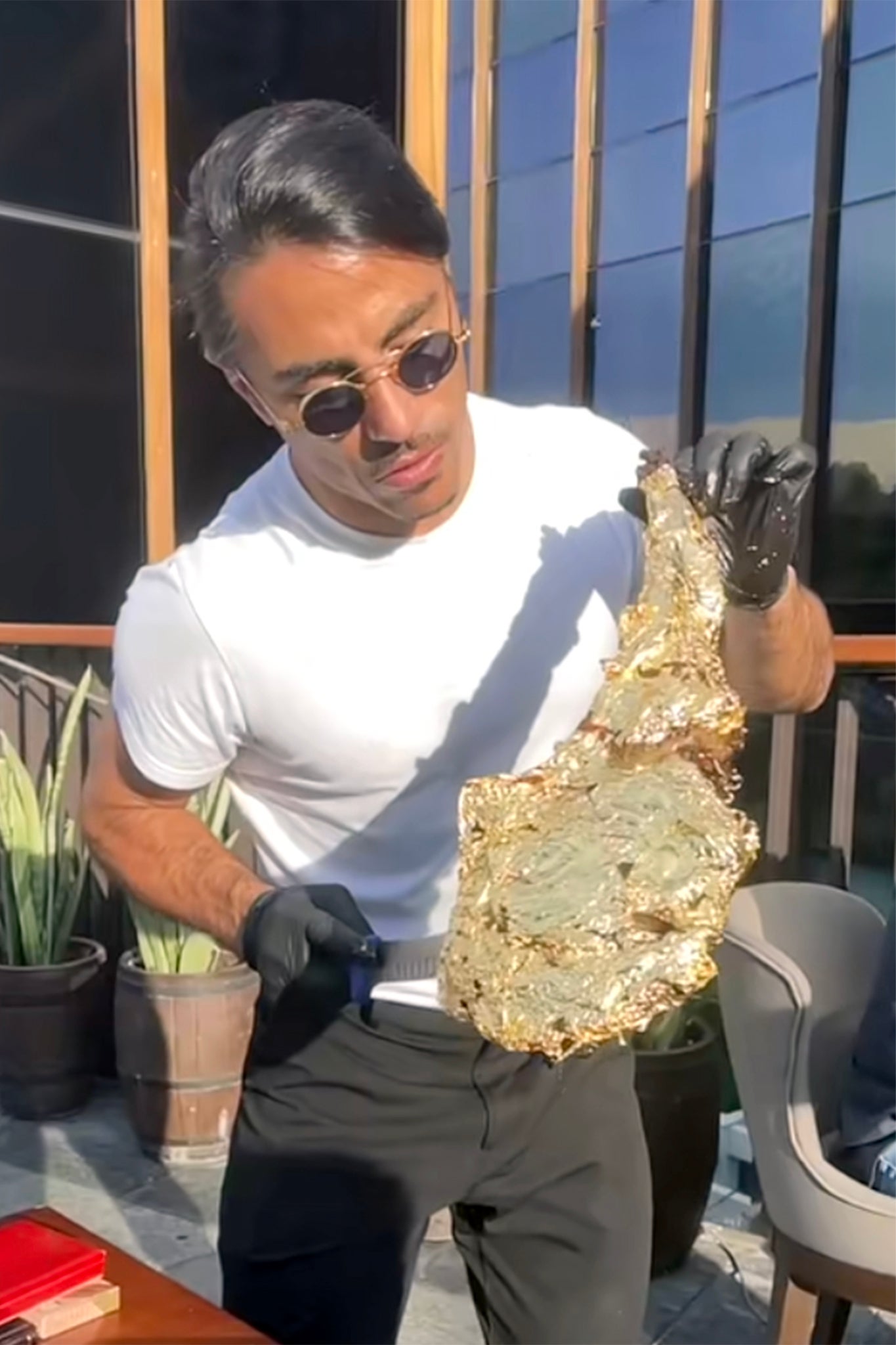
It doesn’t help that Gökçe has continued to flaunt his wealth – most recently posting a video tour of his £36m Maçka Palace in Istanbul, complete with crystal chandeliers and gold accents. Or that he once offered Boston students a “30 per cent discount” on gold-wrapped steaks, still totalling more than $1,000 (£750). Even his generosity feels gilded.
Compare that to what’s trending: the “Where to eat for under £60” videos, the “best steak in London for under £100” lists, the return of Hawksmoor’s lunch special. It’s not that people have stopped eating out, they’re just choosing restaurants that deliver comfort, provenance and value.
There’s also something distinctly un-British about Salt Bae’s shtick. This is, after all, the country that gave the world the roast dinner and the full English. Where showmanship is reserved for Bake Off and we still apologise to waiters for existing.
We do love ceremony, but only when it feels earned. We’ll happily book weeks ahead for two Michelin-starred tandoori masala lamb chops at Gymkhana, or drop £100 a head for British grass-fed, traditionally reared steak at Hawksmoor – because it feels like those places deserve it. But a man in sunglasses theatrically slicing shipped-in wagyu for the camera? That doesn’t feel British; it feels like Vegas.
And maybe that’s the point. Nusr-Et London was never really for Londoners. Its Knightsbridge clientele are tourists, footballers, Gulf royalty. The same crowd that fills his other restaurants in Miami, Dubai, Istanbul and Milan – cities where the dining culture is more about theatre than taste. In that sense, the failure isn’t ours – it’s his misreading of us.
Because the truth is, there is money to spend in London. We just don’t like being taken for fools.
Salt Bae might have picked the wrong moment to go off the boil, because meat is quietly back in fashion. According to the Agriculture and Horticulture Development Board, meat, fish and poultry volumes rose 1.4 per cent in January, while vegetable-based alternatives have fallen 12.4 per cent year on year, underscoring a renewed appetite for traditional proteins and “real” foods. The fading enthusiasm for Veganuary – attempted by just 5.6 per cent of Britons this year – suggests that, for now at least, the plant-based boom has lost its bite.
But the way we consume meat has changed. The conversation is now about quality – grass-fed, regenerative, traceable – and health, not excess. Consumers are seeking nutrient-dense, minimally processed foods, not protein for protein’s sake. In that sense, Salt Bae’s steak was the wrong kind of indulgence: ostentatious, not authentic.
In other words, we want steak. Just not his steak.
Culturally, too, his moment has passed. Salt Bae was the patron saint of the steak bro: the gym-sculpted, crypto-rich, alpha-protein male who equated appetite with power. But that archetype is looking increasingly dated.
£5.5m
Salt Bae’s annual loss at his London restaurant
We’re in a post-Ozempic era now. Appetite-suppressing GLP-1 drugs are shrinking portion sizes and alcohol sales across the restaurant industry. When your customers literally can’t finish a steak, the £600 tomahawk becomes a liability.
Meanwhile, the new icons of masculinity are less Gordon Gekko, more Tim Spector: softly spoken, gut-health-obsessed, preaching the virtues of fermented cabbage and fibre diversity.
The irony is that Salt Bae’s empire always looked indestructible – a global chain built not on Michelin stars but on meme power. In a decade in which the fastest way to open a restaurant was to go viral, he seemed to have cracked the code. Yet the same algorithm that lifted him has buried him. The internet has moved on to new obsessions: fakeaways, £3 lunchboxes, cottage-cheese desserts.
His restaurants’ downfall mirrors the life cycle of viral fame itself: initial fascination, mass replication, backlash, decline. Like any one-hit wonder, he became trapped by his own greatest hit.
None of this is to say that decadence is dead. Londoners still love a treat. But today’s indulgence looks different: it’s a two-course lunch at Mountain, a bottle of natural wine, a steak that tells a story rather than screams one. More importantly, a steak that isn’t overly salty.
Salt Bae’s downfall isn’t just a business story. He represented an era when food was flex, when virality equalled value, when gold leaf could stand in for craft. Now, diners want the opposite: food that feels grounded, personal, quietly luxurious.
His Knightsbridge restaurant will probably limp on, buoyed by tourists and the curious. But as far as the British appetite is concerned, the salt has lost its sting.
Join our commenting forum
Join thought-provoking conversations, follow other Independent readers and see their replies
Comments
Bookmark popover
Removed from bookmarks